
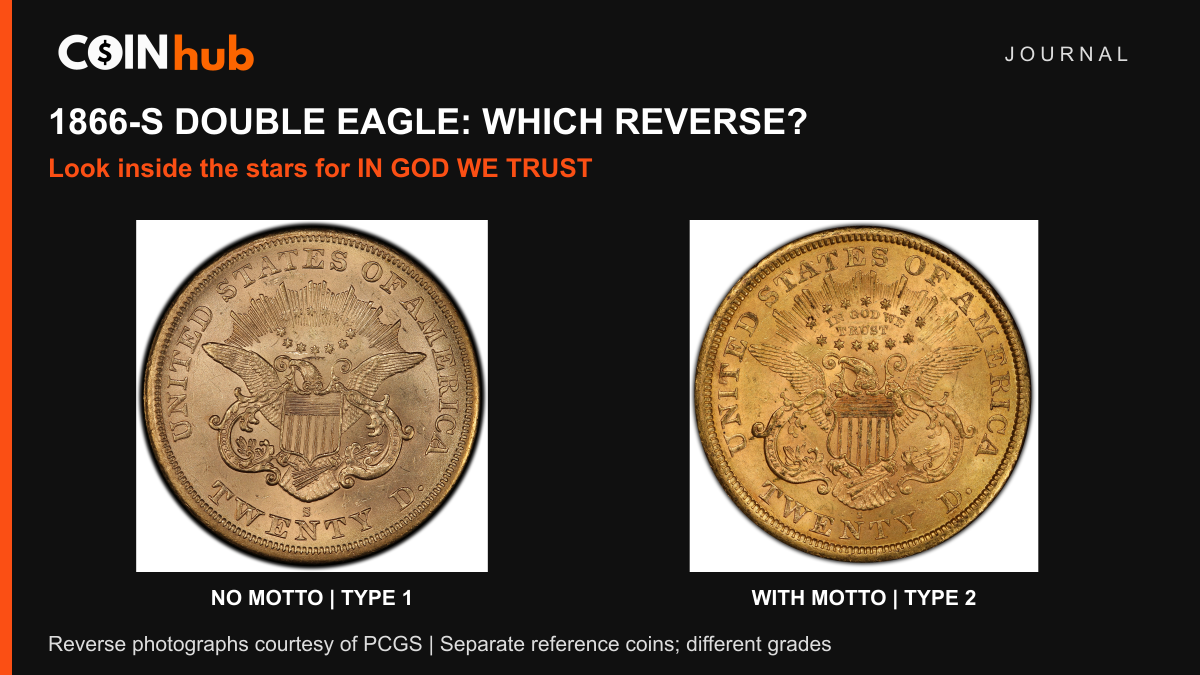
The same date and mint can have two reverse types
Quick answer: On an 1866-S Liberty Head double eagle, look inside the ring of stars above the eagle. The With Motto reverse carries IN GOD WE TRUST there. The No Motto reverse does not. Both are recognized designs; the missing motto on the earlier type is not, by itself, a striking error.
A double eagle is a United States twenty-dollar gold coin. The S identifies the San Francisco Mint. Those two details matter because “1866 gold coin” could describe other denominations, and their designs need separate checks.
The photographs above show the reverse sides of two different PCGS reference coins. Their wear, marks and color are not matched. Use the pictures to compare the designs, rather than treating them as a demonstration of equal grades.
Read the motto area before the price label
PCGS places the 1866-S No Motto in Type 1. It places the 1866-S With Motto in Type 2. The main change is visible on the reverse, the back of the coin.
On the No Motto design, the stars above the eagle surround an open central space. On the later reverse, the words IN GOD WE TRUST occupy that space. Check the whole area. A single blurred letter, dark patch or reflection is a poor basis for deciding which type you have.
| Feature | 1866-S No Motto | 1866-S With Motto |
|---|---|---|
| Words inside the star ring | No IN GOD WE TRUST | IN GOD WE TRUST present |
| PCGS design classification | Type 1 | Type 2 |
| Denomination below the eagle | TWENTY D. | TWENTY D. |
| Mintmark | S below the eagle | S below the eagle |
TWENTY D. therefore does not separate these two 1866-S types. Nor does the S mintmark. The useful order is denomination, date, mintmark and reverse design. Each observation answers a different part of the question.
Why 1866 needs an extra design check
The year falls at the change from the earlier No Motto reverse to the With Motto design. San Francisco struck coins of both types with the 1866 date. The Philadelphia 1866 With Motto listing provides another reference for the new design, but it is a different mint issue.
That means a date-only search can send you to the wrong catalog entry. A listing for 1866 without an S is not a direct substitute for an 1866-S. A sale for the With Motto type is not a clean comparison for the No Motto type.
These are intentional design types. The same principle applies in our 1861 Paquet reverse guide: first establish which design and mint issue is present. A different reverse does not automatically mean that a coin was struck twice or lost part of its design through a mint mishap.
Wear can make the first check harder
A genuine motto can be hard to read on a worn or poorly lit coin. That does not turn the coin into the No Motto type. Look at the full pattern of stars, lettering and nearby detail, then compare it with a clear reference of the correct issue.
Likewise, an unusually smooth area deserves care. A photograph cannot establish whether a surface is original, altered or simply reflecting the light. Keep the identification provisional if the design cannot be seen clearly. Do not rub the area to make a result easier to read.
Keep the record attached to both sides
A useful identification file contains a full front view with the date, a full back view with the S and denomination, and one closer view of the motto area. Keep a holder label or seller description as a separate record. It is a claim to check against the coin.
For example, a folder labeled “1866-S, possible No Motto” is more useful than one labeled only “rare gold.” It preserves what has been observed and what still needs confirmation. Add the source reference and the date of your comparison so the conclusion can be reviewed later.
Type, condition and value are separate decisions
A correct type identification does not establish a grade or a selling price. Wear, marks, cleaning, repairs and authenticity affect how an individual coin is assessed. A bright surface is not proof of an uncirculated coin, and a high auction result for another specimen is not an appraisal.
Compare dated completed sales only after matching the date, mint, type, grade and surface description. If the coin may be an important early gold issue, an in-hand examination is a more useful next step than a value claim based on one enlarged image.
Sources checked October 17, 2026: PCGS CoinFacts entries 8945, 8950 and 8949. Photographs courtesy of PCGS under CoinHub's saved photo permission; reverse views cropped from the complete originals, resized and placed in the CoinHub layout. No coin details altered. Historical price, survival and population figures are not presented as current values.