
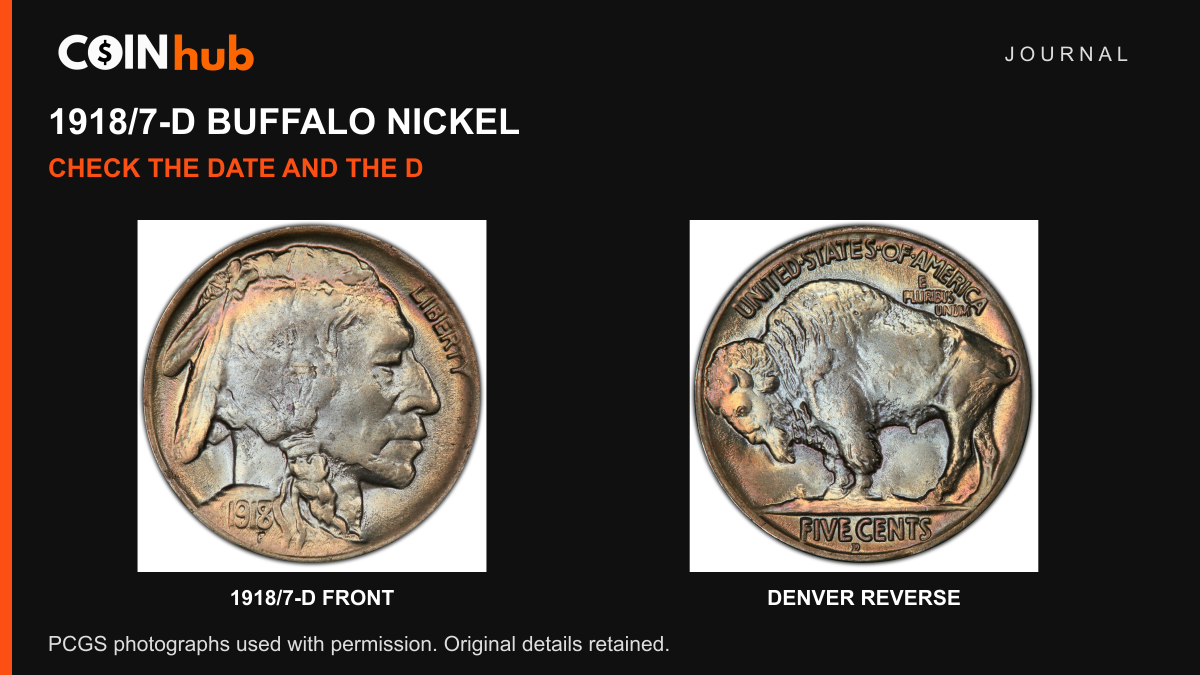
The 1918/7-D Buffalo nickel has traces of a 7 beneath the final 8 in its date. The D on the back identifies Denver. Check both areas against genuine reference photos: a line inside an 8, or a D in the right general place, does not prove the variety.
An overdate is a date made over an earlier date on a die, the tool that strikes a coin. Here the key detail is part of the die's design. It is different from a scratch added to a finished nickel.
Read the date before making a value claim
Start with the full front of the coin, called the obverse. Find 1918 below the portrait, then compare the final digit with the close-up below. Look at the shape and position of the extra lines within the 8, rather than choosing any mark that could resemble a 7.
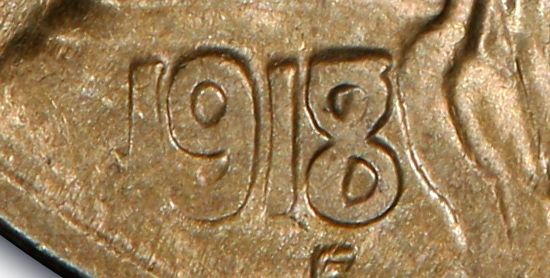
PCGS catalogs the 1918/7-D separately from the regular 1918-D. Its reference page also links the FS-101 attribution. FS-101 is a catalog label for a specific variety; it is not a grade or a promise of value.
Turn the coin over and check the D
The reverse is the bison side. Its mint mark sits below FIVE CENTS. PCGS notes that genuine 1918/7-D nickels have a D that leans to the left. Compare the mark's shape and angle as well as its location.
That check matters because a mint mark can be added to a different coin. A correctly placed letter is only one part of the evidence. Keep a full reverse photo alongside your close-up so the mark remains tied to the actual nickel.
| Area | Useful check | Limit |
|---|---|---|
| Final 8 | Compare the underlying 7 with a genuine reference. | A scratch or rough surface can suggest a false match. |
| D below FIVE CENTS | Compare its leftward tilt and full shape. | Position alone cannot rule out an added mark. |
| Both full faces | Keep the close-ups connected to one coin. | Photos alone do not establish authenticity. |
Two different counterfeit problems
In its 2012 altered-coin study, NGC examined a nickel with both a changed date and an added D. The counterfeit mark had a poorly shaped top serif, and the supposed 7 crossed the lower loop in the wrong place. A serif is a small finishing stroke on a letter.
NGC also described a crack running from the hair braid toward the jaw on many genuine examples. Treat such a feature as supporting evidence, with its source qualification intact. A hidden or unclear crack in a worn photo is not a reason to invent a firm result.
A separate NGC case published in 2021 involved a counterfeit with weak details, an incorrect date and the wrong metal mix. That particular fake weighed 5.4 grams. It does not follow that every fake has that weight, or that a coin at the normal 5.00 grams must be genuine.
Why the dates overlap
NGC explains the overdate as a working die receiving impressions from differently dated hubs. A hub carries the design used to make a die. The apparent sequence used a 1917 hub and then a 1918 hub while the die was being made. It was not a finished 1917 nickel simply struck again in 1918.
Keep this separate from the 1916 doubled-die Buffalo nickel and the 1938-D/S overmintmark. Their dates and diagnostics describe different varieties.
Make a useful comparison record
- Photograph both full faces and take clear date and mint-mark close-ups.
- Try light from another direction. Leave the surface as found; do not scrape or use chemicals to expose a feature.
- Record each match and each area that wear, glare or damage hides.
- Ask an experienced attributer to review a strong candidate before buying or selling it as the overdate.
The CoinHub Variety Attribution Assistant can help organize a research question. It does not authenticate the coin or confirm an FS number. A possible match should stay provisional until the evidence supports it.
For wider error and variety study, CoinHub founder Blake Alma's The CoinHub: An Ultimate Guide to Coin Errors is an optional resource. It is CoinHub's own book; the reference checks above remain available without it.
Sources and photograph credit
Research: the PCGS catalog and the two dated NGC case studies linked above, checked October 22, 2026. Header and date photographs: PCGS, used under CoinHub's documented permission. Coin faces are proportionally framed; no coin detail, color or diagnostic mark was changed. The photographs do not authenticate a reader's coin.