
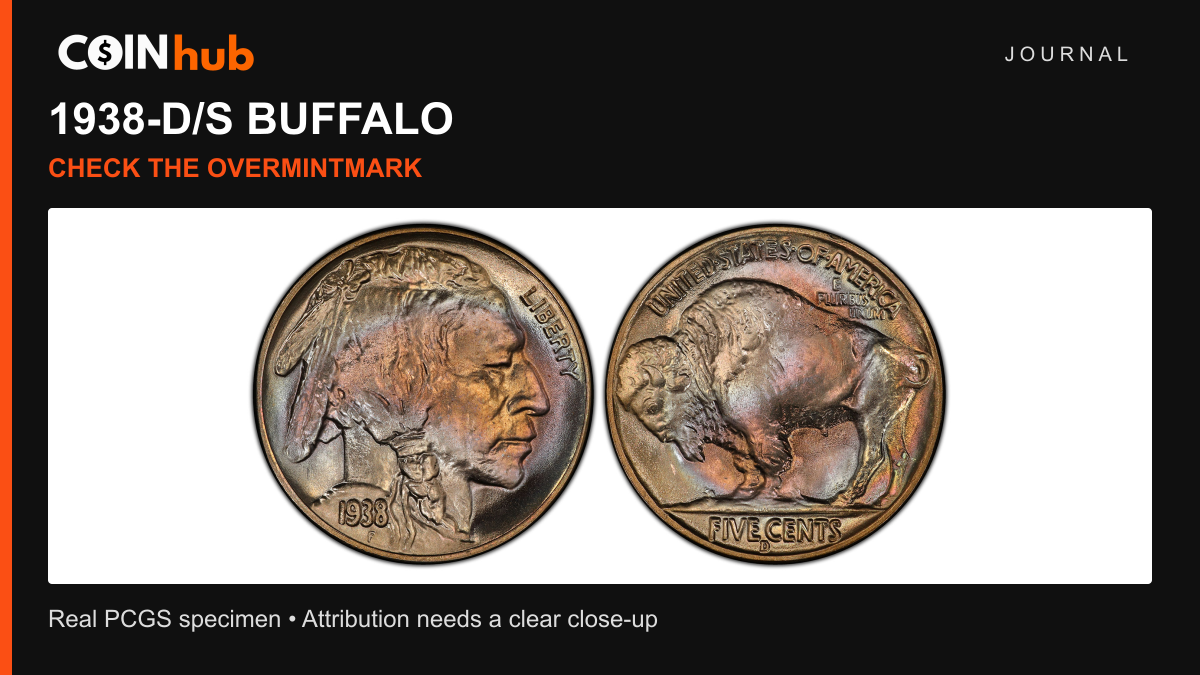
A change to the die can survive on the coin
The puzzle is understandable. If the coin was made in Denver, why would an S appear underneath its mintmark? The answer concerns a die prepared for one mint and subsequently used for another. It does not mean a finished coin traveled through two mints to acquire its lettering.
Why there is no contradiction with the 1938 date
PCGS’s history of the variety explains that Buffalo nickel dies originally intended for San Francisco were repurposed for Denver as the series approached its end. The earlier S was overpunched with a D. No Buffalo nickels were struck at San Francisco in 1938.
The resulting D/S is a die variety. It is distinct from a doubled die, an overdate or a second strike on a finished coin. Those terms describe different processes, even when a marketplace listing groups all of them under “errors.”
Keep three descriptions separate
| Description | What it says | What to verify |
|---|---|---|
| 1938-D | The date and Denver mintmark | The coin’s basic identity |
| 1938-D/D | A repunched D mintmark | Evidence for the particular D-over-D attribution |
| 1938-D/S | A D over an earlier S | The underlying mark and matching recognized variety |
A slash is doing real descriptive work. Do not substitute D/D for D/S because both show extra detail around a D. The 1964-D/D Jefferson nickel guide offers another repunched-mintmark example, but its diagnostics belong to that different issue.
How to examine a possible D/S
- Confirm the whole coin. Obtain a readable 1938 date and a full reverse view. A cropped mintmark without the coin’s context is incomplete evidence.
- Use a steady close-up. Photograph the mark below FIVE CENTS with the camera square to the coin. Try light from a second direction without changing the surface.
- Compare shape and position. Use the enlarged images in PCGS CoinFacts 3985 and the exact attribution cited by the seller. Look at how the extra feature relates to the D, rather than searching for any convenient curve.
- Keep the conclusion provisional. If glare, wear or damage obscures the feature, describe it as a possible variety until an experienced attributer can evaluate it.
Our hero shows a real PCGS-identified D/S specimen. At social-preview size, even a genuine example cannot supply all the detail needed to attribute another coin. A sharp full-size comparison is more useful than repeatedly enlarging a blurred thumbnail.
Why the exact attribution matters
PCGS describes multiple overmintmark dies and differences in their visibility. Its discussion distinguishes stronger recognized examples from less obvious varieties. That is a reason to read the complete certification description and request the supporting reference, not to assign every unusual D the strongest variety’s name.
For a raw purchase, ask the seller to identify the reference they used. “Looks doubled” is an observation; a specific attribution is a conclusion supported by comparison. If the asking price depends on that conclusion, arrange an independent assessment or buy on terms that allow the identity to be checked.
Make a fair value comparison
First match the date, mintmark and attributed variety. Then match grade, surface condition and eye appeal. Keep a cleanly graded example separate from one with damage or an uncertain attribution. An old article’s retail estimate is not a current offer, and a highest-grade auction result is not a typical raw-coin price.
Save the sale date, full lot description and final reported price for each comparison. Our auction-terms guide explains why you also need to know whether a displayed result includes the buyer’s premium.
Should I clean around the D?
No. Do not scrape, rub or chemically expose a mark. Preserve the coin as found and improve the photograph instead. The nickel error list provides broader context when the feature may belong to another mechanism.
Sources checked September 13, 2026. The PCGS historical article dates to September 14, 2020; its old prices, population counts and survival estimates are not presented here as current facts.