
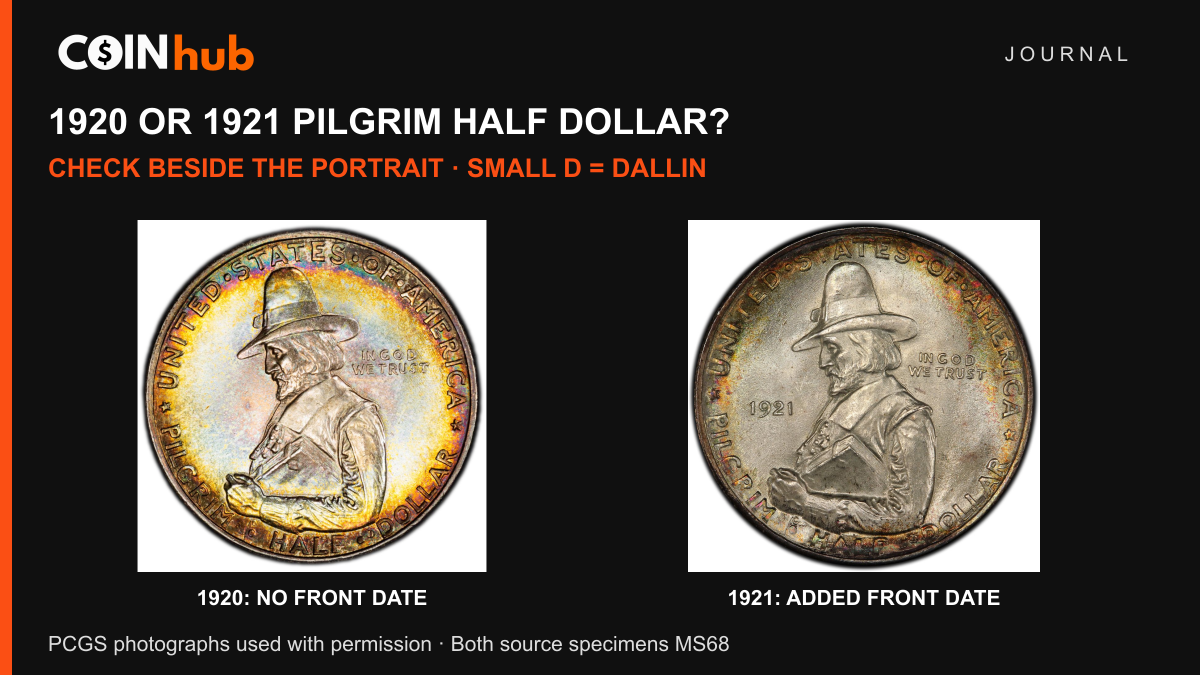
A 1921 Pilgrim half dollar has 1921 to the left of the portrait. The 1920 issue has no corresponding year on that side. Both keep 1620–1920 beneath the ship on the reverse, or back. The small D below the portrait is designer Cyrus Dallin's initial; both years were struck at Philadelphia.
Read PILGRIM HALF DOLLAR first
The words along the lower front identify the coin. They help separate a Pilgrim half dollar from a Walking Liberty half dollar of the same year. A search for a 1921 D half dollar can mix those very different issues, especially in shopping results.
The front shows William Bradford in Pilgrim clothing, carrying a book. The back shows the Mayflower. The U.S. Mint's program record identifies the ship, the anniversary and Cyrus E. Dallin as designer of both sides.
The photographs above show two different PCGS reference coins. The 1920 example is the colorful one; the 1921 example has its added year in the open space left of Bradford. Their color is not the date test. Other examples of either year can look quite different.
Two issue years, one anniversary inscription
| Issue | Portrait side | Ship side |
|---|---|---|
| 1920 | No separate 1920 in the open field | 1620–1920 below the ship |
| 1921 | 1921 left of the portrait | 1620–1920 below the ship |
Tercentenary means a three-hundredth anniversary. The Mint says the half dollar marked the Mayflower's 1620 landing. Read 1620–1920 as the anniversary pair, rather than assuming every coin carrying it was issued in 1920.
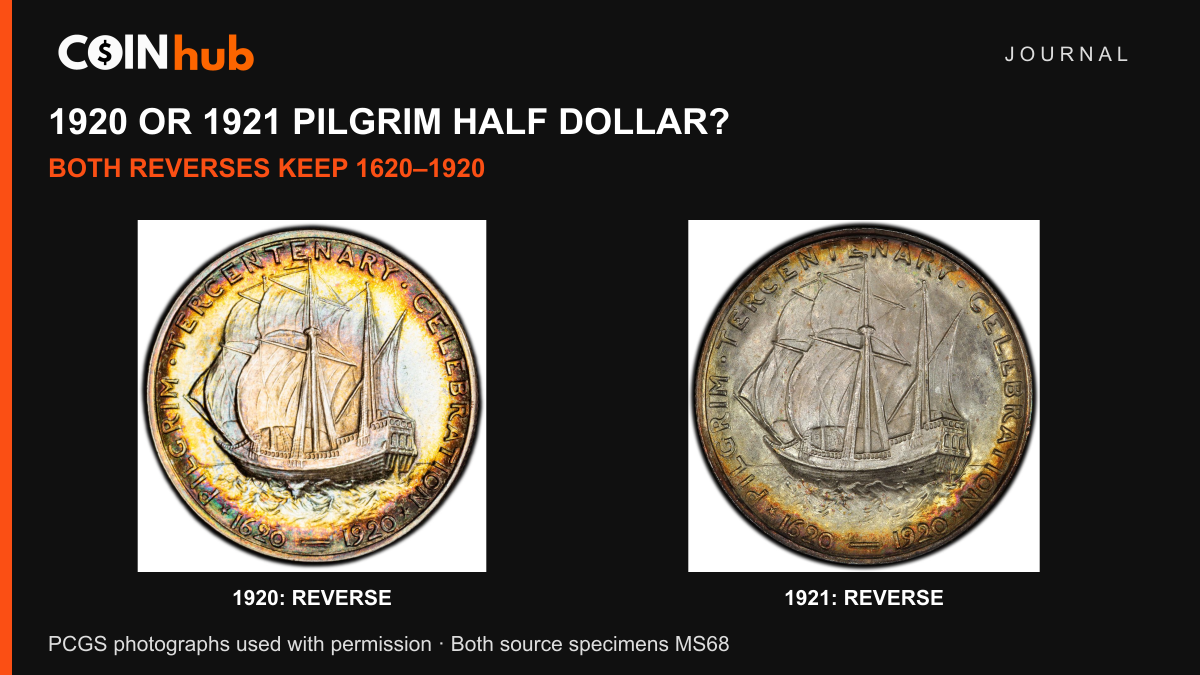
Q. David Bowers's commemorative history records production of the second year's pieces in July 1921, with 1921 added to the left front field. The older anniversary dates remained part of the reverse design. That combination is a normal feature of the 1921 issue.
The small D names the designer
Look below Bradford's elbow for the small D. It is incuse, meaning recessed into the surface. PCGS's 1920 entry explains that the letter represents Dallin's last name, rather than a Denver mint mark.
The 1921 entry also identifies Philadelphia as the mint. Keep the meaning of a letter tied to the particular design and its documented location. The familiar D-for-Denver rule on many regular U.S. coins does not identify this small designer initial.
A useful collection note would read “1921 Pilgrim commemorative half dollar; date left of portrait; Dallin initial under elbow.” Calling it a 1921-D Pilgrim can give the wrong impression about where it was made.
Keep identification and value separate
Reading the date is one part of describing a coin. It does not prove that the coin is real or set its grade or selling price. Keep full front and back photos with its purchase record. Note wear, marks or changes to the surface.
Do not polish a dull coin to imitate a bright reference picture. When comparing sales, match the Pilgrim issue year, condition and any surface problems. A sale of a Denver Walking Liberty half dollar is not a comparable just because its date is 1921.
The dates on other commemoratives also need context. Our 1892 and 1893 Columbian half-dollar comparison explains a different anniversary and issue-date arrangement. Read each coin's own inscriptions rather than carrying one date rule across the series.
Sources and photograph credit
Mint program history, PCGS entries and Bowers's account checked October 24, 2026. PCGS photographs used with permission: CoinFacts 9359 for 1920 and 9360 for 1921, both source specimens labeled MS68. The source grades apply to those coins only. CoinHub proportionally framed complete faces and added labels; original color and design details remain intact.