
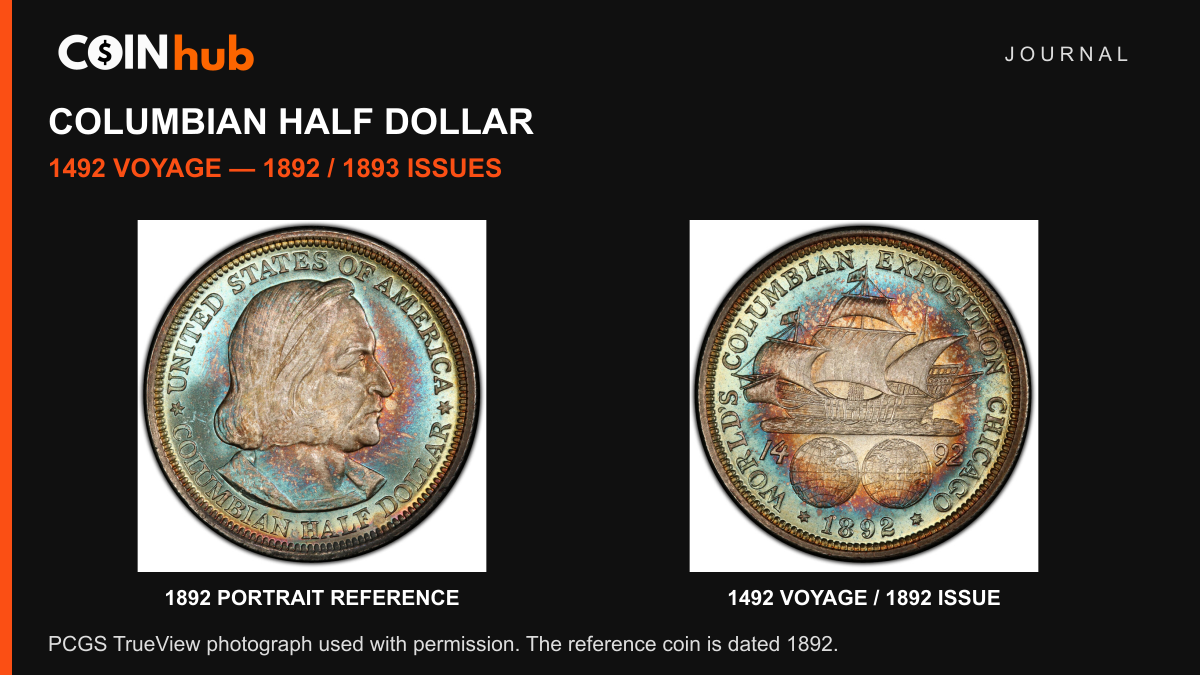
A Columbian half dollar dated 1892 was made for a fair that opened in 1893. The World's Columbian Exposition in Chicago was delayed, and the souvenir half dollars were issued in both years. The 1492 date beneath the ship marks Columbus's voyage. It is not the year the coin was made.
Those dates answer different questions. Read them with the portrait, ship and denomination before deciding what kind of coin you have. The real 1892 coin in the PCGS photo above shows both sides.
Find the issue date below the globes
The obverse, or front, has a portrait of Christopher Columbus. UNITED STATES OF AMERICA runs above it, COLUMBIAN HALF DOLLAR names the coin below. Half dollar means a face value of fifty cents.
Turn to the reverse, or back. The U.S. Mint describes the ship as the Santa Maria, with two globes beneath it. WORLD'S COLUMBIAN EXPOSITION CHICAGO runs around the outside.
In the reference photo, 14 sits to the left of the globes and 92 to the right. Together they form 1492, the voyage that the coin marks. The larger 1892 at the bottom is the issue date. On the other year's half dollar, that lower date is 1893.
A useful inventory note would be “1892 Columbian half dollar; portrait front, ship reverse.” Calling it a “1492 coin” confuses the event with the issue. Keep photos of both sides with the note. They help when you sort a group of silver coins you do not yet know.
Why the fair and coin dates differ
The fair marked four hundred years since Columbus's 1492 voyage to the Americas. It was planned for 1892 but postponed until the next year. Q. David Bowers's commemorative history explains that change in schedule.
Congress authorized the souvenir half dollars on August 5, 1892. Bowers records the start of their production at Philadelphia on November 19, 1892. The coins were therefore underway before the delayed fair opened.
The fair ran from May 1 through October 30, 1893, according to PCGS's history of the first commemoratives. Both coin dates belong to that same event. The 1892 date is not, by itself, a mint error or a sign that someone changed an 1893 coin.
A commemorative coin was also a fundraiser
A commemorative is an official coin made to mark a person, event or subject. The Mint's record says these half dollars helped pay to get the fair ready. They were real coins with a face value, rather than just entry tokens or private medals.
The half dollars were offered for one dollar each. That was the price asked for a fifty-cent coin at the time. It was not the face value. PCGS notes that many remained unsold and were later released into circulation or melted.
Keep three amounts separate when discussing one today: fifty cents is the face value, one dollar was the first asking price, and today's price needs its own check. Neither old sum tells you what a buyer will pay now. Check the grade, surface and past sales of like coins.
What “first commemorative” means here
The U.S. Mint calls the Columbian half dollar its first commemorative coin. PCGS adds a useful qualification: some collectors describe the earlier 1848 CAL. quarter eagle as an early coin made to mark an event. Its special punch records the source of the California gold.
The Columbian half dollar starts the formal series in the Mint's coin history. The earlier gold coin has its own story, explained in CoinHub's guide to the CAL. quarter-eagle mark. The two coins have linked histories, but they are not the same issue.
The 1893 Isabella quarter also belongs to the exposition. It has a different design and face value. Keep its records apart from the half dollars, even though both came from the fair.
Read the complete coin before judging a listing
Compare the portrait, full inscriptions, ship, globes and lower issue date with a recognized reference. A known design alone cannot prove a coin is real. Clear full-face pictures are more useful than a closeup that cuts off the rim or hides the date.
The photo shows one real 1892 coin. Other coins may have a different color, grade or price. Avoid polishing a coin to imitate a bright listing photo; a changed surface can hide clues and make the coin less appealing.
If you compare sales, keep the date, grade and any surface problems together. A top-grade auction result, a dealer's asking price and a circulated example are different comparisons. This guide explains the dates and design; it does not set a price for your coin.
Source and photo notes: The U.S. Mint program record, PCGS's origin essay and Bowers's commemorative history were checked October 20, 2026. The number allowed by law, the number made and the number left after melting are different figures. No disputed total is used here. The PCGS TrueView photo shows both sides of an 1892 half dollar, used with CoinHub's saved permission. CoinHub added labels and resized each full face. The coin and its color are unchanged.