
The two 2s refer to Alabama's place in the Union
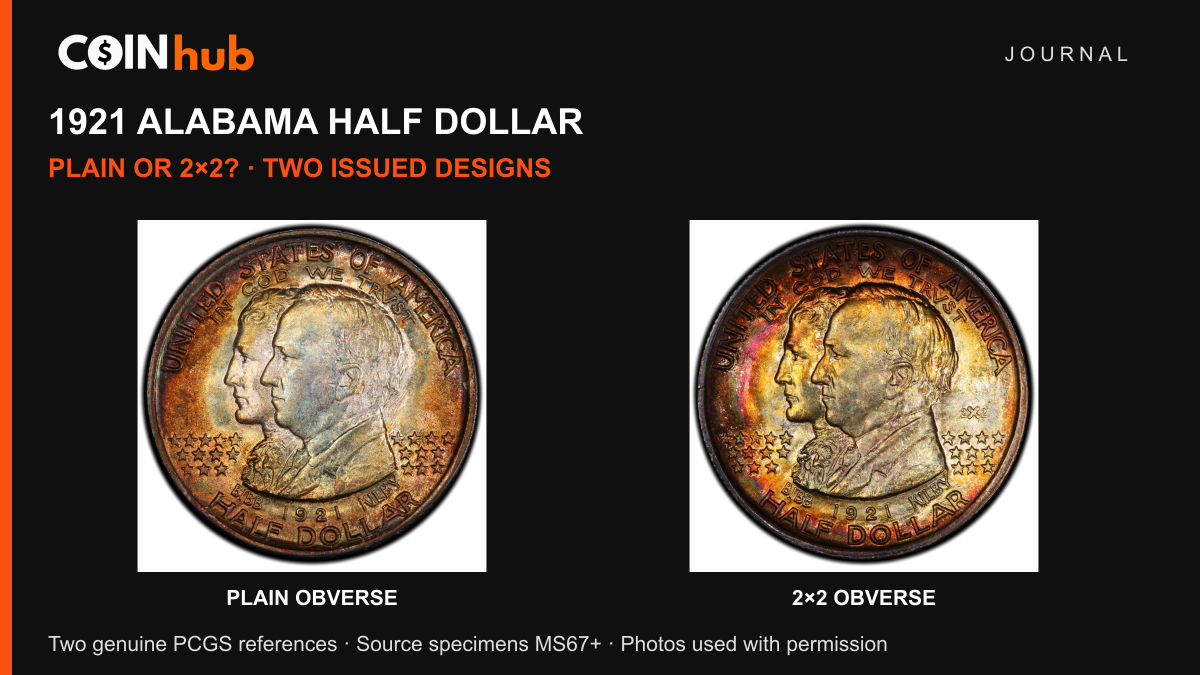
The 2×2 mark on a 1921 Alabama half dollar refers to Alabama being the 22nd state. Look to the right of the paired portraits on the obverse, or front. Some coins have the mark; the plain version does not. These are two issued designs, rather than a normal coin and a coin with an accidental extra mark.
The dates tell a separate story. Alabama entered the Union in 1819, so its centennial fell in 1919. This commemorative half dollar was issued in 1921. A coin can honor an earlier anniversary without carrying that anniversary year as its issue date.
Compare the same area on two genuine obverses
The main image uses two separate PCGS photographs. The left coin is the plain Alabama half dollar. The right is the 2×2 version. Both source specimens are labeled MS67+; their toning is not a test for which design you have.
Locate the space beside the nearer portrait and above the right-hand stars. On the marked coin, two small 2s flank the cross-shaped feature. On the plain coin, that space is clear. Compare the whole face before deciding that a small isolated mark is the feature you are seeking.
A worn or damaged area may leave the answer uncertain. Do not scratch or polish it to make a symbol appear. Save a sharp photo in ordinary light, with another view from a different lighting angle if needed.
| What you can read | What it means |
|---|---|
| 2×2 beside the portraits | The marked design refers to Alabama as the 22nd state. |
| 1921 below the portraits | The issue year, not the year Alabama became a state. |
| 1819 and 1919 on the reverse | Statehood and its 100th anniversary. |
| 22 stars on the front | A second reference to the state's order of admission. |
Read the portraits and eagle as parts of one design
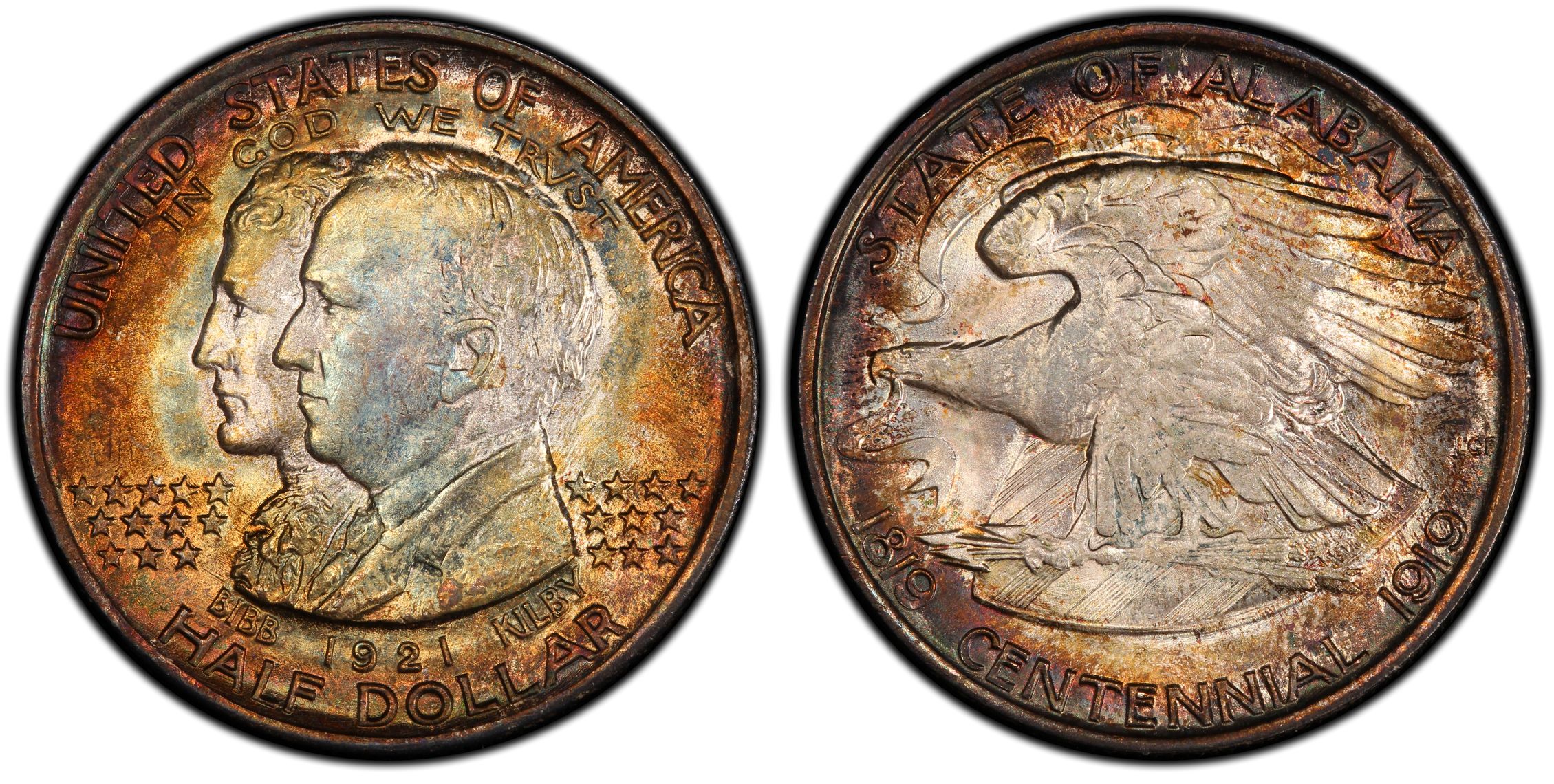
The U.S. Mint's Alabama commemorative record names the portraits as William Wyatt Bibb, the state's first governor, and T. E. Kilby, governor at the time of the commemoration. The Mint identifies this issue as its first coin to portray a living person.
Both sides were designed by Laura Gardin Fraser. On the back, the eagle design adapts Alabama's state seal. Read STATE OF ALABAMA around it, the centennial dates below, and HERE WE REST on the banner. The Mint lists Philadelphia as the issuing mint.
The 2×2 is not a branch-mint letter
A mint mark identifies the mint that struck a coin. The Alabama 2×2 has a different purpose: it refers to the state. Calling it a “2×2 mint mark” in a sale title does not change that meaning. Keep the issued design and the place of manufacture as separate fields in your notes.
The plain version is not automatically a missing-mark error. It is an established counterpart to the marked issue. For a useful comparison with another small letter on a commemorative, see the Pilgrim half dollar's date and designer D. Read each coin's own context before assigning a familiar label.
Be cautious with a simple rarity ratio
PCGS author David Hall discusses conflicting historical mintage figures for the two Alabama versions. Its catalog fields and expert narrative should not be treated as a settled count of surviving coins. A smaller number on a page is not enough to calculate how many times rarer one design must be.
Nor does the mark alone set a price. Identify the version first, then examine condition and any evidence of alteration. A sale of a high-grade specimen is a record of that coin, not an appraisal of every Alabama half dollar. This guide supplies a design comparison, rather than a current price range.
For your own record, photograph both faces and copy the dates and visible mark exactly. Keep uncertain details open. That short record will be easier to check than a price-based guess made from one close-up.
Sources and photographs checked October 24, 2026. PCGS photographs used with permission. Complete selected coin faces are proportionally framed; original details and color remain unchanged.