
The star marks an issued variety, not a minting accident
A 1922 Grant half dollar with a star is an issued version of the Grant commemorative coin. The other version has no star. On the front, look above the name GRANT, beside the portrait. The genuine star is recessed into the surface. Its presence does not make the coin a mint error, and its absence does not make the plain version an error.
The star has no firmly established historical meaning. The American Numismatic Association's design account says it has no historical significance. PCGS's expert narrative describes its purpose as unclear, while suggesting that creating another variety could help sales. Neither supports reading it as a specific military rank.
Compare the same space on two genuine coins
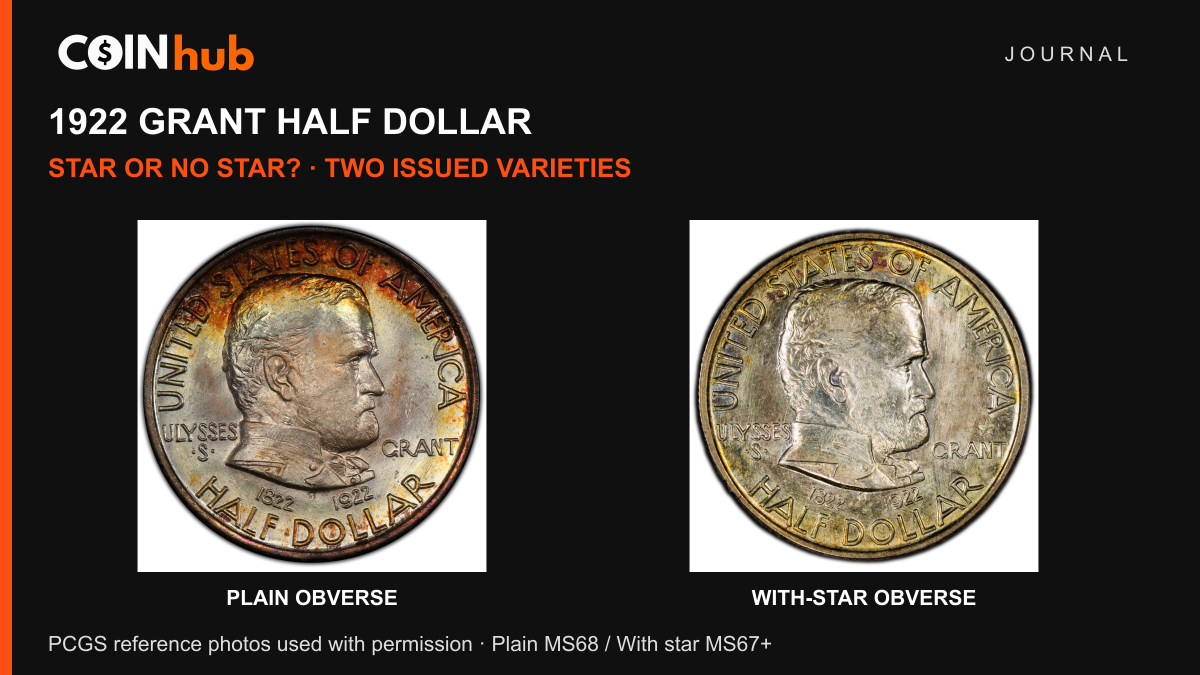
The main image shows two separate PCGS reference coins. The plain obverse, or front, is on the left. The star version is on the right. Find the word GRANT on each coin, then move upward from the N. The small five-pointed star sits in that open area on the marked coin.
Compare the whole front before judging one tiny shape. Both coins show Grant facing right, the dates 1822 and 1922, and HALF DOLLAR below. Different colors in these photographs are not a test for the variety. The source specimens also have different grades: PCGS MS68 for the plain coin and MS67+ for the star coin.
| Feature you see | What to record |
|---|---|
| A recessed star above the N in GRANT | A possible match to the with-star variety; authenticity still needs review. |
| A clear field in that area | The plain design is an issued version, not automatically a missing-star error. |
| 1822 and 1922 below the portrait | Grant's birth year and the commemorative issue year. |
| A small G between the dates | The designer's initial, a separate feature from the star. |
If wear, a mark or glare hides the area, leave the identification open. A dark patch in one photo is not enough. Take sharp pictures of both faces, followed by a closer view with the light coming from a second direction. Keep the original files.
Read the anniversary and the birthplace together
The U.S. Mint's Grant commemorative record identifies the 1922 issue as honoring the 100th anniversary of Ulysses S. Grant's birth. Laura Gardin Fraser designed both sides. The portrait is on the front; Grant's Ohio birthplace appears on the reverse, or back.
The full reference pair below lets you follow those details without losing their context. On the back, trees surround the building and a fence runs across the foreground. Read IN GOD WE TRUST above and E PLURIBUS UNUM to the left. The reverse does not supply the star-variety distinction shown on the front.
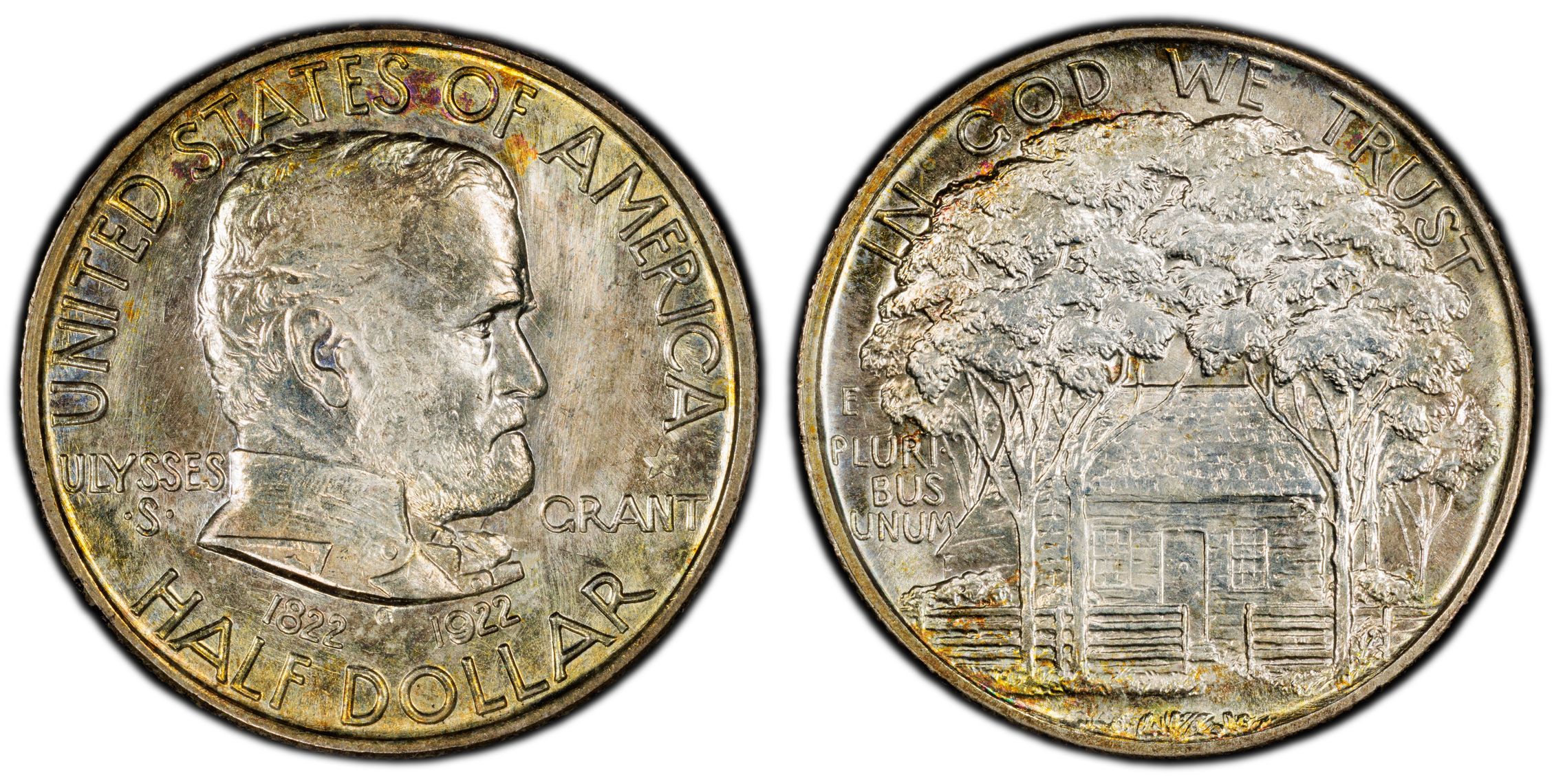
PCGS lists the half dollar as a Philadelphia issue with a nominal weight of 12.50 grams and diameter of 30.60 millimeters. Its listed composition is 90% silver and 10% copper. Those specifications help describe the type; a correct weight or size alone cannot establish a genuine star or authenticate a coin.
A recessed star can still be an added star
An incuse feature sits below the surrounding surface. That explains what the Grant star looks like, but it is not a complete test. A person can punch a recessed mark into a plain coin after it leaves the Mint.
NGC documented an altered Grant half dollar in 2019 with an added star. Its examination described displaced metal and problems with the star's shape and position. On the genuine design, a raised feature on the die—the steel tool that strikes the coin—forms the recessed star during striking.
Use that example as a reason to seek a careful examination, not as a rule that one photo can settle every case. Do not press, scrape or polish the field to test it. Before paying a with-star premium, ask for clear full-coin photographs and an expert assessment of the actual piece. Verify a grading holder's record as well as looking at the label.
Keep variety, quantity and value separate
The plain and star versions have different catalog entries. PCGS's plain Grant entry is a useful counterpart to the star reference. Read each record as a description of that issue, rather than assuming that one star sets the price of any coin.
Published counts can refer to coins struck, pieces distributed, assay pieces or later returns. They are not all counts of coins that survive today. This guide does not turn those figures into a rarity ratio. Nor does a past sale of a high-grade example supply a current value for a worn or altered coin.
For a useful collecting record, write down the date, the star observation, both-face photos and any verified certification. Keep condition and authenticity as separate questions. The same approach helps when reading another intentional commemorative mark, such as the 2×2 on the Alabama half dollar: identify the coin's own design before assigning a familiar meaning.
Sources and photographs checked October 27, 2026. PCGS photographs used with permission. Complete selected coin faces are proportionally framed; their details and color are unchanged.