
Two Massachusetts landmarks explain one anniversary coin
The 1925 Lexington–Concord half dollar shows the Concord Minute Man on its front and Lexington's Old Belfry on its reverse. The dates 1775–1925 mark the 150th anniversary of the battles. Chester Beach designed both coin faces; the Minute Man statue that inspired the front was Daniel Chester French's work.
The long word sesquicentennial means a 150th anniversary. The front and back tell one story. One town supplies the figure, the other supplies the building, and the dates join them.
Read the Concord side first
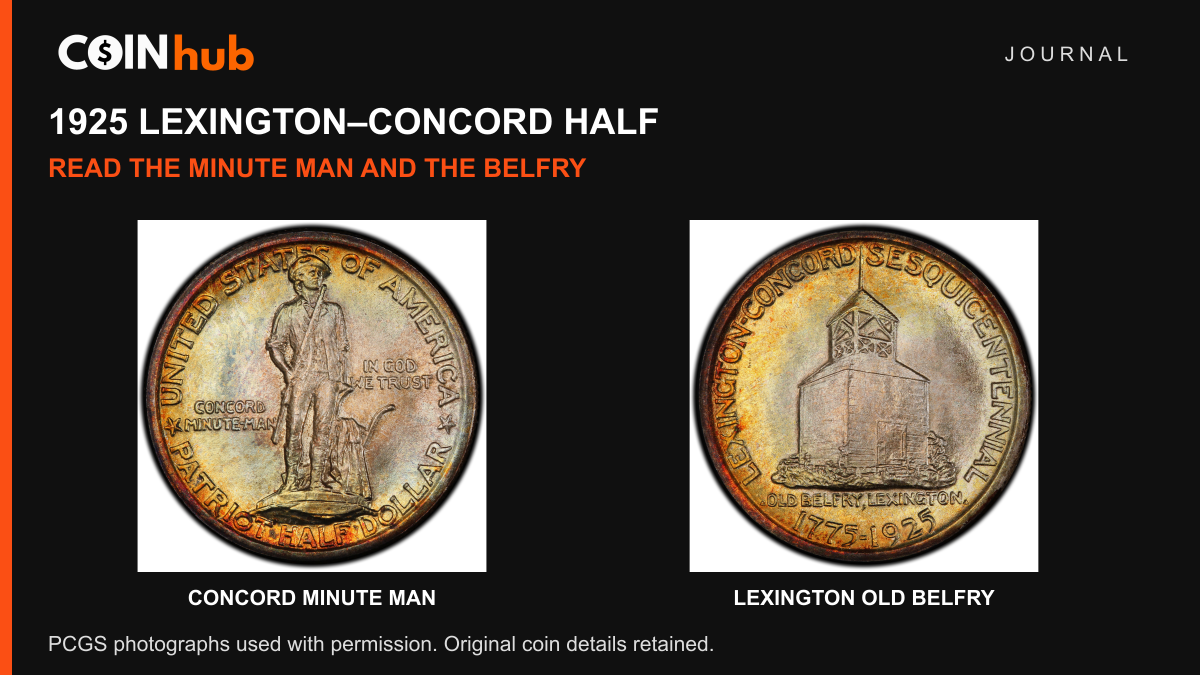
The obverse, or front, shows a Minute Man with a musket and a plow. CONCORD MINUTE-MAN names the figure. PATRIOT HALF DOLLAR tells you the coin is worth 50 cents at face value, even without a large 50.
The U.S. Mint's official design record names the figure and credits Beach with both coin designs. The two artists had different roles. French made the statue; Beach used that subject on the coin.
The building belongs to Lexington
Turn the coin over to see the belfry, a small bell tower. OLD BELFRY, LEXINGTON appears below it. Words around the rim link the towns, while 1775–1925 marks the 150-year span. This coin was made in 1925, not 1775.
| Where to look | What it tells you |
|---|---|
| Minute Man and CONCORD inscription | The front uses Concord's memorial subject. |
| Belfry and OLD BELFRY, LEXINGTON | The reverse represents Lexington. |
| 1775–1925 | The coin commemorates a 150-year interval. |
| PATRIOT HALF DOLLAR | This is the commemorative half dollar, not a medal with a similar historical theme. |
The real PCGS photo above shows both full coin faces. Read the words as well as the design. A copy or a medal could use a bell tower too, so that subject alone does not identify the half dollar.
Why the coin represents both towns
Q. David Bowers's history of the Lexington–Concord issue tells how each town asked Beach to make a coin. The two groups then worked together. Concord chose the front's theme, and Lexington chose the landmark on the back.
The Mint names two banks that sold the coins: Lexington Trust Company and Concord National Bank. The half dollar was a keepsake. Its face value was 50 cents, but that does not mean the banks had to sell it for 50 cents. The price paid then is also not today's price.
Philadelphia made it in 1925
PCGS CoinFacts 9318 lists the mint as Philadelphia. Its standard weight is 12.50 grams; its metal is 90% silver and 10% copper. It has a reeded edge, which means grooves around the outside. Do not apply the metal mix of a modern clad half dollar to this coin.
Metal and weight help with a check, but they cannot prove that a coin is genuine. Wear can affect weight, and a scale can be off. Record what you measured without treating one number as a full test.
Why two mintage numbers appear
Bowers records 162,099 coins struck and 86 sent back to be melted. The current PCGS coin page lists 162,013. Take 86 from 162,099 and you get that smaller number. One counts all coins struck; the other is the net after those returns.
These are counts from old records. They do not tell us how many coins still exist. Bowers suggests why some might have been sent back, but does not prove the reason. We should not turn that guess into a fact about damage, sales or rarity.
Make a useful record of your example
Take clear photos of both faces and the edge. Note the words, any label on the holder and any marks on the coin. Check the figure's leg and the corner of the belfry: the PCGS sources point to rub in those spots. A bright photo alone cannot settle a grade.
When you check a sale, match the coin type, grade and state of its surface. A cleaned coin and a top-grade coin are not fair matches. An old record price is not what every example will bring. Silver content is only one part of the coin's value.
For another early U.S. anniversary coin, see the 1892 and 1893 Columbian half dollars. Their dates tell a different story. Read each coin on its own terms; two old half dollars need not mark the same event or have the same value.
Mint and PCGS sources checked October 23, 2026. Old grade totals and prices are not used as current market data. PCGS photos used with permission. Both full faces keep their original details and colors.