
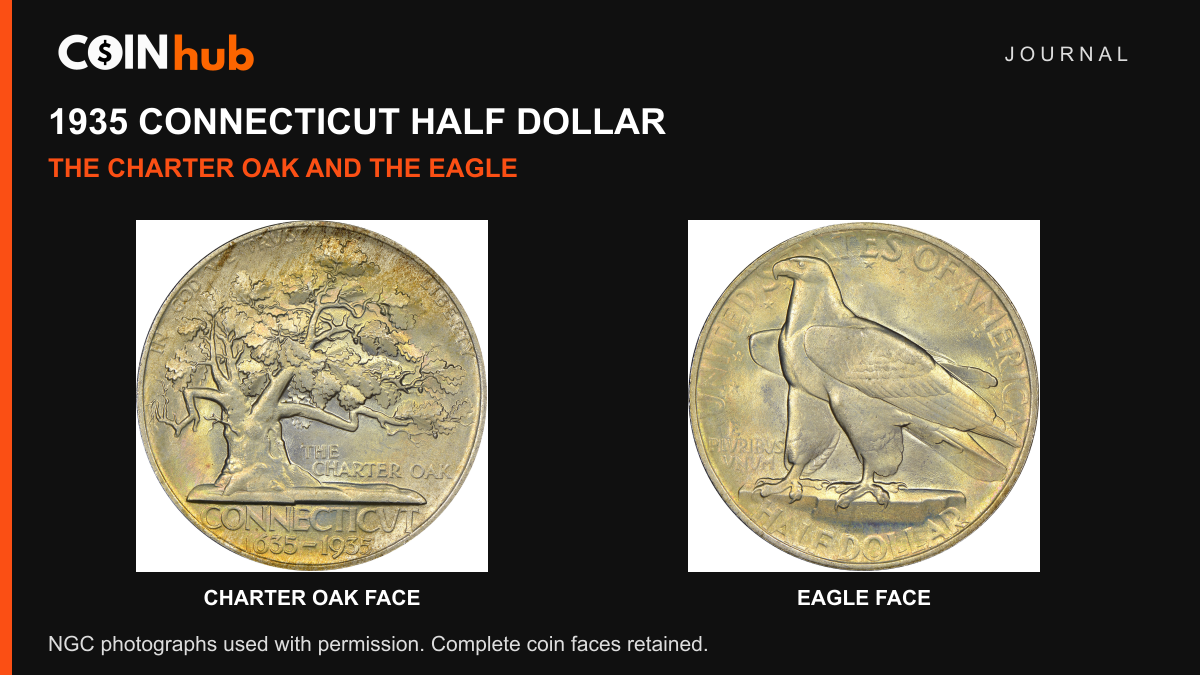
The tree and paired dates identify the occasion
The 1935 Connecticut half dollar pairs the Charter Oak with a bold eagle. Its dates, 1635–1935, mark 300 years since the colony's founding. This is a U.S. silver commemorative half dollar, rather than a 1999 Connecticut state quarter or a private souvenir medal.
Start with the words as well as the pictures. THE CHARTER OAK appears below the branches, and CONNECTICUT sits above the paired dates. The other face carries HALF DOLLAR and UNITED STATES OF AMERICA. Together, those details identify the type much better than the tree alone.
Why the Charter Oak appears
The U.S. Mint's Connecticut commemorative record gives 1935 as the year of issue. It credits Henry G. Kreis with both sides and identifies Philadelphia as the mint. Tercentenary is simply a 300th anniversary.
The oak represents Connecticut's charter story. In the traditional account, colonists hid their royal charter in a tree when royal agents sought to take it. Q. David Bowers's history of the coin links its tree design to Charles DeWolf Brownell's 1855 painting. That is the design's historical reference, not a photograph of the tree at the time of the coin's release.
Look at the real coin photo above. The thick trunk bends toward the left, while broad branches and large leaves spread across the face. The wording fills spaces around that tree. Reading the date below its roots helps distinguish this half dollar from other coins that also show an oak.
Compare each face without relying on a side label
On the tree face, follow the trunk, the name below the branches and the two dates. On the eagle face, look for the folded wing, curved beak and rock beneath the feet. E PLURIBUS UNUM appears beside the bird; HALF DOLLAR curves along the lower edge.
Some source descriptions disagree about which face to call the obverse, or front. Naming the tree face and eagle face makes a photo request clear even when a catalog uses a different label. Send both pictures rather than assuming that a request for “the reverse” means the same thing to everyone.
The large, smooth shapes are part of Kreis's design. They do not by themselves show that a coin was worn flat or made with a faulty die. Judge an individual mark against the same location on a clear reference. A familiar design still does not prove a particular piece genuine.
What the basic specifications can tell you
NGC's Connecticut entry lists a nominal weight of 12.5 grams, a diameter of 30.6 millimeters and a reeded edge. Reeded means the edge has a series of grooves. Its listed silver fineness is .900, or 90 percent.
These are reference measurements, not an authentication test. A scale's precision, a holder and wear can affect a reading. Record how you measured the coin and avoid weighing it inside a holder as though that were the weight of the bare coin.
There is a more important limit: a fake can have the expected weight and metal. NGC documented a counterfeit Connecticut half dollar with weight and silver content within the expected tolerances. Its graders relied on surface and detail problems as well. One passing measurement cannot rule those problems out.
Keep the anniversary date separate from value
The two dates describe the commemoration; they do not imply that the coin was made in 1635. For a collection record, write “1935 Connecticut Tercentenary half dollar,” then add the observed condition, certification details if present and clear photos of both faces.
A collector price also differs from the coin's fifty-cent denomination and from its silver content. Condition, genuine status and surface damage matter. Before using a sale as a comparison, check its date, exact issue, grade and any cleaning or damage notation. This article does not assign a current value.
Handle the coin by its edges and keep its original surfaces intact. If something seems wrong, save clear photos and ask a skilled dealer or grading service to review it. For another Kreis design with a different local anniversary, see CoinHub's Bridgeport half-dollar guide.
Official history, numismatic references and photographs checked October 22, 2026. NGC photographs used with permission; the complete tree and eagle faces retain their original detail. The photos are identification references, not a grade or authenticity finding for another coin.