
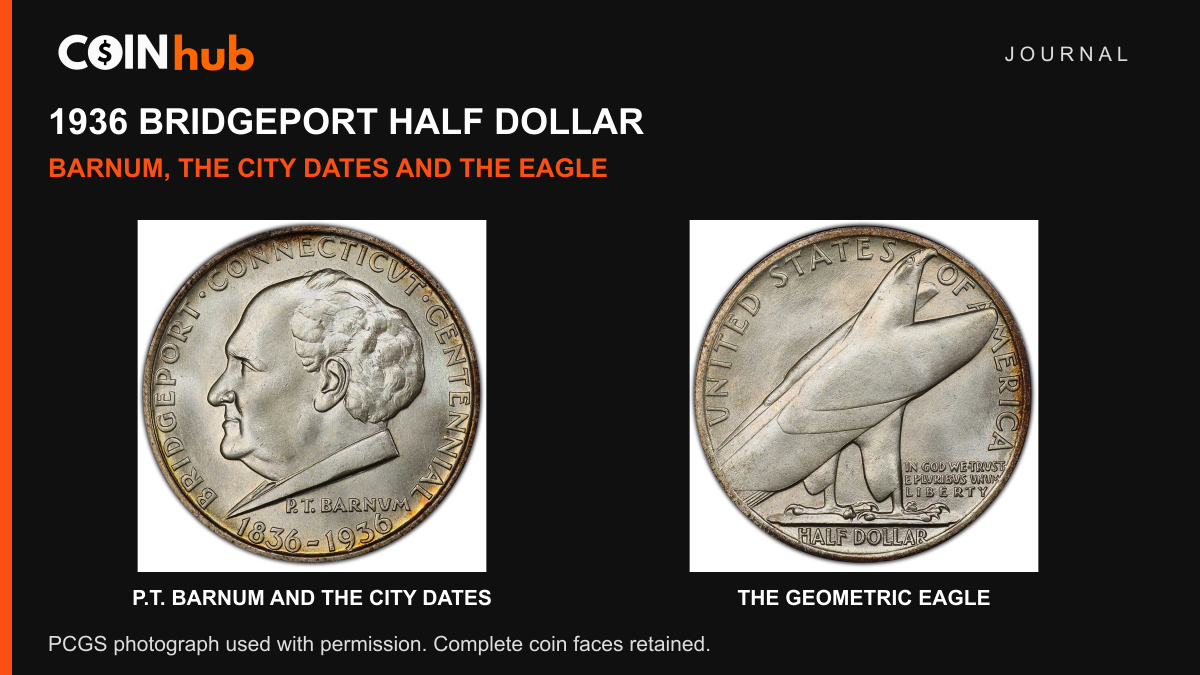
Two faces tell the story of one city centennial
The 1936 Bridgeport half dollar pairs a portrait of P.T. Barnum with a bold eagle design. The dates 1836–1936 mark a century since Bridgeport, Connecticut, became a city. They do not give Barnum’s lifespan. On the back, parts of the eagle and lettering meet or cross the rim as part of the design.
That last point is useful when a coin looks odd at first glance. A design element touching the rim is not, by itself, a mint error. Start by identifying the whole coin, then compare the same locations on a documented reference.
Why Barnum appears on a half dollar
The U.S. Mint’s Bridgeport record says the coin honors 100 years since Bridgeport became a city. It names Henry G. Kreis as the artist for both sides and Philadelphia as the mint.
The face is Barnum, the circus promoter whose name appears below the bust. The American Numismatic Association also links the coin to Barnum and the city’s milestone. A commemorative coin marks a person, place or event. This one is a U.S. half dollar, rather than a private circus token with a similar face.
Read the surrounding words as well as the face. “BRIDGEPORT CONNECTICUT CENTENNIAL” supplies the place and occasion. “P.T. BARNUM” names the subject. The paired dates complete the city’s anniversary message.
Follow the eagle to the rim
The reverse, or back, shows an eagle with folded wings. Big, smooth shapes and clear lines give it an Art Deco look. That style uses bold shapes, so this bird need not show the fine rows of feathers found on another U.S. coin.
In the real reference photograph, follow the beak toward the upper right edge. It reaches through the inner rim area. Then look at the end of UNUM and the words HALF DOLLAR below the bird. Some letter shapes also extend into the rim’s space.
PCGS’s design study explains why these details cross the rim. They belong to the design. Do not call them an off-center strike, a clipped coin or a damaged rim just because a letter does not stay neatly inside the border.
Separate the design from the condition of one coin
A coin with a normal design can still suffer damage later. The source photo does not make every mark near the edge harmless. Compare the full outline, nearby letters and the same feature on another clear coin.
For instance, a letter may meet the rim where the source photo shows it should. A dent that bends several nearby details is a different clue. Write down what you see in each spot. One odd edge should not become an answer for the whole coin.
Marks can stand out on the eagle’s broad, smooth wing. A bright streak may be light, while a scratch is a change to the surface. One image cannot settle every case. Turn the light, keep the first photos and do not polish the coin to make the design clearer.
A short identification record
- Front: record Barnum’s name, the Bridgeport inscription and the paired centennial dates.
- Back: record the geometric eagle, national inscriptions and HALF DOLLAR denomination.
- Rim: compare the beak and lettering with the same locations in the complete reference.
- Uncertainty: note glare, wear, a dent, a holder obstruction or an unreadable area.
A design match helps name the coin. It does not prove the piece is real or establish its grade, which describes its condition. Copies and changed coins need more than a familiar face to rule out. Show both sides when asking a skilled dealer or grading service for help.
Read an old price with its date attached
Old books and new sales listings do not show the same kind of price. The price asked at release belongs to 1936. Today’s asking price is what one seller wants. Neither shows what a different coin would sell for now.
If you research value later, match the exact issue, grade and surface condition with dated sales that actually took place. This guide makes no current price claim. For another early coin’s date story, see CoinHub’s 1892 and 1893 Columbian half-dollar guide.
Official history, design references and photograph checked October 21, 2026. PCGS photograph used with permission; complete coin faces and original details retained. Reference resemblance does not prove another coin genuine or establish its value.