
Find the named composer, then turn to the lyre
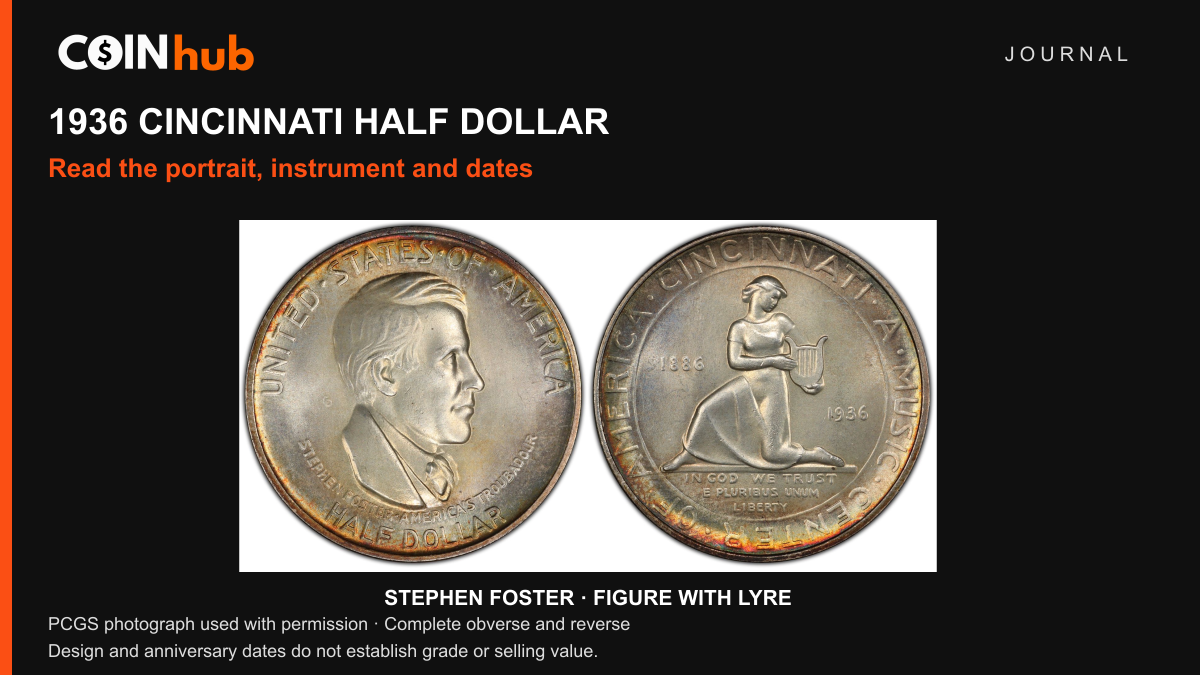
The man on the 1936 Cincinnati half dollar is composer Stephen Foster. The other face shows a kneeling figure holding a lyre, a stringed musical instrument. The two dates, 1886 and 1936, show a span of 50 years. The coin links that span to the city's musical role. They are not Foster's birth and death dates or the dates when Cincinnati was founded.
The U.S. Mint's issue record credits Constance Ortmayer with both designs. Its record gives the stated musical theme. Begin with those visible clues before comparing a seller's grade or price.
Read the words beneath Foster's portrait
The front, called the obverse, has Foster facing right. Beneath him, the lettering identifies STEPHEN FOSTER and calls him AMERICA'S TROUBADOUR. A troubadour is a singer or songwriter. HALF DOLLAR appears along the lower edge.
This combination is more useful than the portrait by itself. A worn face can look unfamiliar, and a close crop may leave out the name. Keep a full photograph of each side so the name, denomination and reverse design stay tied to the same coin.
This is a separate design from the regular Walking Liberty half dollar. A commemorative coin marks a person, place or event; several different U.S. commemorative halves share the year 1936.
The reverse names the musical theme
The back is the reverse. Its kneeling figure holds the lyre in front of her. Around the edge, CINCINNATI and A MUSIC CENTER OF AMERICA state the theme. The date 1886 sits to the left of the figure, with 1936 to the right.
Read these parts as a group. The instrument explains the music theme, while the city name separates this coin from other portrait commemoratives. The standard mottoes below the figure do not identify the issue on their own.
| Visible clue | What it helps establish |
|---|---|
| Stephen Foster's name | The portrait's identity |
| Kneeling figure and lyre | The musical theme on the reverse |
| Cincinnati around the edge | The city honored by this issue |
| 1886 and 1936 | The 50-year span claimed by the commemoration |
Why the anniversary needs context
The words on a coin tell you what it was made to honor. They do not, by themselves, establish a city's founding date or the start of a cultural tradition. That distinction matters here.
The American Numismatic Association's account notes that 1886 has no historical musical significance for this issue. The choice of anniversary has long drawn criticism in coin histories. Keep that limit clear when you describe the coin. The dates do not point to a known musical event that began in 1886.
For a different kind of anniversary date, compare CoinHub's Lynchburg half dollar. Its dates mark 150 years for that city. Each design needs its own historical explanation, even when the coins share a denomination and year.
One coin or a three-mint set?
Cincinnati halves were made at Philadelphia, Denver and San Francisco. The Denver and San Francisco issues are listed as 1936-D and 1936-S. The original offering combined coins from the three mints in a set.
The photograph here is the Philadelphia reference from PCGS CoinFacts. It does not show all three mint issues. For a set, check the date and mint on each coin. Ask for photos of all three; a single image cannot show the whole set.
PCGS lists the issue's nominal weight as 12.50 grams and diameter as 30.60 millimeters, with 90% silver and 10% copper. Those are reference figures. Matching them does not prove a coin is real. Keep your own measurements in a separate part of the record.
- Save clear photographs of the portrait and music figure.
- Record the exact date and mint identification for each coin.
- Check whether an offer is for one coin or a complete set.
- Verify a certification number when a grading-service holder is part of the sale.
Finally, keep the design, condition and price separate. The name and lyre help you name the type. They cannot tell you its grade or whether its surfaces were changed. The price still depends on the actual coin.
Primary references and photograph checked November 1, 2026. PCGS photograph used with permission. CoinHub added proportional framing and labels; the complete Philadelphia reference remains unchanged. No current price or grade is assigned from the photograph.