
The name beneath the portrait is the first clue
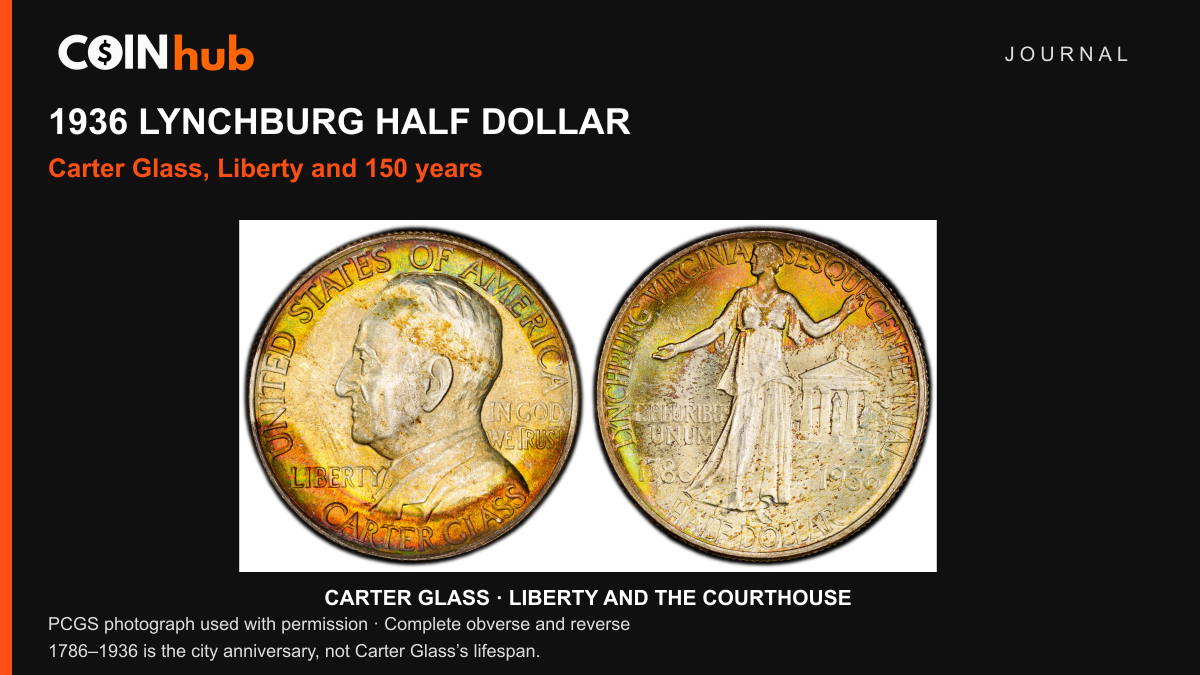
The man on the 1936 Lynchburg half dollar is Carter Glass, a U.S. senator from Virginia. Liberty stands on the back beside the city's old courthouse. The dates 1786 and 1936 mark 150 years for the city. They are not Glass's birth and death dates.
The U.S. Mint's issue record names Charles Keck as the artist for both faces. Start with the name, value and dates when you read this coin. They give you more clues than a worn face alone.
Who was Carter Glass?
Glass was born in Lynchburg in 1858 and worked in newspapers before he went into politics. The official House record traces his time in the House, as Treasury secretary from 1918 to 1920, and in the U.S. Senate from 1920 until his death in 1946.
Glass was still alive when the coin came out in 1936. He was then a U.S. senator. He was never a president. His portrait was part of the approved design; the choice of a living person was not a mint error.
The American Numismatic Association, or ANA, explains why he was chosen. The first choice was city founder John Lynch, but no suitable portrait could be found. The name beneath Glass's bust shows the final choice.
Read the two faces
| Feature | What to read |
|---|---|
| Front, or obverse | Glass faces left. CARTER GLASS appears beneath the portrait. |
| Back, or reverse | Liberty stands with outstretched arms. The courthouse scene appears to the right. |
| 1786–1936 | The anniversary spans 150 years. “Sesquicentennial” means a 150th anniversary. |
| HALF DOLLAR | The face value is 50 cents. The words do not give a modern collector price. |
The ANA names the steps near the courthouse as part of Monument Terrace. It also notes the Confederate monument shown in front of the building. Both are details of the scene on the back of this coin.
The large figure is Liberty. Read the words around her, then find the two dates and HALF DOLLAR. A seller's short title may leave out these clues. Color alone will not tell you which coin you have.
What the specifications can establish
PCGS's coin record lists Philadelphia as the mint. It gives a weight of 12.50 grams and a width of 30.60 millimeters. The edge is reeded, meaning it has small ridges. The metal is 90% silver and 10% copper. A match to those figures alone does not prove a coin is genuine.
Our photo shows a genuine PCGS reference with both faces in full. Its color and marks belong to that one coin. They do not set a grade or color standard for the whole issue. A photo cannot replace a close check of a different coin.
Keep identity separate from value
Once the design matches, record both faces, the edge, weight and any holder details. If a grading service has checked the coin, look up its number with that service. For a coin whose identity is still in doubt, seek a skilled coin specialist's help before using a listed price.
This guide gives no current value. A high-grade auction result, an asking price and the 50-cent face value answer different questions. Wear, cleaning, damage and the terms of a sale can all change what a buyer will pay.
Compare the city and dates in CoinHub's Delaware half-dollar date guide for a different local event. Read each coin's dates with the event it names.
Mint, House, ANA and PCGS sources checked November 1, 2026. PCGS photo used with permission. CoinHub added framing and labels; the coin's detail and color are unchanged.