
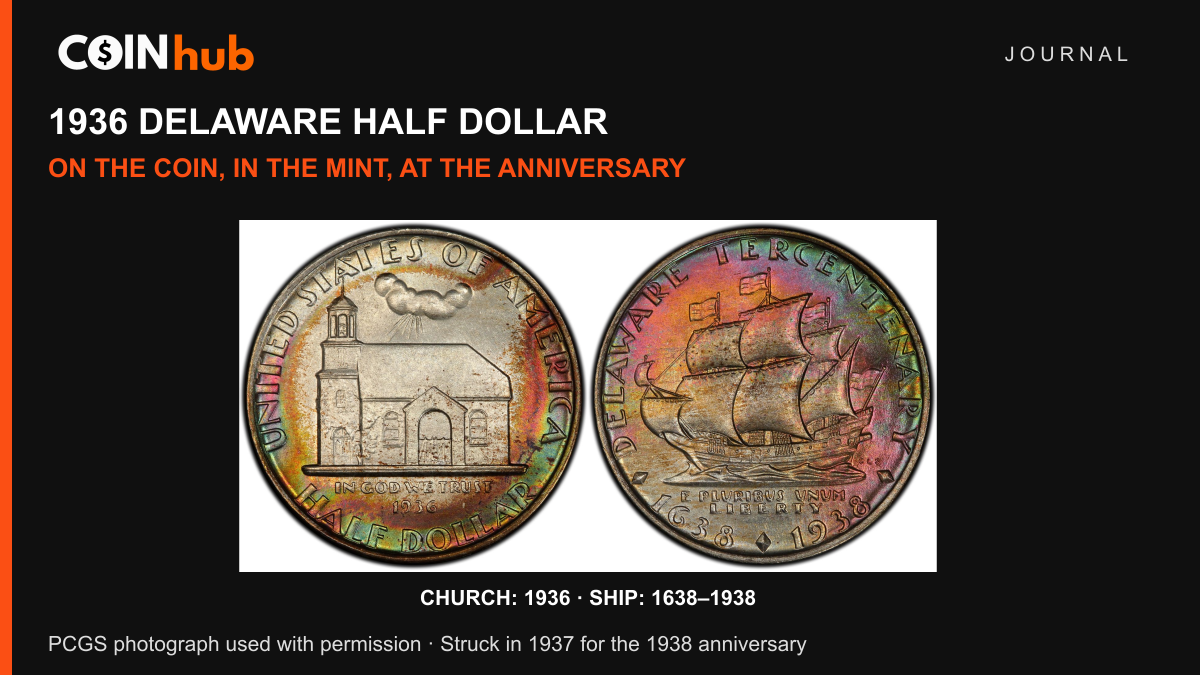
The 1936 Delaware half dollar carries 1936 beneath a church and 1638–1938 beneath a sailing ship. The coins were actually struck in 1937. Those dates describe different parts of the story; they are not evidence that your coin has a date error.
This commemorative half dollar marks the 300th anniversary of the Swedish settlement in Delaware. Start by reading both sides. The church, ship and HALF DOLLAR inscription identify a different coin from a Delaware state quarter.
Put each year in its place
The U.S. Mint's Delaware archive explains when Congress approved the coin and when the Mint struck it. It lists 1937 as the year of issue, with 1936 on the front and the anniversary dates on the back. Coin catalogs usually list the issue by its visible 1936 date.
| Year | Where it belongs |
|---|---|
| 1638 | The start of the anniversary interval shown below the ship. |
| 1936 | The year of authorization and the date beneath the church. |
| 1937 | The year the Philadelphia Mint struck the coins; it is not a date printed on the design. |
| 1938 | The 300th-anniversary year, paired with 1638 on the ship side. |
That explains why a search for a “1937 Delaware half dollar” can lead to a catalog entry headed 1936. A seller may mean the year the coin was struck. Check the pictured design and the full description before deciding that a listing names a different issue.
Read the church side
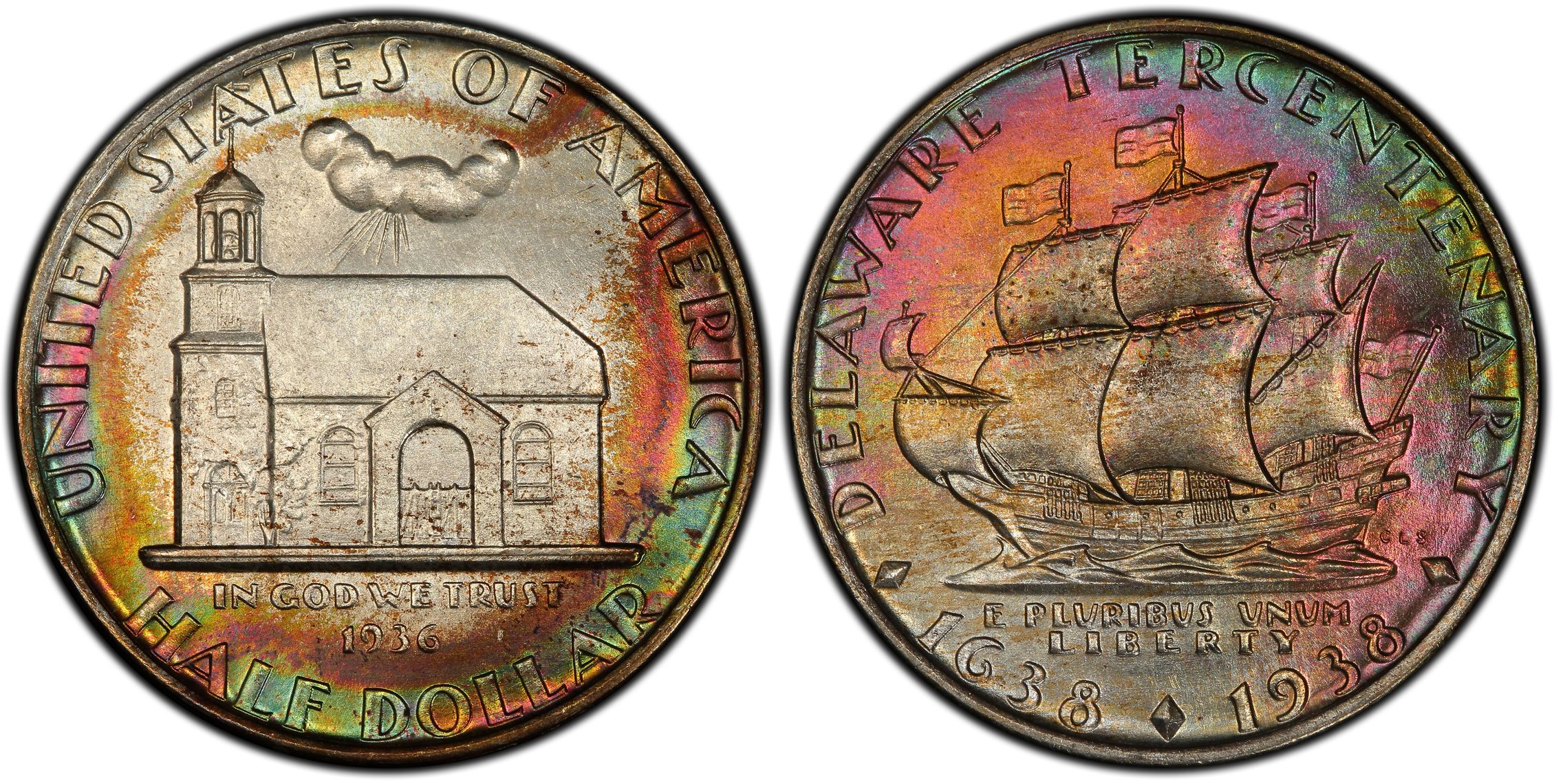
The obverse, or front, shows Old Swedes Church in Wilmington. A cloud and rays appear above the building. UNITED STATES OF AMERICA follows the upper edge; HALF DOLLAR runs below. The date 1936 sits beneath IN GOD WE TRUST.
Carl L. Schmitz designed both sides. The church scene links the coin to the Swedish community's history. It does not mean that the building was erected in 1638 or that this view documents the moment of settlement.
The PCGS history of the issue explains how the church and ship connect that later building with the earlier voyage. The scene is a tribute to that history. Read each date in context.
Turn to the Kalmar Nyckel
The reverse, or back, shows the sailing ship Kalmar Nyckel. DELAWARE TERCENTENARY curves around it. “Tercentenary” means a 300th anniversary. Below the ship are E PLURIBUS UNUM, LIBERTY and the paired dates 1638–1938.
Three small diamonds accompany the lower design. The American Numismatic Association's description connects those diamonds with Delaware's three counties: Kent, New Castle and Sussex. The designer's small initials also appear near the ship.
Use the complete, unaltered PCGS reference photograph to inspect the inscriptions at a larger size. The two sides show one reference specimen; its color and preservation are not a grade standard for another coin.
A small record prevents a large mix-up
Write down the denomination, both design subjects and all visible dates before searching for a value. A record such as “Delaware half dollar, church and ship, 1936 / 1638–1938” is more useful than a note saying only “old Delaware silver coin.”
- Keep photographs of both complete sides, including the rim.
- Record 1937 separately as the striking year, rather than adding it to the inscriptions.
- Keep a holder's grade and any problem designation with the coin's identification.
- Compare actual condition and surfaces before choosing a sold example as a reference.
Marks, wear, cleaning and other surface problems still matter after the type is identified. Attractive toning or a sharp date alone does not settle those questions. Avoid polishing the coin to make the roof, sails or lettering look clearer.
The Norfolk half dollar's date guide offers another example of why several years on a commemorative need separate explanations. For Delaware, the key distinction is simple: 1936 on the coin, 1937 for striking, and 1638–1938 for the anniversary.