
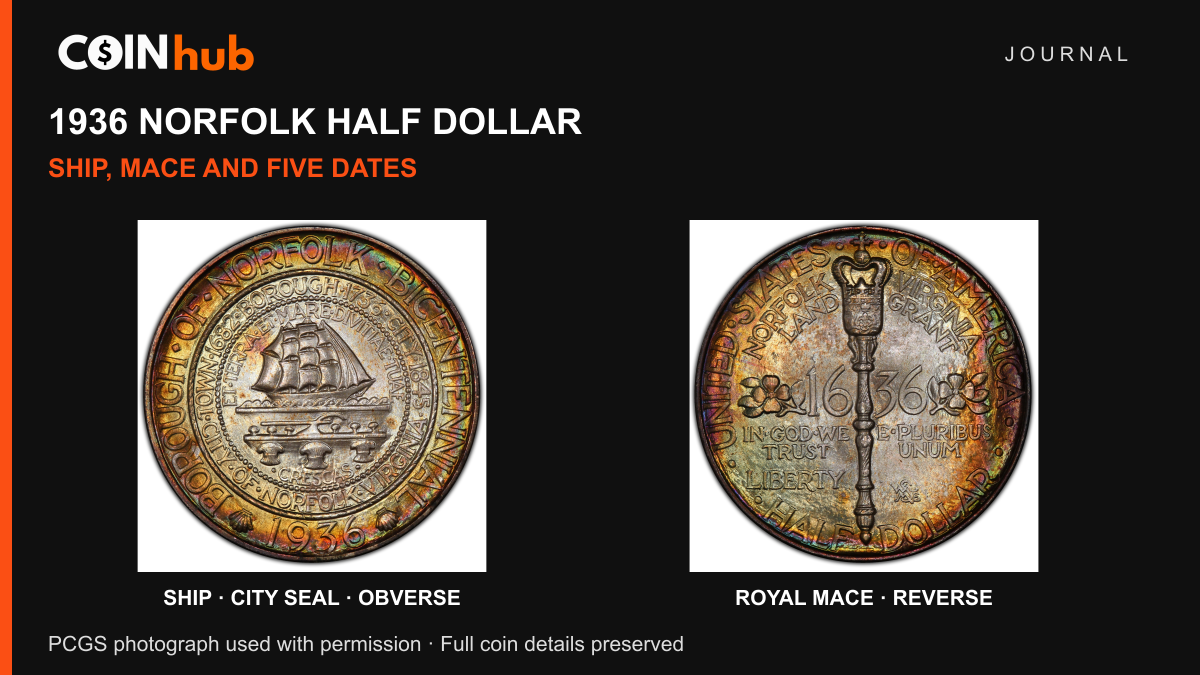
Five dates tell the story of one city
The 1936 Norfolk half dollar shows a ship on the front and a ceremonial mace on the back. Its five dates are 1636, 1682, 1736, 1845 and 1936. They mark stages in Norfolk, Virginia's history and its anniversaries; they are not five minting dates.
The American Numismatic Association's account makes a useful further distinction: the coin bears 1936 but was minted in 1937. A date that differs from the production year is part of this issue's history, rather than proof of a mint error.
Read the ship side from the center outward
The obverse, or front, uses the city's seal. A sailing ship sits above waves. Below it are a plow and three bundles of grain. These small objects connect the design to both sea trade and work on the land.
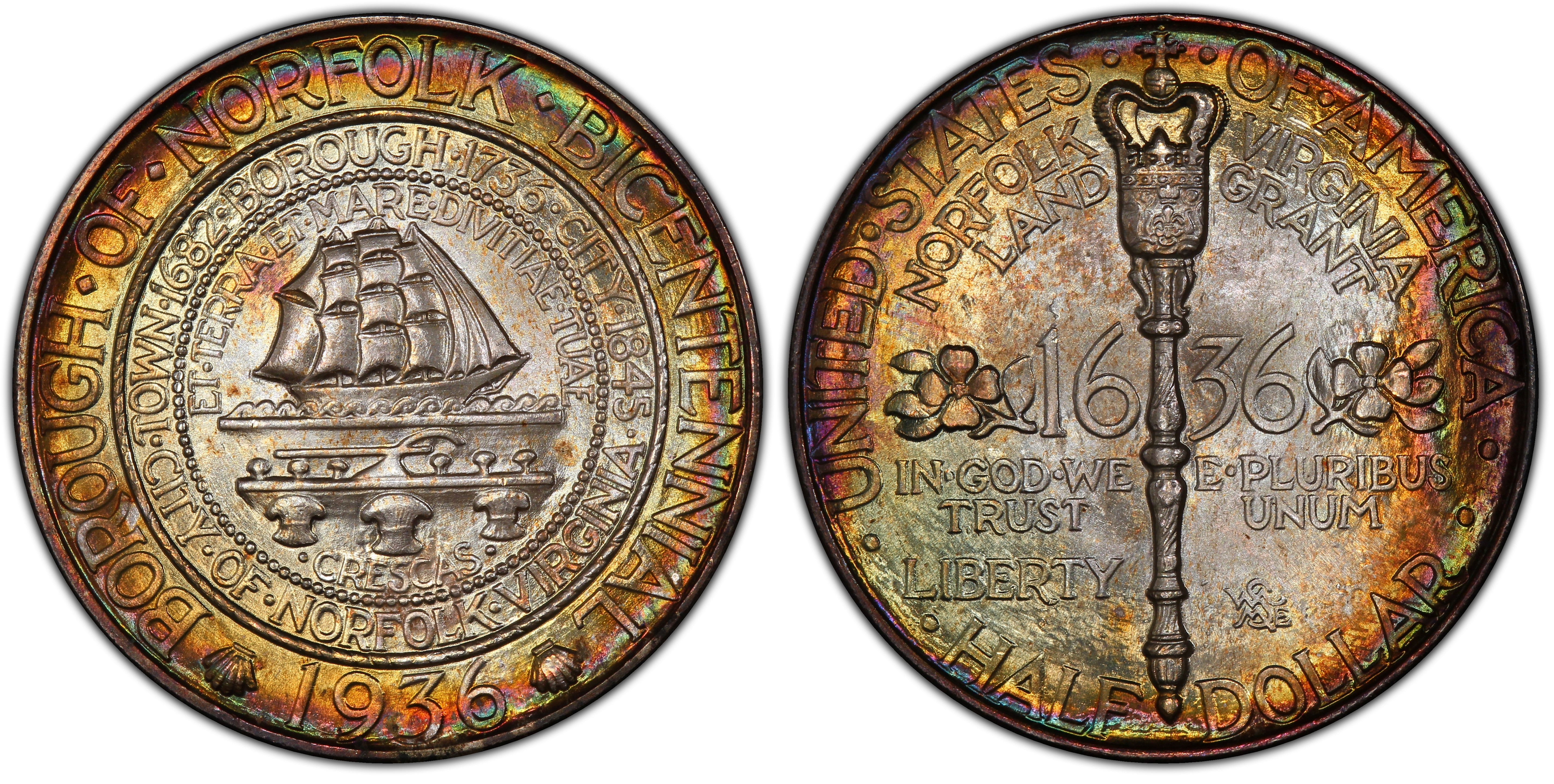
Look around the inner ring for TOWN 1682, BOROUGH 1736 and CITY 1845. Each year follows a different civic label. The large 1936 sits at the bottom of the outer ring, beside the words that mark the borough's two-hundredth anniversary.
The lettering is dense. A close photograph with the whole rim in view helps more than a tight crop of one date. Turn the image upright, then follow each ring separately instead of reading all the inscriptions as one sentence.
The tall object is a royal mace
The reverse, or back, centers on Norfolk's Royal Mace. A mace in this setting is a ceremonial staff that represents civic authority. The crown at its top is part of the historical object; it does not turn the half dollar into a British coin.
The digits 16 and 36 sit on opposite sides of the staff. Read them together as 1636, with NORFOLK VIRGINIA LAND GRANT above. HALF DOLLAR at the bottom gives the U.S. denomination.
| Date | What the design commemorates |
|---|---|
| 1636 | The Norfolk land grant, shown across the mace. |
| 1682 | Town status, labeled on the ship side. |
| 1736 | Borough status, the bicentennial's starting point. |
| 1845 | City status, labeled in the inner ring. |
| 1936 | The anniversary date carried on the coin. |
A reference standard is not a full authentication
PCGS CoinFacts 9337 lists a nominal weight of 12.50 grams, a diameter of 30.60 millimeters and a reeded edge. It records 90% silver and 10% copper. These are the issue's reference specifications, not a guarantee that every worn example gives the exact same reading.
The Mint's design record identifies Philadelphia and describes the ship-and-seal front and mace back. Its date summary differs from the ANA's production-year account. Use the visible 1936 inscription to name the issue and the ANA's explicit qualification when discussing when it was made.
For a collection note, record both sides, all five dates, condition and the source of your identification. The toning on this reference belongs to this specimen. A matching color is not required, and matching the design alone does not prove authenticity or value.
If you enjoy reading local history on U.S. coins, compare CoinHub's York half dollar guide. Its stockade and county seal tell a different story. Keep the inscriptions of each issue tied to its own coin.