
A Maine county, a stockade and two anniversary dates
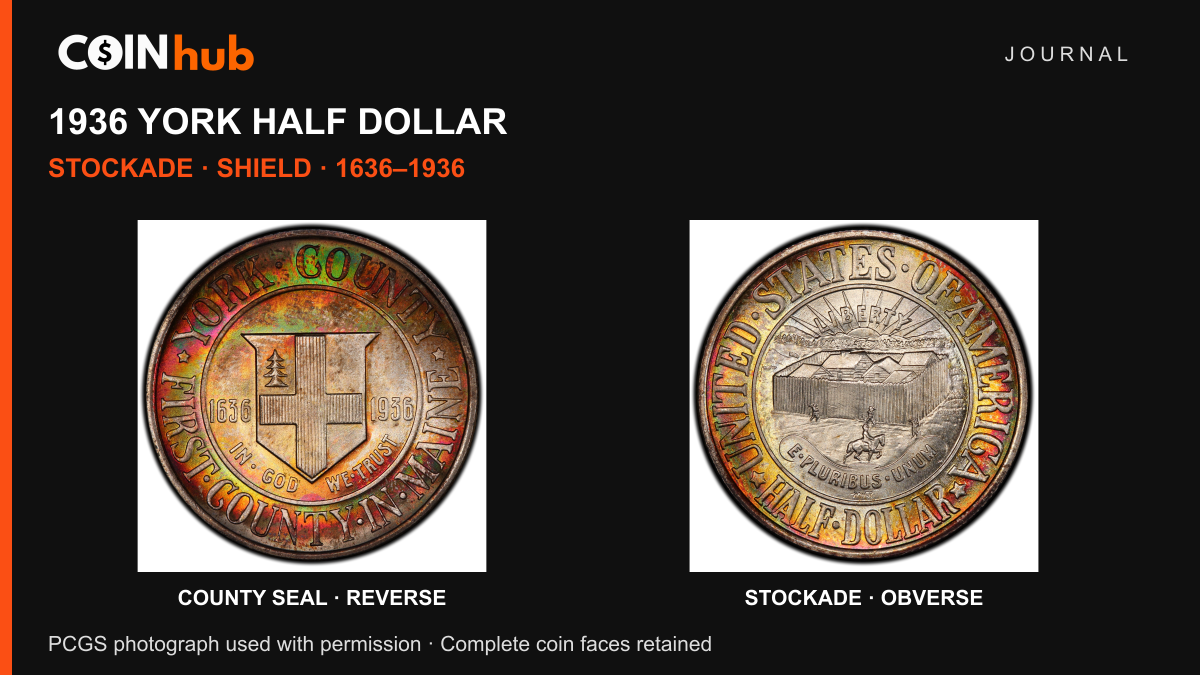
The 1936 York half dollar honors the 300th anniversary of York County, Maine. Its stockade scene is the obverse, or front. The county seal is the reverse, or back. The large 1636 and 1936 beside the seal mark the anniversary; the denomination is still fifty cents.
Start with those features rather than a price headline. This is a commemorative U.S. half dollar, not a colonial coin made in 1636. The word Maine also keeps its York County subject separate from similarly named places elsewhere.
Follow the stockade scene
The U.S. Mint's coin record identifies a stockade on the Saco River. A stockade is an enclosure made with upright wooden posts. The American Numismatic Association's design account connects this scene with Brown's Garrison and describes four sentries outside it, including one on horseback.
Read from the outer edge toward the center. UNITED STATES OF AMERICA names the country. HALF DOLLAR gives the denomination. Inside, the wooden wall, small figures and sun rays form the local-history scene. These are planned parts of the design, not minting mistakes.
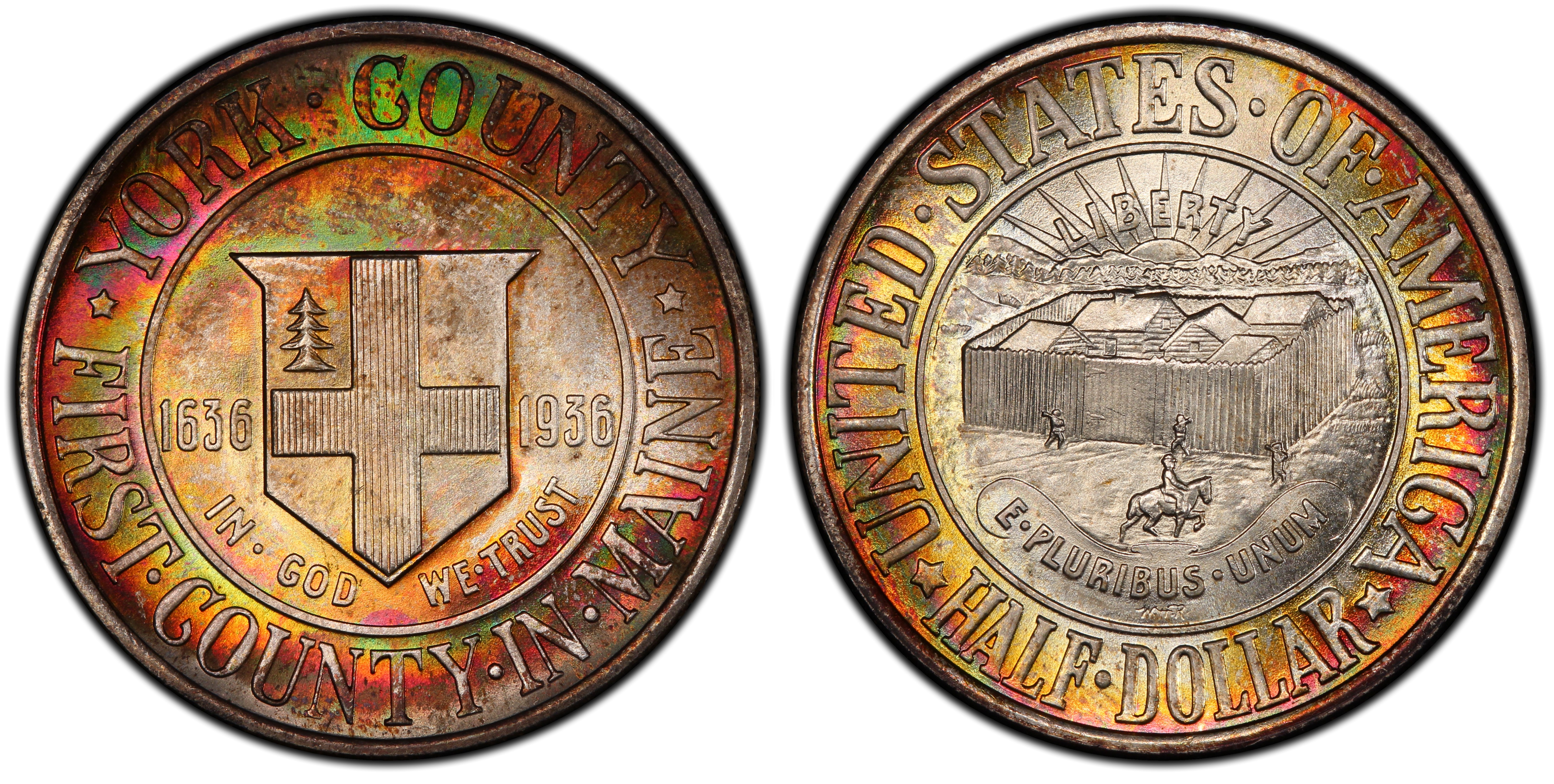
The photograph's left-to-right order does not determine which side is the front. Use the design descriptions and inscriptions. This matters when comparing a listing that presents the seal first with one that begins with the stockade.
Read the shield as a county seal
On the reverse, a cross divides a shield into four areas. A pine tree occupies the upper-left area. YORK COUNTY and FIRST COUNTY IN MAINE surround the central design, while IN GOD WE TRUST sits closer to the shield.
The 1636 at left and 1936 at right work as a pair: three centuries separate them. Neither date is a mint mark. Do not treat a worn numeral, a dark patch or the shape of the cross as a rare variety without separate evidence.
| Visible feature | What it tells you |
|---|---|
| Stockade and sentries | The obverse's historical scene. |
| Shield, cross and pine tree | The York County seal on the reverse. |
| 1636 and 1936 | The anniversary dates, not two mint locations. |
| HALF DOLLAR | The fifty-cent denomination. |
What the 1936 authorization actually says
The act approved June 26, 1936 authorized up to 30,000 silver half dollars for the commemoration. It required the coins to bear 1936 even if their year of minting or issue differed. An authorized maximum is not the same figure as the number actually struck or sold.
The Mint identifies Philadelphia as the producing mint and Walter H. Rich as the artist for both sides. PCGS CoinFacts 9449 lists the nominal specifications as 12.50 grams, 30.60 millimeters and 90% silver with 10% copper. Nominal means the reference standard, not a promise that every worn coin will measure exactly that.
Make the identification useful
Save clear photographs of both faces and the edge, then record the date pair and complete inscriptions. That is more useful than a cropped picture of a shield alone. If a label claims a grade, keep the service and full grade with the record rather than estimating it from the photograph's color.
Design identification comes before a value comparison. Surface preservation, wear and any damage still matter. A photograph that matches the general design cannot establish authenticity or a fixed sale price.
For another way an anniversary appears on a coin, see CoinHub's Wisconsin territorial half-dollar guide. Its dates and historical subject differ. On the York coin, follow the stockade, the county seal and 1636–1936 together.