
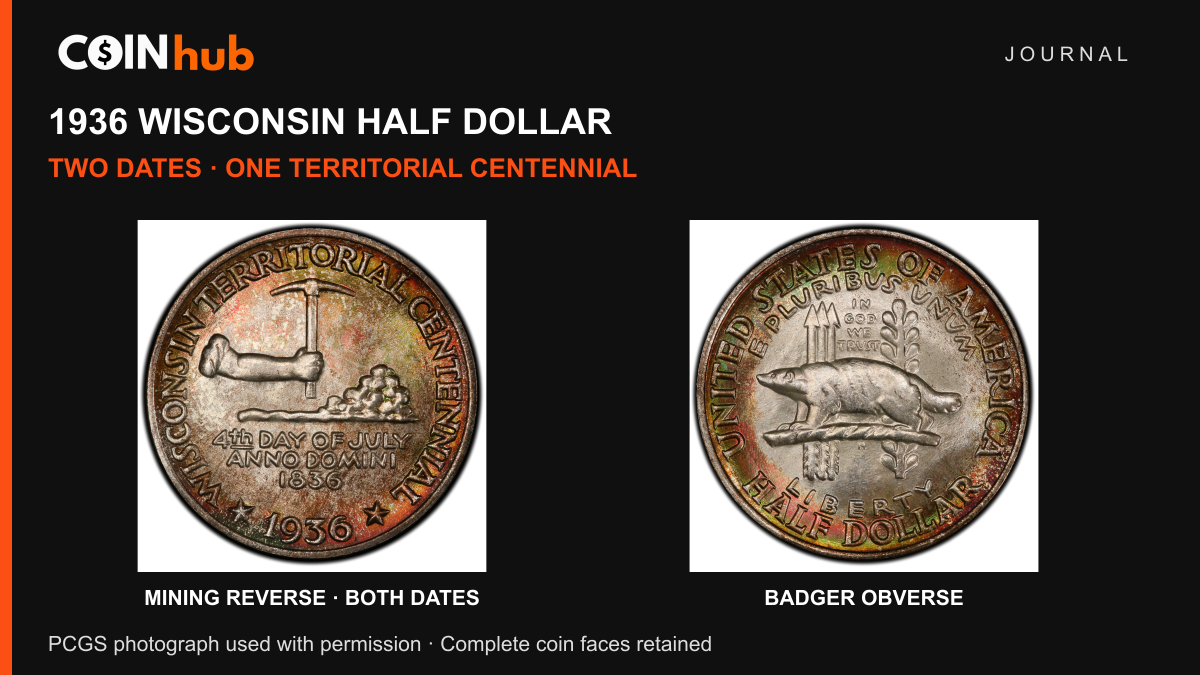
1936 is the issue year; 1836 is the anniversary reference
The 1936 Wisconsin half dollar marks 100 years of Wisconsin as a U.S. territory. Its mining side carries both 1936 and the longer inscription 4TH DAY OF JULY ANNO DOMINI 1836. The older date names the event. It is not the year this half dollar was issued.
The other side shows a badger on a log, with arrows and a branch behind it. These two designs identify the Wisconsin Territorial Centennial half dollar. It is a different coin from a regular Walking Liberty half dollar dated 1936.
Read the mining side from the rim inward
WISCONSIN TERRITORIAL CENTENNIAL runs around the design. Inside it, an arm grips a pick above a pile of ore. The issue year sits at the bottom between two stars. The separate 1836 inscription is higher, beneath the arm and ore.
The Mint's official record identifies the anniversary and both designs. The American Numismatic Association's account identifies the pile as lead ore and ties the July 4 date to the first territorial governor, Henry Dodge, taking office.
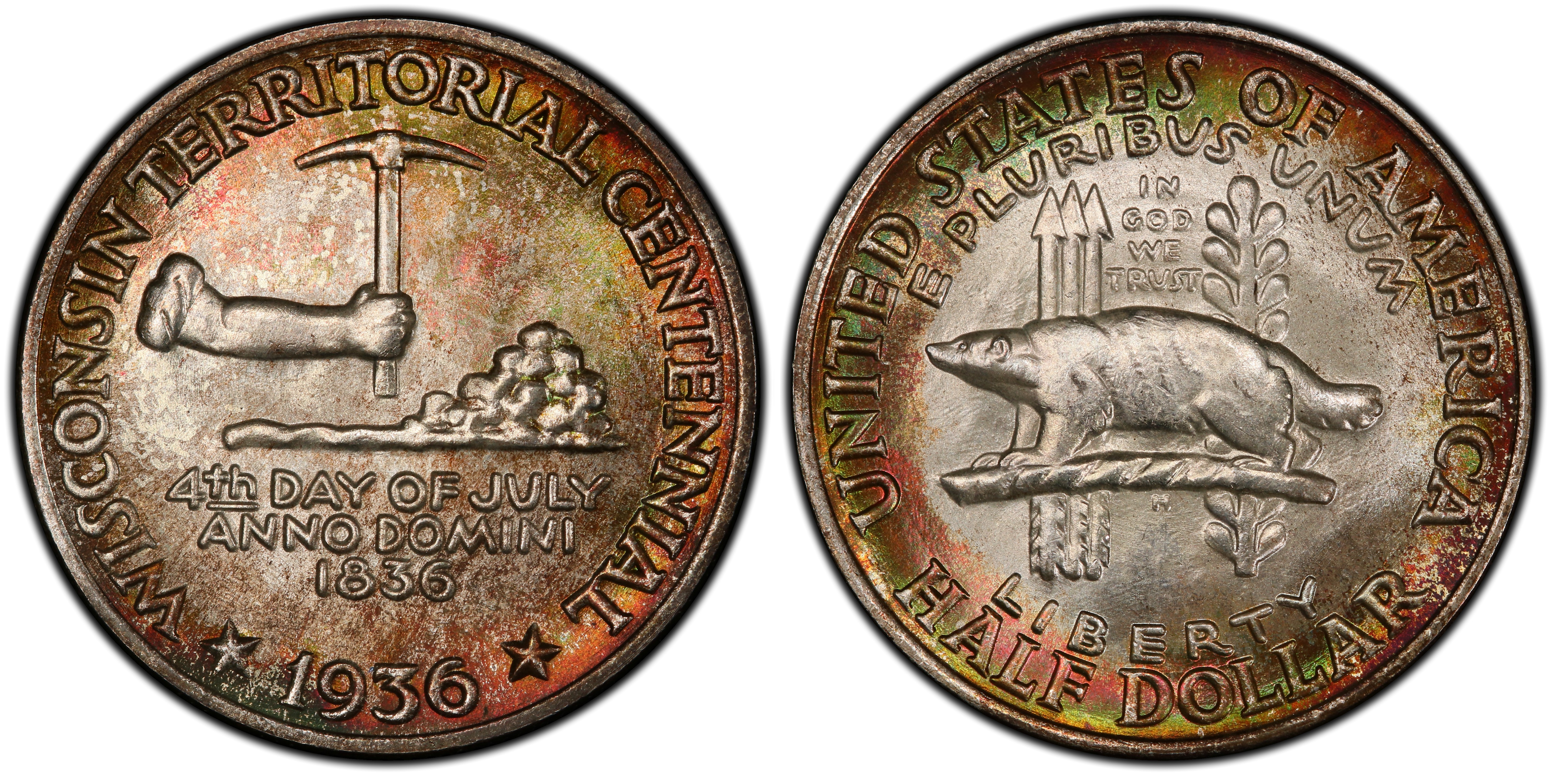
For a simple check, find 1936 first. Copy the longer date on a line of its own. Do not shorten your notes to “1836 half dollar.” Doing so loses the feature that places the coin in its actual series.
The badger side carries the denomination
The obverse, or front, is the badger side in the Mint's record. The reverse, or back, is the mining side. A coin's front does not need a portrait. The date can be on the back.
Follow the badger's body across the log. Three arrows stand behind it, with a leafy branch beside them. The ANA connects the arrows with the Black Hawk War and the olive branch with peace. These shapes are part of the design. They do not mean this coin was made during that war.
HALF DOLLAR appears below the animal. LIBERTY sits just above it, while the national inscriptions fill the border and upper field. Use those words and both faces to name the coin. A close-up of the badger leaves out half the clues.
A compact record for an unfamiliar example
| Record this | What to look for |
|---|---|
| Issue identity | Wisconsin Territorial Centennial, with the mining and badger designs. |
| Dates | 1936 at the bottom; the separate July 4, 1836 inscription above it. |
| Denomination | HALF DOLLAR on the badger side. |
| Unclear details | Note wear, glare, a holder edge or a mark that prevents a reliable reading. |
PCGS lists Philadelphia as the mint. It gives the standard weight as 12.50 grams and the diameter as 30.60 millimeters. The coin is 90% silver and 10% copper. A weight match alone cannot prove a piece real. It also cannot settle the grade, which describes condition.
Keep historical dates separate from condition and value
Both dates belong to the design. They do not mean the coin was struck twice, a century apart. Look-alike souvenirs and copies can repeat a familiar design too. When a piece is in doubt, clear photos of both sides and an examination by a qualified specialist matter more than a matching online title.
Leave the surface alone while you investigate. Do not scrub the ore, polish the badger or scrape a faint numeral. Changing the surface can hide marks and remove information about the coin's condition.
For a price check, use a sale of the same coin type and grade. Include the sale date and any surface defects. The price asked when the coin was new is a different kind of number. So is a seller's asking price today. This guide does not give a current value.
CoinHub's 1936 Bridgeport half-dollar guide offers another date comparison: its anniversary belongs to a city. Read the event named on each coin before deciding what its paired dates mean.
Official design record, ANA history, PCGS specifications and genuine photograph checked October 28, 2026. Photograph used with permission; both complete faces and their original details and color are retained. CoinHub added proportional framing and labels.