
A city founder on one face, the Great Lakes on the other
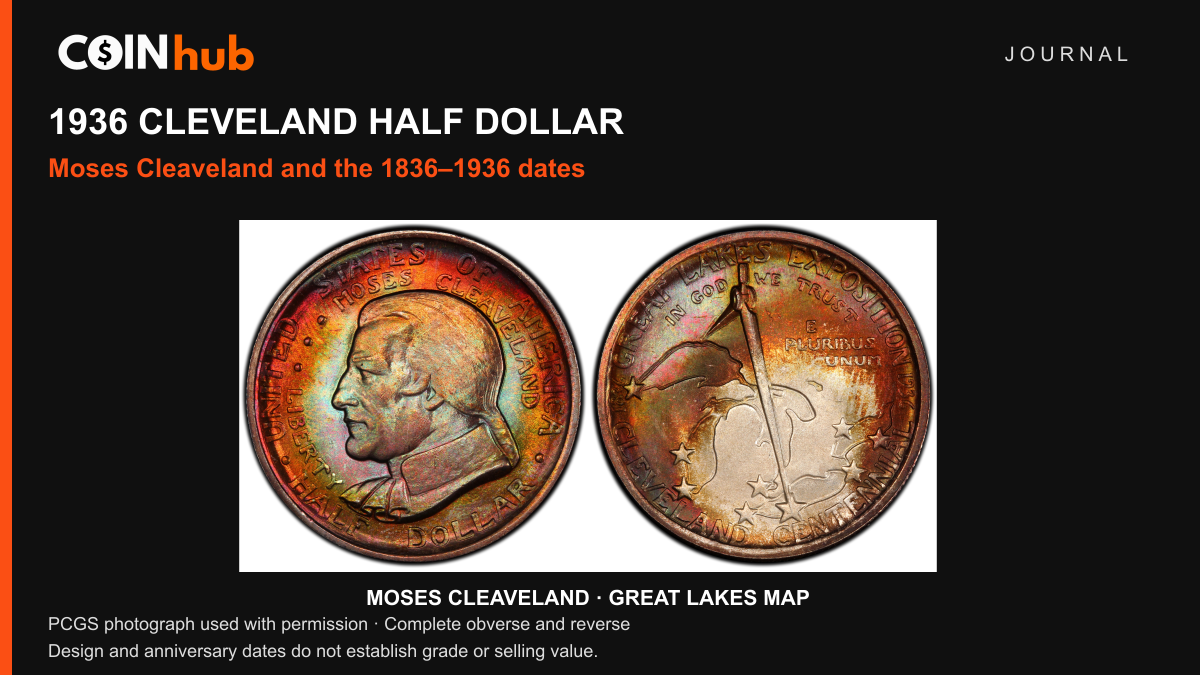
The 1936 Cleveland half dollar shows Moses Cleaveland on the front and a map of the Great Lakes on the back. A mapmaker's compass stretches across that map. The dates 1836 and 1936 mark 100 years since Cleveland became a city. They do not give the founder's lifespan.
The U.S. Mint's issue record identifies Brenda Putnam as the designer of both faces. The coin also honors the Great Lakes Exposition. Read the portrait name, map and rim inscriptions together to identify the issue.
Why the man and city have different spellings
Look above the portrait for MOSES CLEAVELAND. The man's surname includes an A after the first E. On the back, the city name appears as CLEVELAND. That difference belongs to the normal design.
The American Numismatic Association's account places the settlement's start in 1796 and the city's incorporation in 1836. Incorporation means becoming a legally organized city. The coin's centennial, or 100th anniversary, refers to that later milestone.
A useful reading order is name, event, then dates. A portrait does not always mean that the years elsewhere on a coin describe that person's life. CoinHub's Lynchburg half dollar guide offers another example: its 1786–1936 span marks a city anniversary too.
Read the compass and stars on the map
The back is called the reverse; the portrait side is the obverse. On this reverse, the compass is a drawing instrument with two long legs. It is not a compass rose with a needle that tells you which way is north.
Start with the shapes of the lakes, then follow the stars around them. The largest star marks Cleveland. The ANA identifies the other city stars as Duluth, Milwaukee, Chicago, Toledo, Detroit, Buffalo, Toronto and Rochester. The large tool and these smaller markers share the same scene.
The surrounding words give the scene its purpose: GREAT LAKES EXPOSITION and CLEVELAND CENTENNIAL. On a worn example, a few clear words may be more helpful than a weak portrait. Compare the entire layout with the genuine photograph, rather than naming the issue from one star or line.
All bear 1936, even when struck in 1937
There is a second date question that the design alone cannot settle. Some Cleveland halves were made in 1936 and the rest in 1937. All carry the 1936 date. Q. David Bowers's production account explains the second batch and states that the two groups look the same.
That makes “struck in 1937” a production-history fact, not a feature you can pick out in this photograph. A seller's date claim needs evidence beyond the normal 1936 design. Do not assign a coin to the later batch from its color, shine or an unfamiliar mark.
A short record for the coin in hand
| Record | Reference for this issue |
|---|---|
| Identity | 1936 Cleveland Centennial / Great Lakes Exposition half dollar |
| Mint | Philadelphia |
| Nominal weight and diameter | 12.50 grams; 30.60 millimeters |
| Metal | 90% silver and 10% copper |
Those specifications come from PCGS's Cleveland record. Nominal means the stated reference standard. A scale reading or ruler check can help you describe a coin, but matching those figures does not prove that it is genuine.
- Photograph both faces with the whole rim visible.
- Copy the name, event words and both anniversary dates.
- Record weight and size separately from the published standard.
- Keep any holder number and the source of the identification.
The image here shows one reference coin. Its surface color does not tell you the grade or worth of another example. For a purchase, check the actual coin, its condition and any certification record. The fifty-cent face value, silver content and collector price are separate pieces of information.
Primary references and photograph checked November 1, 2026. PCGS photograph used with permission. CoinHub added proportional framing and labels; both complete faces retain the original detail and color. No current price, grade or production-batch attribution is supplied.