
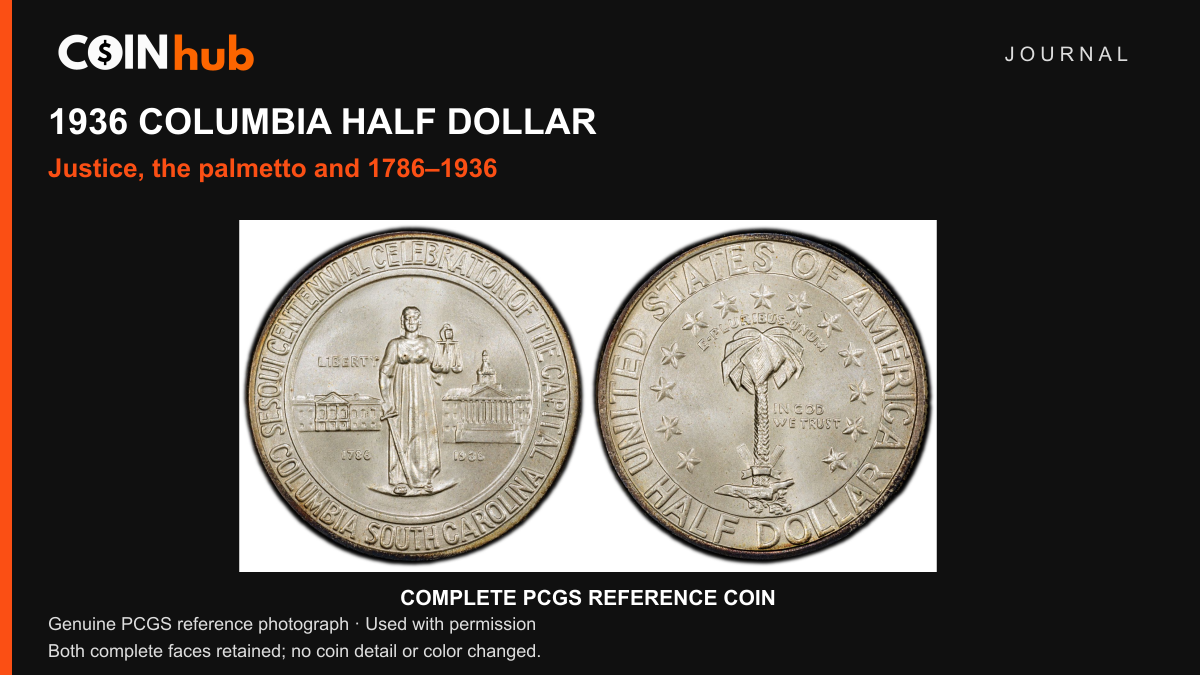
A standing figure of Justice, two buildings and a palmetto tree identify the 1936 Columbia, South Carolina, half dollar. The dates are 1786 and 1936, a span of 150 years. They mark Columbia’s founding as the state capital. The coin is a commemorative issue from 1936.
The U.S. Mint's issue record names the event. It credits artist Abraham W. Davidson. Coin guides also call him A. Wolfe Davidson. Both names refer to the designer of this issue.
Follow Justice to the two State Houses
The obverse, or front, shows Justice holding a sword and a set of scales. These are symbols of justice. A building stands on each side of her. They represent the old and then-current State Houses.
The American Numismatic Association describes the scene: the old State House is on the left, with 1786 beneath it. The later State House is on the right, above 1936. Justice stands between the two.
Read COLUMBIA SOUTH CAROLINA around the lower rim. The long upper inscription says SESQUICENTENNIAL CELEBRATION OF THE CAPITAL. Sesquicentennial means a 150th anniversary. That word links the two visible dates to the city named below.
The dates do not mean the coin was made in 1786. One date belongs to the history being honored; the other is the coin's issue year. Reading the buildings and wording together is more useful than subtracting years without context.
The palmetto side confirms South Carolina
The reverse, or back, shows a palmetto tree. A broken oak branch lies at its base. The ANA also identifies crossed arrows tied to the tree and 13 stars for the original states. Look at the complete scene before trying to name a tiny isolated shape.
UNITED STATES OF AMERICA surrounds the upper part of this face. HALF DOLLAR is below the tree. IN GOD WE TRUST appears to its right, while E PLURIBUS UNUM sits above it.
The palmetto, the South Carolina inscription and the two State Houses form a useful set of clues. A tree alone is not enough: many coins use trees. Keep a view of each whole face in your collection record, alongside any detail photographs.
Columbia is different from Columbian
The name on this coin is Columbia, the city in South Carolina. It is not the Columbian Exposition half dollar dated 1892 or 1893. That earlier issue has Columbus and a ship, rather than Justice and a palmetto.
Small differences in a listing title can send a search to the wrong coin. Read the full place name, both dates and the denomination. Denomination is the face value: here, half a dollar. It is not an estimate of the coin's current collector price.
The Connecticut half dollar's Charter Oak tells a separate state story. Both coins have trees, but they tell different stories. Their dates and designs are not the same.
Check the full issue before comparing examples
The Mint records Columbia halves from Philadelphia, Denver and San Francisco. Do not assume that every 1936 example is the Philadelphia issue shown here. Preserve any holder label and clear photographs when seeking a specific mint attribution.
PCGS lists the Philadelphia reference at a nominal 12.50 grams and 30.60 millimeters, with a reeded edge. Reeded means it has small ridges; nominal means a published reference measure. The metal is 90% silver and 10% copper.
These measures help describe the type. They cannot prove a coin is real. Wear, damage and tools affect readings. The open areas around Justice, the small buildings and the tree provide places to inspect marks and wear. A photograph cannot settle the grade of a different coin.
For buying or selling, compare the same mint issue and similar condition in completed sales. Avoid treating a top-grade auction record or a replica's asking price as the value of an unexamined example. Leave the surfaces as found. Ask an expert to check the coin if its grade or origin affects the decision.
U.S. Mint, ANA and PCGS references checked November 6, 2026. No current price, survival estimate or reader-coin grade is assigned. Genuine PCGS reference photograph used with permission; both complete faces and their original detail and color are retained within CoinHub's framing.