
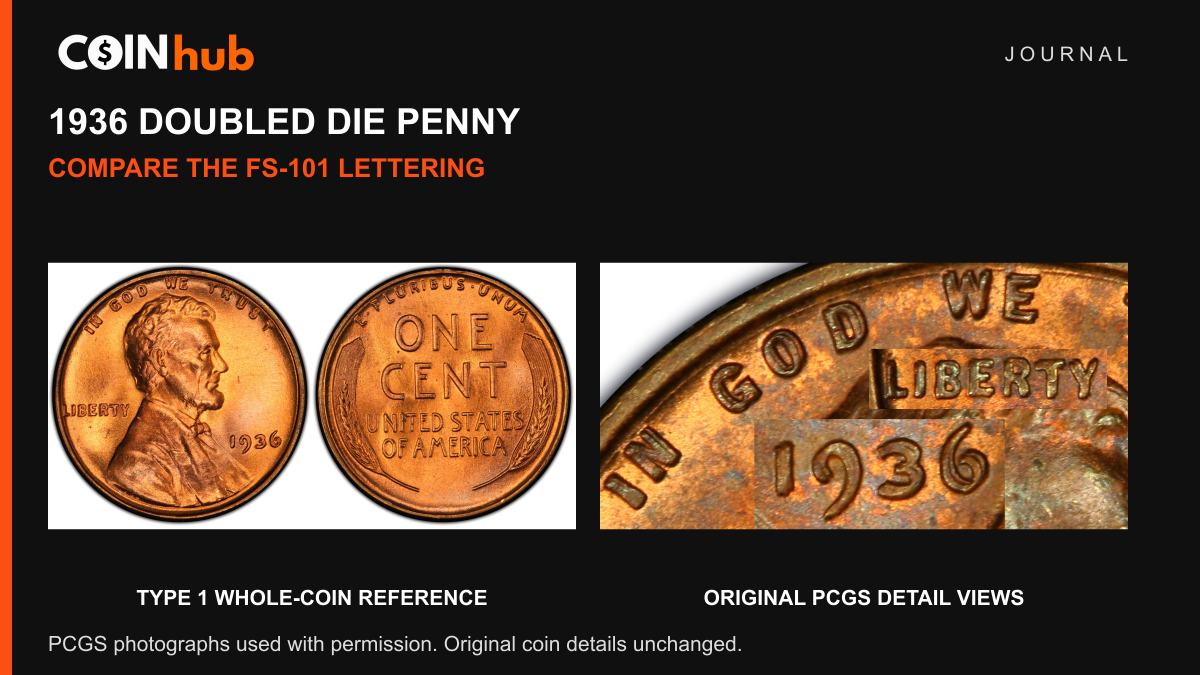
The 1936 doubled die penny known as Type 1 or FS-101 shows repeated detail in IN GOD WE TRUST, LIBERTY and the date. Start with that pattern across the front of the coin. One thick digit or a bright line in a photo does not prove a match.
This guide uses a real PCGS Type 1 coin and the detail views published with it. Use it to choose what needs a closer look. A possible match is not proof that a coin is real, or a claim about its price.
Confirm which 1936 penny you are checking
The obverse is the front, with Lincoln and the date. The reverse is the back, with two wheat heads around ONE CENT. The variety discussed here belongs to the Philadelphia issue, which has no mint letter below the date. A D or S identifies a different issue.
PCGS catalogs FS-101 as a regular-strike variety. A regular strike is made by the method used for coins meant for daily use. A Proof is made by a special process for collectors. Keep the full date, mint and variety together in your notes.
FS is part of a guide label, not a grade. Nor does FS-101 always mean this cent: the number appears under other dates and coin types. PCGS also lists other 1936 doubled-die types, so “1936 doubled die” is a starting description rather than a confirmed match.
Follow the lettering, then check the date
In its account of the 1936 Type 1 cent, PCGS identifies doubling in the motto, LIBERTY and 1936. Its closeup shows all three areas. Match the shape and place of each extra edge. Do more than ask whether a letter looks wide.
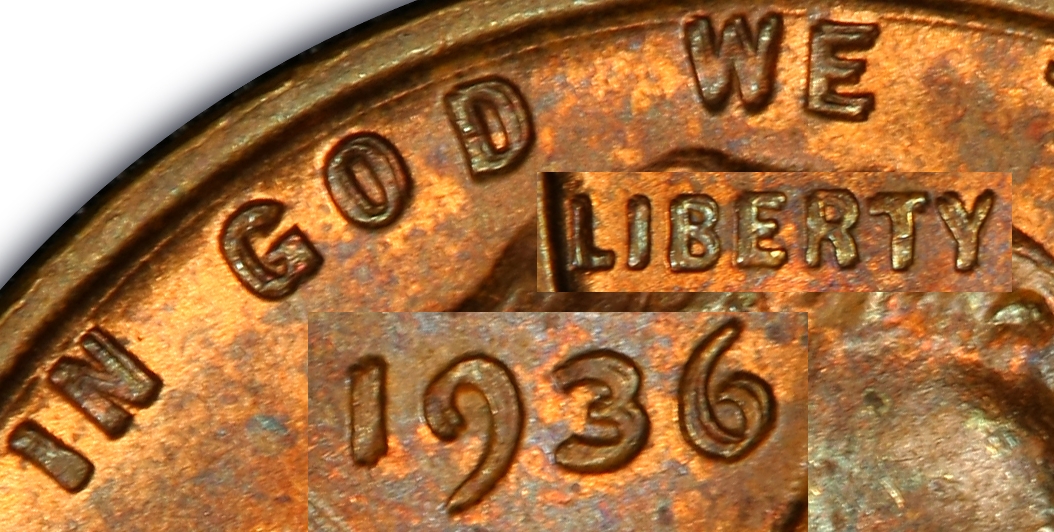
- Read the motto above Lincoln. Compare several letters in IN GOD WE TRUST. Look at their edges and corners, with the reference facing the same way as your coin.
- Move to LIBERTY. Check the repeated letter shapes to the left of Lincoln. A scratch through one letter does not establish the wider pattern.
- Finish at the date. Compare the numerals with the published detail. The date supports the lettering check; it should not replace it.
Keep a full-face photo beside the closeups. Without that context, a small detail can be mistaken for another date, another variety or even another denomination. If wear or an unclear image hides the needed features, record the result as uncertain.
Separate a doubled die from movement during the strike
A die is the steel tool that stamps the design into a coin. A doubled die has extra design detail before it strikes the coin. The same die makes that detail on each coin. It does not mean the cent went through the press twice.
NGC's comparison of die and machine doubling explains a common look-alike. Movement during striking can leave a low, flat shelf beside a design. This differs from the separated design detail seen on a genuine doubled die.
That distinction still needs care. NGC shows that die doubling and machine doubling can occur on the same coin. Do not reject or accept a candidate from one shiny edge. Check the full reference pattern, and use CoinHub's double strike and doubled die comparison when the terms become confusing.
Make the next inspection useful
Take photos of both sides under steady light, then take separate closeups of the motto, LIBERTY and date. Keep the original files. Strong sharpening can create bright outlines that make a weak photo harder to judge.
The CoinHub Variety Attribution Assistant can help you note the date, mint and feature you want to check. It cannot confirm a doubled die, assign an FS number or prove a coin is real. Use known references or an expert to check a possible match.
Do not clean, scrape or polish a candidate. If it is in a graded holder, leave it sealed. Check the service's record against the actual coin. Confirm the variety and grade before you compare past sales. An asking price or a sale of a much finer coin does not set the price of your cent.
For more reading, CoinHub founder Blake Alma's The CoinHub: An Ultimate Guide to Coin Errors is a book by CoinHub's own author. It is an optional next read. First, match your coin to the right photos.
Source and photo notes: PCGS's January 17, 2023 article, current CoinFacts entry 37750 and NGC's doubling comparison were checked October 20, 2026. Old prices and counts of known coins are not current figures. The total number of 1936 cents made is not a count of FS-101 coins. PCGS whole-coin and detail photos are used with CoinHub's saved permission. CoinHub added labels and resized the photos without changing the coin detail.