
Ask what repeated before naming the doubling
If a seller calls a coin “double stamped,” treat that as the start of a question. It does not establish a particular error, a recognized variety or a price. Look at the entire coin and ask whether the evidence points to a second impression, a repeated die feature or movement affecting the relief.
Read the real double-strike example
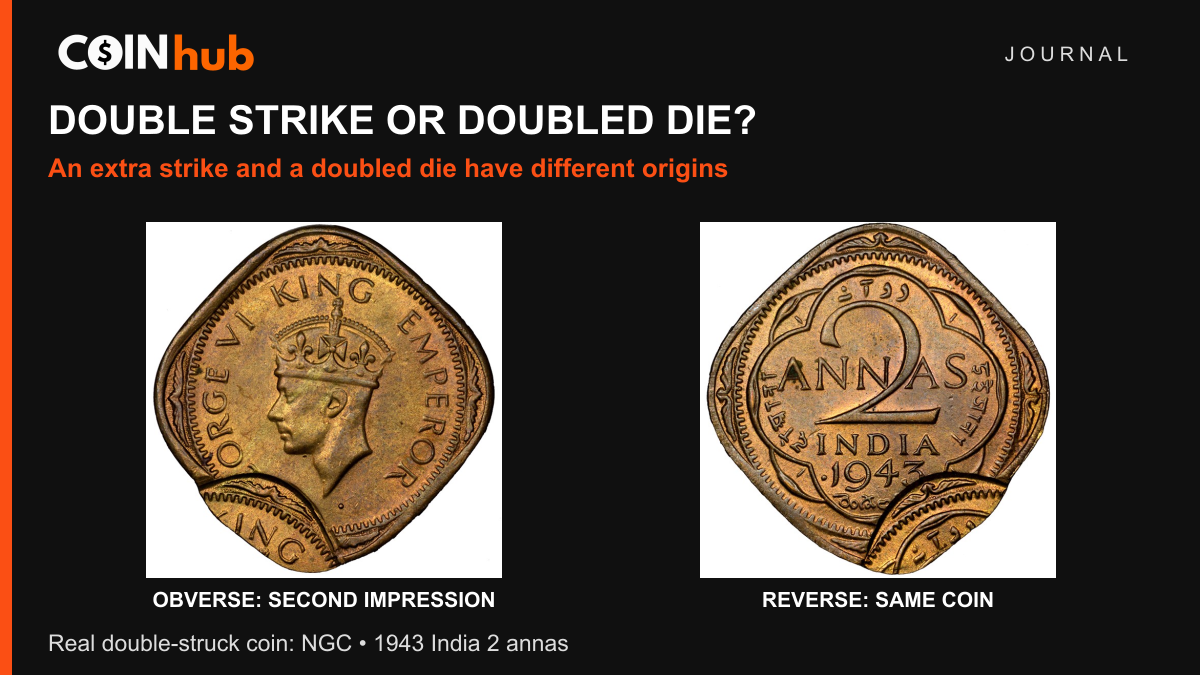
The photographs above show both faces of one 1943 India two-annas coin. NGC’s mint-error article identifies it as double struck, with its second strike 75% off-center. At the lower portion, a second segment of design overlaps the earlier impression. This is evidence from a documented specimen, not a suggested attribution for every coin with doubled lettering.
The example also demonstrates why both faces help. A tight crop of one repeated letter loses the surrounding rim, orientation and relationship between impressions. Save the whole-coin views even if you also make detail photographs. The second strike on another coin may sit in a different position or overlap more closely, so this photograph is an illustration rather than a universal visual template.
Three causes, three different questions
| Term | Where the duplication originates | Useful question |
|---|---|---|
| Double strike | The coin is struck again | Can the visible features be explained by an additional impression? |
| Doubled die | The die’s design contains duplicated detail | Does the pattern match a documented variety and its markers? |
| Machine doubling | Movement associated with striking affects the design’s appearance | Is the secondary feature a flat shelf or displaced relief rather than the expected variety detail? |
NGC explains that an ejection failure can leave a coin in position to receive additional strikes. The important idea is a repeated manufacturing event affecting that coin. A doubled die instead carries its distinguishing detail into coins made from that die. NGC’s variety explanation is useful for understanding why collectors compare matching die characteristics across specimens.
Why machine doubling causes confusion
NGC’s doubling comparison describes the flat, shelf-like secondary areas often associated with mechanical movement. Those areas can resemble extra lettering at first glance. A true doubled die originates in die production; it is not created simply because a coin was struck twice.
Do not convert that distinction into a one-photo rule such as “every notch proves a doubled die” or “any flat area rules one out.” Small varieties can be subtle, lighting can conceal relief, and a coin may have more than one feature. Match the relevant date, denomination, side, location and documented diagnostics together. If the available image cannot show those details, the attribution should remain open.
A practical inspection sequence
- Identify the ordinary coin. Record denomination, date and mintmark before looking for a special name.
- Photograph both complete faces. Keep the coin’s outline and the orientation visible.
- Describe the feature plainly. For example, record a second rim segment or a shelf beside particular letters without assigning a cause yet.
- Compare an appropriate reference. A famous doubled die from another date is not a match.
- Keep evidence and conclusion separate. Note what is visible, which reference you used and what remains uncertain.
Changing the direction of ordinary lighting can help show whether a feature is raised, recessed or simply a reflection. Preserve the original photographs and avoid sharpening an image until artifacts look like coin detail. Cleaning or scraping the surface will not make an attribution more trustworthy and can remove useful evidence.
Two related errors that need separate names
A second strike may be off-center, as in the illustrated example, but an off-center strike does not automatically mean the coin was struck twice. One displaced strike is still one strike. The number of impressions and their location answer different questions.
A double-denomination error involves designs of different denominations on the same piece. A repeated strike from the same denomination is not sufficient for that label. Keeping these distinctions in the description helps a specialist understand what you actually see.
What to do before assigning a premium
There is no universal double-struck price. An attribution must come first, followed by comparisons with genuinely similar authenticated pieces. The underlying issue, visibility and nature of the error, condition and market interest can all change the comparison. A dramatic photograph of a different coin does not establish your coin’s value.
For a potentially significant piece, retain its purchase information and request an informed examination before offering it under a specific error or variety name. A description such as “possible extra impression; attribution unconfirmed” tells the next person more than a confident but unsupported label.
Primary references and current search results reviewed September 20, 2026. The hero shows one documented NGC extra-strike example. This guide does not authenticate a reader’s coin or promise a grading result.