
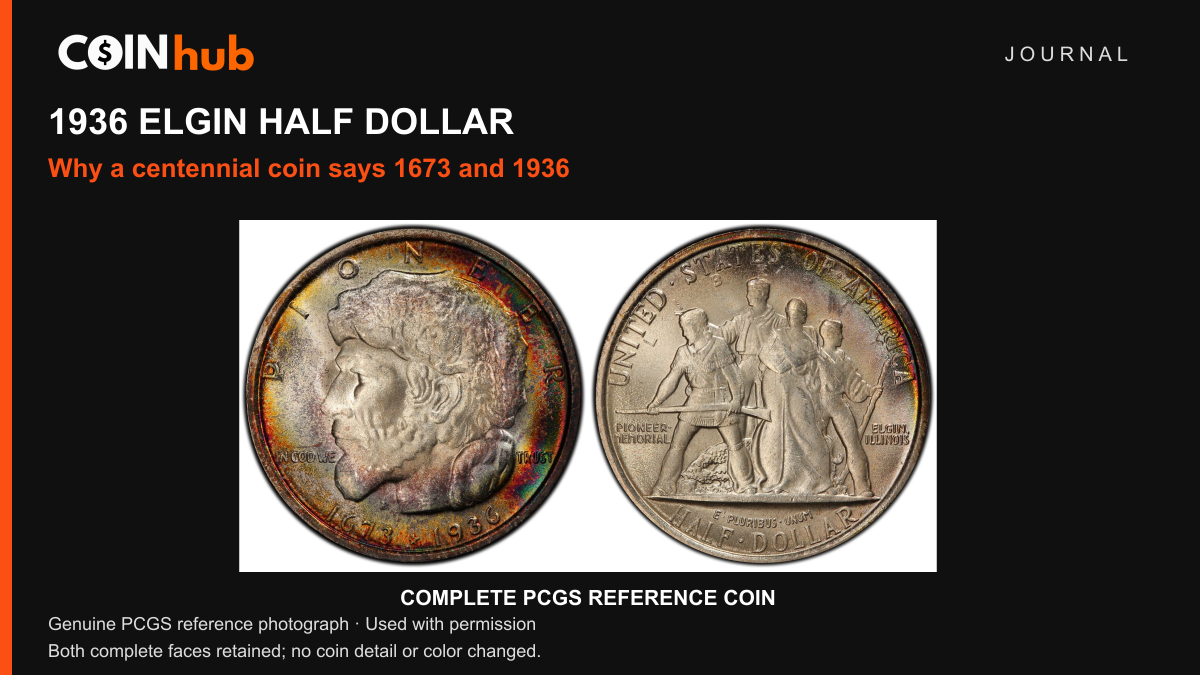
The 1936 Elgin half dollar shows 1673 and 1936, even though it marks a city's hundredth anniversary. The first date refers to French exploration of the region. The second is the coin's issue year. They are not the two ends of Elgin's centennial.
Identify the coin by its bearded pioneer on the front and pioneer family on the back. The U.S. Mint's issue record names Elgin, Illinois. Trygve A. Rovelstad designed both faces. HALF DOLLAR gives the denomination, or face value.
Three dates explain the centennial
Start with the two years below the portrait. The American Numismatic Association explains 1673 as the year explorers Joliet and Marquette entered the general region. It is not the year Elgin was founded.
Elgin was founded in 1835. Its hundredth year was 1935, but the coin came a year later. Q. David Bowers's history of the issue records that delay. Congress authorized the coin in 1936.
| Year | What it refers to |
|---|---|
| 1673 | Regional exploration; shown on the coin |
| 1835 | Elgin's founding; explains the centennial |
| 1936 | The authorized coin's issue and production year |
Subtract the visible dates and you get 263 years. The math is a clue to ask what each date means. It does not reveal a date error. Keep the wording from both sides in your notes.
Read the portrait and the family together
The obverse, or front, shows a pioneer wearing a fur cap. PIONEER is spaced around the upper rim. IN GOD WE TRUST is split by the portrait, and a star separates the years below it. The small designer's initials appear beneath the beard.
The reverse, or back, shows four adults, with an infant held by one of them. A rifle crosses the lower part of the group. PIONEER MEMORIAL appears at the left and ELGIN, ILLINOIS at the right. Those words tie the scene to the project the coin helped fund.
Count the figures with care. The Mint describes four pioneer figures. The ANA also mentions the baby. Both sources describe the same group. The full scene is shown in the main photo, with the infant and small words still in place.
The coin helped fund a monument
The coin helped fund the Pioneer Memorial. It also marked the city's anniversary. A commemorative is a coin made to honor a person, place or event. The family scene shows Rovelstad's plan for the monument.
The ANA dates the bronze memorial's dedication to 2001. An older book says the statue had not yet been built. That was true when the book was written. Keep the later dedication date separate from the coin's date.
Other local commemoratives use dates in different ways. The 1936 Cleveland half dollar uses a Great Lakes map and a different city anniversary. The shared year does not give the two coins the same subject or date story.
Specifications describe the type, not its condition
PCGS lists Philadelphia production, a reeded edge, 12.50-gram nominal weight and 30.60-millimeter diameter. The metal is 90% silver and 10% copper. Reeded means the edge has small ridges; nominal means a published reference measurement.
The figures help describe a coin. A match alone does not prove it is genuine. Wear, damage and the tools you use can affect readings. Save clear views of both faces and the edge, plus any holder number to check with its grading service.
Inspect the pioneer's cheek, the open areas and the small family figures in person when possible. One colorful photograph cannot settle surface condition or grade. Keep the coin as found. For a price check, use completed sales of the same issue in similar condition.
U.S. Mint, ANA and PCGS references checked November 5, 2026. No current price, survival total or grade is assigned. Genuine PCGS photograph used with permission; CoinHub added proportional framing and labels while preserving both complete faces and their original detail and color.