
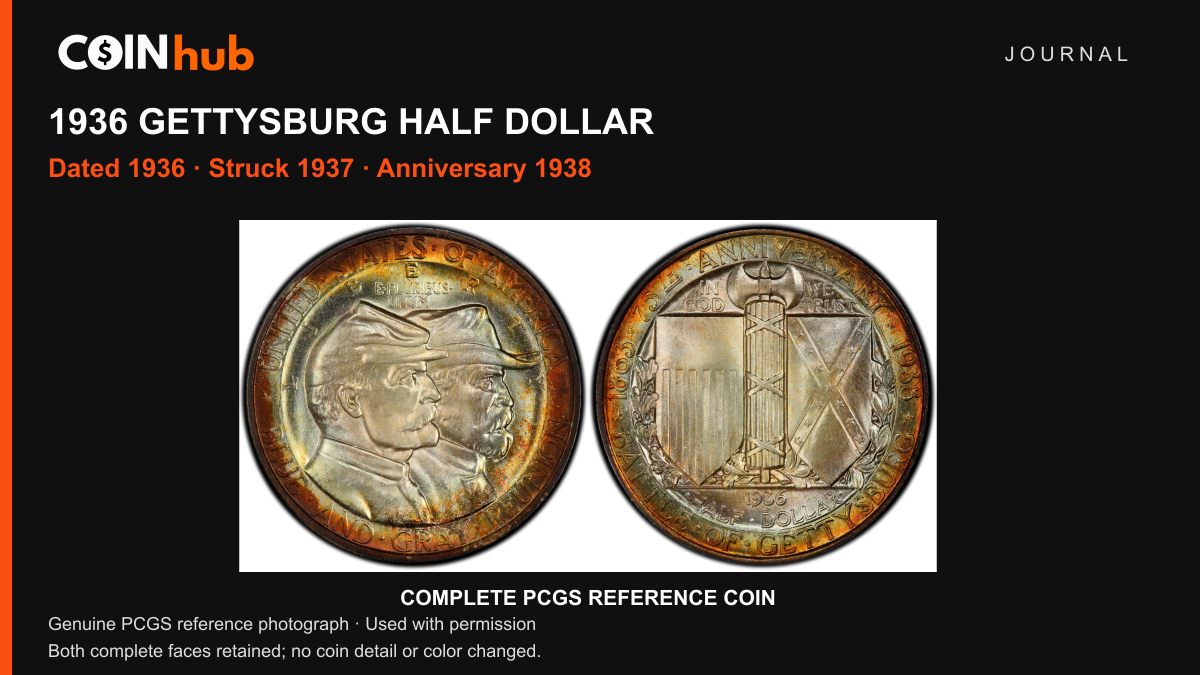
The 1936 Gettysburg half dollar has two soldiers on the front and two shields on the back. Its dates tell different parts of the story: 1863 is the battle year, 1936 is the required coin date, and 1938 is the 75th anniversary. The coins were actually struck in 1937.
That timeline is easy to miss...especially when a listing calls it simply a 1936 half dollar. Read the complete design before sorting it by date alone. This is a classic silver commemorative, a coin made to mark an event.
Start with the soldiers and BLUE AND GRAY REUNION
The obverse, or front, shows two uniformed soldiers facing right. The Mint identifies them as Union and Confederate soldiers. Around the lower rim, BLUE AND GRAY REUNION names the reunion theme. UNITED STATES OF AMERICA appears above them.
The complete PCGS reference photograph preserves both faces. Use the soldiers' profiles and the surrounding words together when identifying the design. The Gettysburg name alone can lead to a different coin: the modern Gettysburg Address quarter belongs to another denomination and program.
The official design and inscription reference is Battle of Gettysburg Half Dollar (https://www.usmint.gov/learn/coins-and-medals/commemorative-coins/battle-of-gettysburg-half).
The shields lead you to the anniversary dates
On the reverse, or back, two shields flank a fasces. A fasces is a bundle of rods bound around an axe. The bundle rises between the shields. Branches frame the sides, and HALF DOLLAR gives the coin's face value below.
Follow the outer inscription from 1863 through 75TH ANNIVERSARY to 1938. Subtract 1863 from 1938 and you get 75 years. The separate 1936 sits near the bottom, above HALF DOLLAR. Those numbers do not claim that the battle happened in 1936.
Frank Vittor designed both sides. The Mint's design archive and the American Numismatic Association's 1936 Battle of Gettysburg Half Dollar guide identify his work. The ANA guide also connects the coin with the 1938 Blue and Gray Reunion (https://www.money.org/1936-battle-of-gettysburg-half-dollar/).
Why 1936, 1937 and 1938 all belong in the record
The law approved on June 16, 1936 required these coins to carry the date 1936 regardless of when they were minted or issued. The original text appears in the United States Statutes at Large, volume 49, page 1524 (https://www.govinfo.gov/content/pkg/STATUTE-49/pdf/STATUTE-49-Pg1524-2.pdf).
| Year | What it means here |
|---|---|
| 1863 | The Battle of Gettysburg; shown in the anniversary inscription. |
| 1936 | The legally required date on the coin. |
| 1937 | The actual striking year; it is not a separate date shown on this design. |
| 1938 | The 75th anniversary and reunion year; shown beside the anniversary wording. |
The ANA and Q. David Bowers both give the 1937 striking year. Bowers separates the coin's date from its production year in Commemorative Coins of the United States, Chapter 8, page 126 (https://www.pcgs.com/books/commemoratives/Chapter08/126). The date mismatch is part of the issue's history, not evidence by itself of an altered date.
Keep a complete identification note
A useful note reads: Gettysburg commemorative half dollar, dated 1936, struck 1937, for the 1938 anniversary. Save clear photographs of both sides. Include the soldiers, shields, date and denomination rather than keeping only a tight crop of one year.
PCGS lists the issue as a Philadelphia product in 90% silver and 10% copper. Its CoinFacts entry is 1936 50C Gettysburg (Regular Strike) (https://www.pcgs.com/coinfacts/coin/1936-50c-gettysburg/9305). Identifying the design does not settle a particular coin's authenticity, grade or price.
If you are comparing other classic commemoratives, the Delaware half dollar's date guide offers another example of why an anniversary date needs context. Keep each issue's own timeline separate.
Source and photograph notes
The Mint archive labels the Gettysburg issue 1936 and describes a 1936 release. For the actual striking year, this guide follows the ANA and Bowers chronology alongside the original law's explicit date rule. The genuine PCGS reference photo is used with permission. Both complete faces retain their original detail and color.