
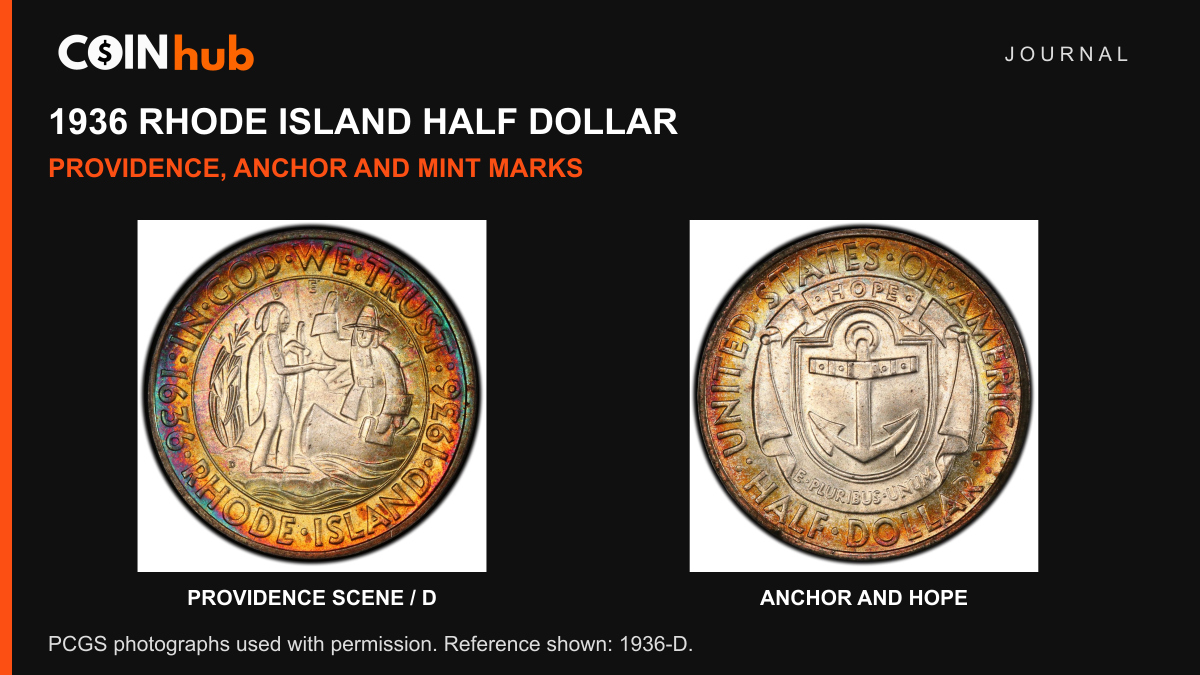
The 1936 Rhode Island half dollar marks the 300th anniversary of the founding of Providence. One side shows Roger Williams in a canoe meeting a Native American figure; the other shows an anchor and HOPE. Philadelphia, Denver and San Francisco made the coins, so this issue is not always without a mint mark.
The paired dates, 1636 and 1936, explain the anniversary. They are not an overdate. Read the scene and the mint mark together before choosing a catalog entry.
Find the small letter below the corn
On the scene side, look near the lower left, beneath the corn stalk and to the left of the standing figure. The genuine reference coin above has a small D there. That identifies the Denver issue. The date 1936 curves along the opposite edge.
| Mint | Mark to look for | Catalog identity |
|---|---|---|
| Philadelphia | No mint mark | 1936 Rhode Island |
| Denver | D | 1936-D Rhode Island |
| San Francisco | S | 1936-S Rhode Island |
The U.S. Mint's history page lists all three mints. The PCGS Denver catalog entry identifies the pictured issue. Check an actual clear mark rather than treating a seller's title or a search summary as the answer.
Providence is the subject, even without its name
The American Numismatic Association's account explains that the coin honors Providence's founding and helped fund a memorial to Roger Williams. It also points out an easy detail to miss: the word Providence does not appear on the coin.
In the photo, Williams kneels in the canoe with one hand raised. A standing figure reaches toward him from shore. The ANA identifies that figure as Narragansett. These are elements of the coin's commemorative scene; the design is not a photograph of the 1636 meeting.
Trace the border to find RHODE ISLAND between the two dates. Then find LIBERTY above the figures and IN GOD WE TRUST around the upper rim. The small D below the corn is a mint mark, not part of the anniversary inscription.
Read the anchor side
The reverse, or back, draws on Rhode Island's state seal. Its center has an anchor within a shield, with HOPE on a ribbon above. UNITED STATES OF AMERICA circles the upper edge; HALF DOLLAR identifies the denomination below.
The two sides serve different parts of the story. The meeting scene points to the city anniversary. The anchor and motto supply state symbols. You do not need to decide which face looks more familiar before recording what is actually there.
John Howard Benson and Arthur Graham Carey designed both faces. The Mint credits both artists, while the ANA describes the scene and seal in more detail. Neither a familiar state name nor an anchor makes this a modern state quarter.
Why two mintage totals can differ
The ANA gives 50,000 pieces made for public sale: 20,000 from Philadelphia and 15,000 each from Denver and San Francisco. Q. David Bowers' issue summary also records small additional quantities for assay, or official testing.
With those pieces included, Bowers lists 20,013, 15,010 and 15,011 respectively. Those three figures total 50,034. Before comparing two catalogs, check whether each count includes the assay pieces. Neither count tells you how many coins survive today.
Identify first, then compare condition
The PCGS Denver entry lists a normal weight of 12.50 grams, a reeded edge and a composition of 90% silver and 10% copper. Reeded means the edge has a row of grooves. Those specifications help identify the type; a matching scale reading does not prove a coin genuine.
For your records, save both full-face photographs, the mint mark and any holder's complete label. Note marks, wear or other surface issues separately. The bright colors in our reference photo belong to that photographed specimen, not to every example of the issue.
Keep a date-and-mint match separate from a price comparison. A high-grade auction coin and a worn, cleaned or uncertain example are different cases. This guide supplies no current price range. Our Oregon Trail date-and-mint guide shows another classic commemorative series where both details matter.
Sources and photograph credit
Research: the Mint, ANA and PCGS sources linked above, checked October 22, 2026. Photograph: PCGS CoinFacts 9364, which labels the source specimen MS68+; used with CoinHub's documented permission. Complete coin faces are proportionally framed with original details and colors retained. No grade is assigned here to another coin.