
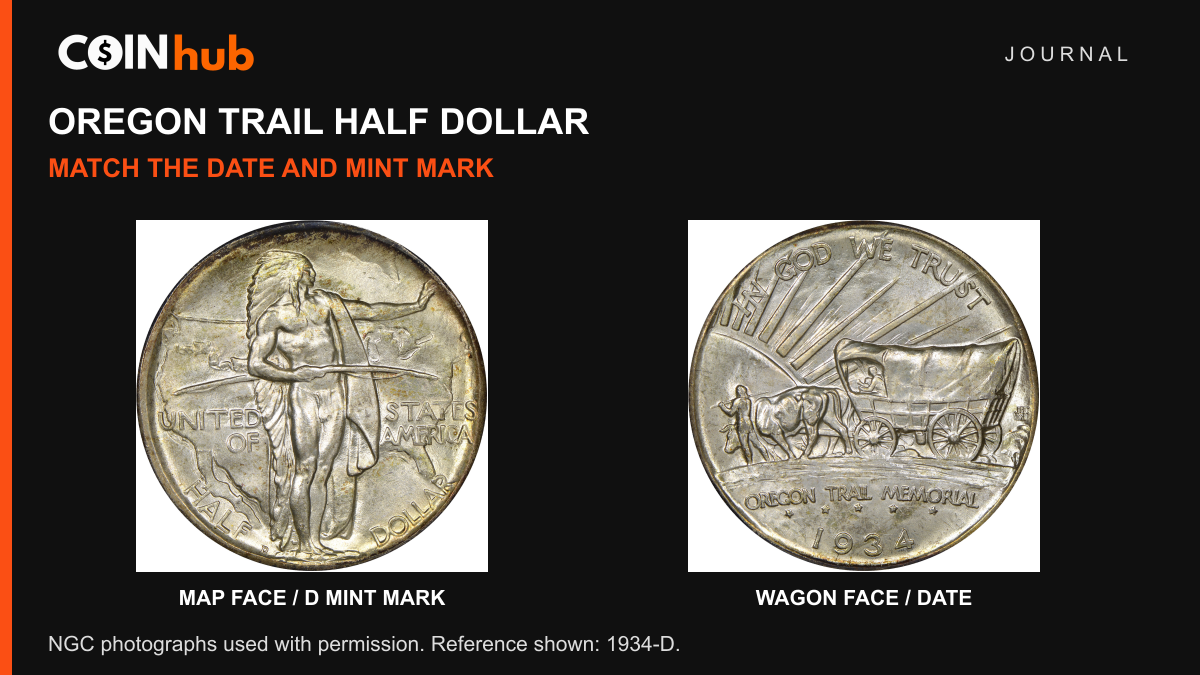
The same design spans several dates and mints
Oregon Trail half dollars were made in some years from 1926 through 1939. The run has 14 date-and-mint pairs, spread over eight dates. You will not find a coin for every year in that span. Read the date and mint mark to name the exact issue.
This helps when you sort coins. Two pieces with the same design can come from different mints. Two coins dated 1938 can differ by mint too. Check both details before you compare a guide entry or a sale.
Read the wagon face and the map face
The wagon face shows an ox-drawn wagon moving toward a low sun. IN GOD WE TRUST arcs above the scene. The words OREGON TRAIL MEMORIAL and the date sit below it. On the other face, a standing Native American holds a bow and raises one hand in front of a map.
The U.S. Mint's history of the coin describes the two scenes. The coin honors people who traveled west along the trail in the mid-1800s. James Earle Fraser and Laura Gardin Fraser created the design together. Its small map reflects that theme, rather than telling the whole history of the West.
Sources use different front-and-back labels for this type. Calling them the wagon face and map face avoids confusion when comparing photos. In the 1934-D reference above, the D appears at the bottom of the map face, to the left of the standing figure's feet.
Use the date and mint mark as a pair
PCGS's series history identifies the following issues. Philadelphia coins have no mint mark; D identifies Denver and S identifies San Francisco. “No mint mark” is a description, so do not search for a literal P on those Philadelphia coins.
| Date | Issued mint marks | Combinations |
|---|---|---|
| 1926 | None; S | 2 |
| 1928 | None | 1 |
| 1933 | D | 1 |
| 1934 | D | 1 |
| 1936 | None; S | 2 |
| 1937 | D | 1 |
| 1938 | None; D; S | 3 |
| 1939 | None; D; S | 3 |
The table totals 14 issues across eight dated years. It does not call for a coin from each year between 1926 and 1939. Do not buy an unexplained “1935 Oregon Trail” piece just to fill the gap. Check an odd date against the known series first.
For example, a 1938 coin with a D and one with an S fill two different spots in a full set. Both share the wagon design and the same date. Write “1938-D” or “1938-S” in your notes, rather than just “Oregon half dollar.”
Separate the date on a coin from its sale history
A coin's date need not tell you when a collector bought it. The program had unsold stock, later sales and coins melted after striking. NGC's series account describes 1928-dated coins held before their later release. Treat that as a distribution-history question, rather than evidence of a changed date on your coin.
The legal limit, the number struck and the number sold are also different totals. Some coins were never sold or were melted. Check what a number counts before you use it to call a coin scarce. Mintage means the number made; it does not tell you how many remain in one grade.
Build a useful record for one coin
- Record the full date and the observed mint mark, including an unreadable result.
- Photograph both complete faces, then the mint-mark area in closer detail.
- Note wear, surface marks, toning and any certification label separately.
- Match that exact issue before comparing a dated completed sale.
A photo can help identify the type and likely mint mark. It cannot establish authenticity, grade or a present selling price by itself. If a mark is faint, try a clear view under different light without polishing the coin. Do not promote a possible letter into a certain mint attribution.
You can collect one example to represent the design or pursue the different issues. Those are different collecting goals; neither requires assuming that every date has the same value. For another commemorative with a date question, see CoinHub's 1892 and 1893 Columbian half-dollar comparison.
Mint history, issue sequence and photographs checked October 22, 2026. NGC photographs of a 1934-D reference used with permission; complete coin faces and original details retained. No current price, survival count or authentication claim is made.