
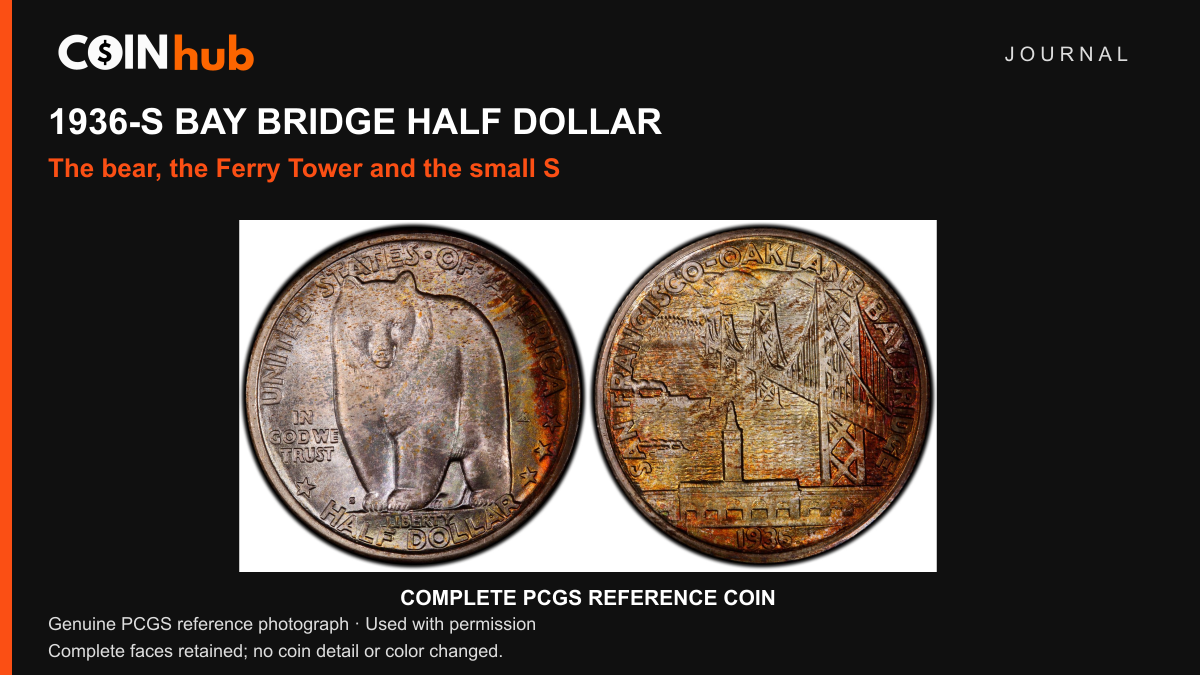
A grizzly bear on one face and a long bridge on the other identify the 1936-S San Francisco-Oakland Bay Bridge half dollar. The building in front of the bridge is the Ferry Tower. Read the full bridge name around the edge: this coin honors the Bay Bridge, not the Golden Gate Bridge.
The U.S. Mint's issue record ties the coin to the bridge's opening in 1936. A commemorative marks a person, place or event. This one is a United States half dollar, although its design differs from the Walking Liberty halves made for everyday use that year.
Begin with the bear and the small S
The bear side is the obverse, or front. The animal is a symbol of California. In the genuine reference photograph, look below and to the left of its paws for a small S. That is the San Francisco mint mark; it is separate from the large national inscriptions and HALF DOLLAR.
The date is on the other face. Photograph both sides together so the mint mark and 1936 stay tied to the same coin. A crop of the bear alone leaves out much of the information needed to name the issue.
Both designs are by sculptor Jacques Schnier. PCGS's design history describes his study of bears in local zoos. It also identifies the foreground building as a clue to the view from San Francisco. The artist used an animal and a city scene to tell two parts of California's story.
Follow the scene from the Ferry Tower into the bay
The reverse, or back, places the Ferry Tower in the foreground. Bridge towers and cables carry the eye toward Yerba Buena Island and the East Bay hills. The Mint names those distant features in its description. SAN FRANCISCO-OAKLAND BAY BRIDGE surrounds the scene, with 1936 along the bottom.
These words are useful when a worn coin or a small seller photo makes the structure hard to recognize. Match the inscription, tower and date as a group. A California location by itself is not enough to turn any bridge image into the Golden Gate Bridge.
Keep it separate from the 1936 Bridgeport half dollar, too. That issue honors a Connecticut city and shows P.T. Barnum and an eagle. Similar names and a shared year do not make the two coins related designs.
Made for a bridge opening, with some sold at the bridge
The bridge opened in November 1936. The coin was made for that occasion, rather than a centennial or a portrait anniversary. Its single date needs no second year to explain the event.
PCGS's coin record describes sales through drive-up booths at the bridge. That is a striking part of its distribution history: a motorist could buy a souvenir coin at the place it celebrated. It does not prove that any particular surviving coin was bought at a booth.
The same record gives 100,055 coins struck and 28,631 unsold pieces melted in 1937. The resulting distributed total was 71,424. Those numbers describe production and distribution, not how many exist today or how many remain in a particular grade.
Use specifications to describe, then check the actual coin
PCGS lists a nominal weight of 12.50 grams and diameter of 30.60 millimeters. The metal is 90% silver and 10% copper, and the edge is reeded, with small ridges. Nominal means the published reference figure. Wear, damage and measuring tools can affect a reading.
Matching those numbers does not authenticate a coin. Save clear views of both faces and the edge, plus any holder number. If it has been graded, compare the actual coin and label with the service's record. Do not remove it from a certified holder just to measure it.
The CoinHub Coin Passport can keep your identification notes and local photographs with a record of the coin. A saved description is still your research record, rather than an authentication or a grade.
The bear's broad body and the open sky around the bridge leave room for marks and reflections to stand out. Their appearance in one photo cannot settle grade or surface condition. Keep the coin as found; polishing to make it shine can alter the surfaces a collector needs to inspect.
The reference here is one photographed coin, not a promise of another example's color, grade or worth. Fifty cents is its face value. Silver content and a collector's price are different questions. For a purchase, compare the same issue and similar condition in completed sales rather than using a high-grade asking price as an appraisal.
U.S. Mint and PCGS primary references and genuine photograph checked November 4, 2026. No current price, survival estimate or grade is assigned. PCGS photograph used with permission; CoinHub added proportional framing and labels while retaining both complete faces and their original detail and color.