
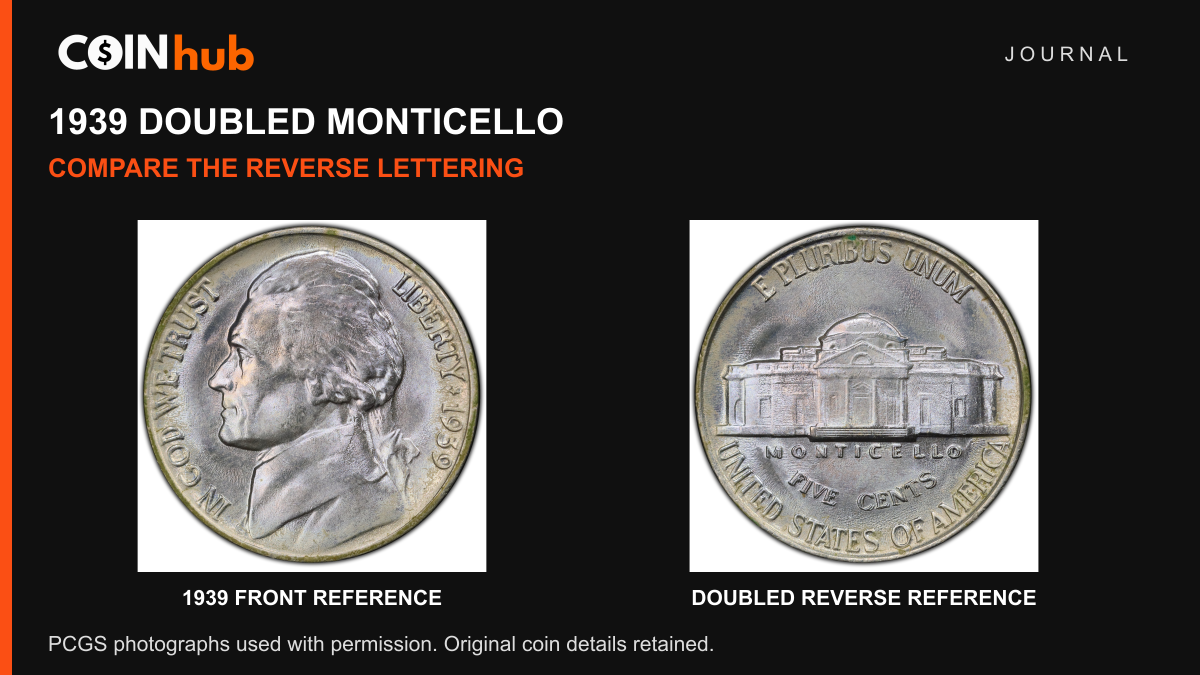
Where to look on a 1939 Doubled Monticello nickel
Start with MONTICELLO and FIVE CENTS on the back. The 1939 Doubled Monticello nickel is a doubled-die reverse variety: extra design detail was already in the die that struck the coin. Compare the lettering with a clear reference before calling a thick edge FS-801.
This Philadelphia issue has a separate place in PCGS's FS-801 catalog. The similar names Reverse of 1940 and Full Steps describe other features. Neither name, by itself, establishes this doubled die.
Read the two lines beneath the building
Find Monticello, the building on the reverse, or back. MONTICELLO runs just below its base; FIVE CENTS sits farther down. Keep the coin upright and compare one letter at a time. Look for a repeated outline that follows the letter's shape, rather than treating every bright border as doubling.
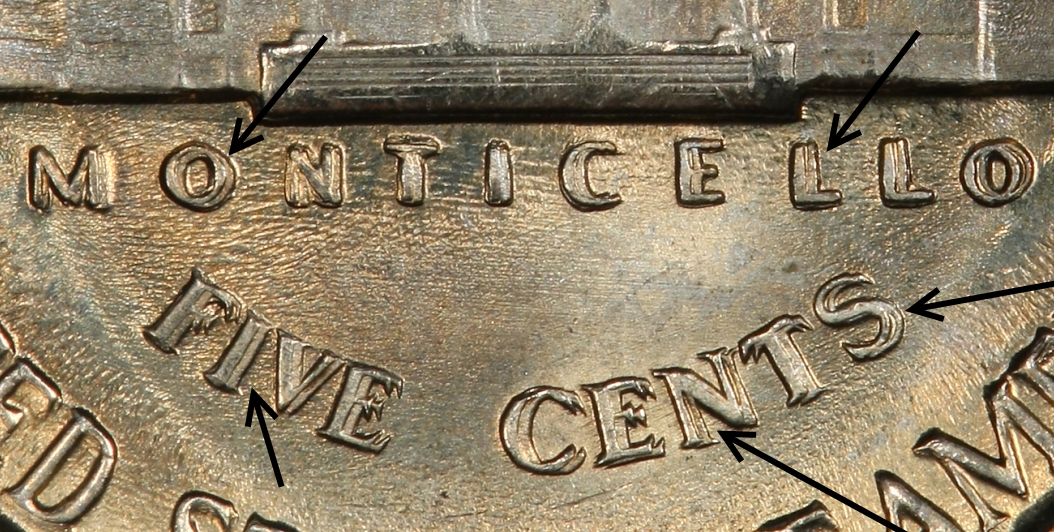
The source arrows make the O and L in MONTICELLO useful starting points. Then compare the lower line, including the N and S in CENTS. Do the features form the same pattern as the reference? A single odd letter on a worn coin is a reason for a closer look, not a finished attribution.
PCGS's Doubled Monticello reference supplies the whole-coin and detail photographs. Use the large detail view for the lettering and the full coin for context. A tiny sales thumbnail can hide the very feature you need to compare.
Why machine doubling can look similar
A die is the steel tool that strikes one side of a coin. On a doubled die, the repeated detail forms during the making of that tool. The tool can then pass that feature to more than one coin. The coin does not need two separate strikes to receive it.
NGC explains that machine doubling forms during striking and can leave a low, flat shelf beside a design. Clear separation in the right places matters more than the impression that a letter looks thick. NGC also shows that both kinds can occur on the same coin, so one shelf does not settle every feature.
Keep reverse design and Full Steps separate
Collectors sort normal 1939 nickels into two reverse designs, called Reverse of 1938 and Reverse of 1940. Those names refer to changes in the building's design. Our 1939 reverse-design comparison explains the staircase clues without treating the newer design as an error.
Full Steps is another question about the coin's detail and condition. A sharp staircase does not prove that MONTICELLO is doubled. Likewise, a possible match in the lettering does not let you award a Full Steps designation. Record each observation separately.
Make a useful photo record
- Photograph the full front and back, keeping the date and any mint mark readable.
- Add a close-up of both MONTICELLO and FIVE CENTS, not just one promising letter.
- Try a second light angle if glare hides the metal's shape. Keep both original files.
- Write which letters match the reference and which remain unclear. Leave the attribution qualified until reviewed.
Do not clean the coin to improve a picture. Do not sharpen a photo until halos resemble extra metal. A note such as “possible doubled reverse; lower lettering unclear” preserves more useful information than a confident variety name based on blur.
Use the CoinHub Variety Attribution Assistant to record the date, side and feature. Its results are possible matches. It cannot confirm a doubled die or assign an FS number. Use an expert service for that.
Resolve the identity before discussing a price
A sale of a top-grade coin does not price every 1939 nickel. Match the exact variety and grade first. Then check its surfaces and dated sold results. Settle a doubtful feature before paying for a named variety or pricing your own coin.
For more on coin errors, try founder Blake Alma's The CoinHub: An Ultimate Guide to Coin Errors. This is our own book, offered as an optional next read. Start with the photos and checks above for this nickel.