
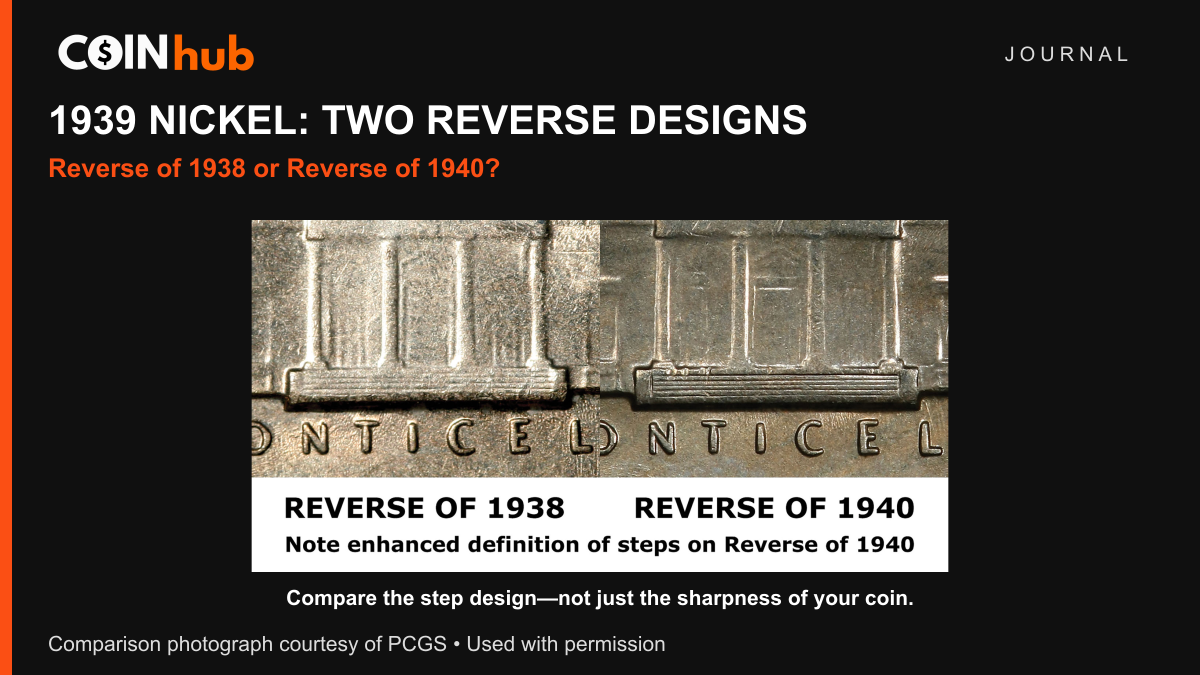
A 1939 Jefferson nickel can have the Reverse of 1938 or the Reverse of 1940. Those names describe two designs of Monticello, the building on the back. Look at the shape of its steps: the older design has softer, less even lines, while the newer design has straighter, sharper lines. Both designs belong on 1939 nickels.
The year in the reverse name does not change the date of your coin. A nickel dated 1939 with the Reverse of 1940 is still a 1939 nickel. It is also not automatically a mint error or a Full Steps coin. Those are separate questions.
Start at the steps beneath Monticello
Turn the coin over and find the central staircase below the columns. Use a clear reference image beside your coin, with both buildings upright. The comparison photograph above shows the two step designs. Focus on the shape of the lines, rather than which photograph looks brighter.
PCGS explains the design change as a sharpening of the steps. The older reverse carried forward the original design. The newer version was already in use during 1939, even though collectors call it the Reverse of 1940.
| What you are comparing | Reverse of 1938 | Reverse of 1940 |
|---|---|---|
| Step design | Softer, uneven or wavy-looking lines | Straighter, more sharply defined lines |
| On a coin dated 1939 | A normal design option | A normal design option |
| What the name does not establish | The coin's grade or price | A Full Steps designation or mint error |
These are design clues, not a rule that every blurred staircase must be the older reverse. Wear, a weak strike, scratches and poor lighting can hide the lines. If the detail is too faint to compare, record the reverse as uncertain.
Keep the date, mint and reverse in separate notes
Write down the date on the front before working on the back. Then record the mintmark, if present. Do not let a seller's label replace those observations. A listing can identify one feature correctly and still leave another unresolved.
Next, compare your reverse with a clearly identified example. Wexler's reference identifies both reverse designs on 1939 coins from all three mints and on proofs. A proof is a coin made by a special production process for collectors; the term does not simply mean a shiny coin.
For a useful collection record, keep three short entries: the date and mint, the reverse design, and the coin's condition. Add the reference used for your comparison. That makes it easier to review the identification later without starting again from a vague note such as “rare nickel.”
If you can read 1939 but cannot see the staircase clearly, you have established the date—not the reverse type. Better photographs or an in-person specialist review are more useful than forcing a choice.
Reverse of 1940 is not the same as Full Steps
The reverse name describes the design used to make the coin. Full Steps describes the surviving step detail under a grading service's rules. A newer reverse design can still have a weakly struck, worn or marked staircase.
CoinHub's Jefferson nickel Full Steps guide explains that separate assessment. Use it after identifying the design. Counting lines alone should not replace the side-by-side design comparison.
Nor does the Reverse of 1940 name identify the 1939 doubled-die reverse. That variety involves doubled design details. The existence of two normal reverse designs and the presence of doubling are different facts about a coin.
Why the 1940 proof exception needs care
The similar names can make search results confusing. Error-Ref documents a 1940 proof with the older reverse. That is a different attribution problem from sorting the two normal designs on a coin dated 1939.
Check the date in a reference's title and the type of strike it discusses. A description of a 1940 proof should not be used as proof that your worn 1939 circulation coin is an unusual error. Keep the full coin identity attached to every comparison.
Compare like with like before discussing value
There is no single price attached to either reverse name. Date, mint, strike type, grade, surface problems and any recognized designation all matter. Asking prices for unrelated high-grade coins do not establish the value of a circulated example.
A sensible next step is to find completed sales for the same identified issue in comparable condition. If that identity remains uncertain, resolve it before paying for a claimed variety or drawing a price conclusion. Do not clean the coin to make the steps easier to see.
The useful first result is a clear identification record: what is visible, which reference supports it, and what remains unknown. That record helps whether the nickel becomes a collection example or simply teaches you to read a small design change.