
Read the small staircase before reading a premium into the coin
A nickel can look bright and attractive while the tiny step area remains indistinct. Conversely, a sharply defined staircase does not tell you everything about marks, surfaces or wear elsewhere. Begin by recording what is visible, then compare it with the grading service’s actual standard.
Where to look on the reverse
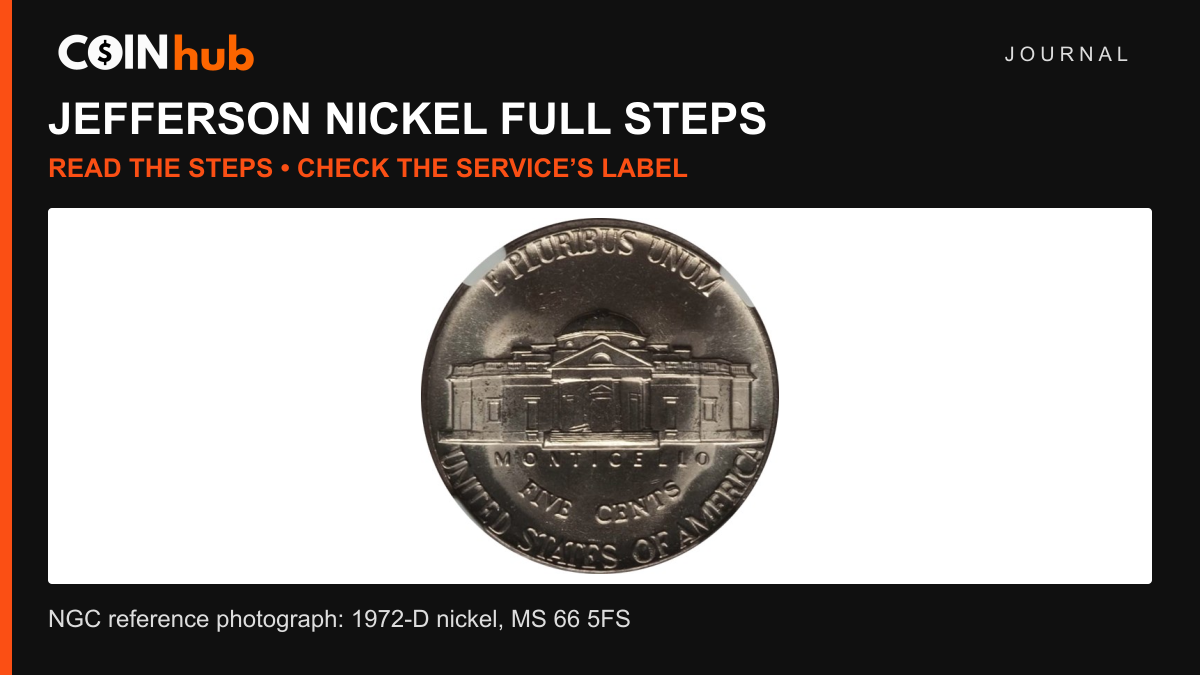
Find the front of Monticello, then the narrow staircase below the columns and above the word MONTICELLO. Study that area across its width. Do not count the building’s thicker foundation or a bright reflection as an extra step.
PCGS’s Full Steps explanation separates the column base, walking surface, individual steps and foundation. It also explains that steps which join together, whether through the strike or later damage, cannot support its FS designation.
Use a light that you can move and modest magnification. Take one complete reverse photograph before making close-ups. That full view preserves the location of the feature; the close-up lets another person see the particular interruption you are questioning.
What the different labels mean
| Holder notation | How to read it | What to keep separate |
|---|---|---|
| PCGS FS | At least five complete steps; MS60 or higher | The numeric grade still describes the coin’s overall condition. |
| NGC 5FS | Five Full Steps on a qualifying Mint State nickel | Do not relabel it 6FS because a photograph seems sharp. |
| NGC 6FS | Six Full Steps on a qualifying Mint State nickel | Use the exact designation when comparing records. |
| Older NGC FS | NGC says its pre-2004 FS designation is treated as 6FS in its Census | Check the holder and certification record rather than assuming modern terminology. |
NGC’s guide explains the 2004 change and limits its 5FS/6FS designations to Mint State coins. Proofs are generally expected to show full steps. A proof’s crisp reverse is therefore not a reason to transfer a Mint State designation onto its label.
Make an inspection record you can actually use
Instead of writing “looks full,” give the next reader enough information to find the same feature. Use this short worksheet for a raw coin, a dealer discussion or your own collection notes:
- Identity: date, mintmark, holder service and certification number, if present.
- Full views: both sides, with the coin or holder kept in the same orientation.
- Step observation: where each visible separation runs clearly and where it becomes uncertain.
- Possible interruption: location described as left, center or right; note whether the appearance changes with the light.
- Image limitation: glare, plastic scratches, blur or an area hidden by the holder.
- Conclusion: clear observation, unresolved question or existing certified designation—keep these as separate entries.
For example, “the center looks joined in the first image, but glare covers it in the second” is useful evidence. “Definitely rare Full Steps” skips the unresolved part. Preserve the original images so sharpening or compression does not become the basis of the conclusion.
The hero shows NGC’s photographed 1972-D MS 66 5FS example. Its attribution belongs to that specimen. The picture is a reference for the design area, not a tool that certifies another coin by visual resemblance.
Three meanings of FS that should not be mixed
FS after a Jefferson nickel’s numeric grade can mean Full Steps. The small FS designer initials on the coin itself refer to Felix Schlag; NGC notes their appearance below Jefferson’s portrait beginning in 1966. A numbered variety reference such as FS-101 is different again: PCGS lists a 1938 doubled-die variety with that number separately from its Full Steps designation.
Always ask where the letters appear: on the coin, in a variety number or after the grade. Copy the complete label instead of shortening every occurrence to “FS nickel.”
Compare like with like
If researching market examples, keep the date, mintmark, service, numeric grade and step designation together. An unusually strong result for one combination is not a valuation for every nickel with visible steps. Our 1950-D Jefferson nickel guide addresses that specific issue; the broader Jefferson nickel collecting guide provides date-based context.
The useful first decision is whether you have a clear observation or a question worth showing to a qualified grader. Keep uncertainty visible, protect the surfaces and resist turning a small staircase into a promise about the whole coin.
Service terminology and original NGC photograph checked September 15, 2026. Inspection worksheet is CoinHub editorial guidance. No current price, population count or grading outcome is promised.