
Why the 1950-D nickel can be a key date without being scarce in every grade
The 1950-D is famous because it had a very low original mintage for a Jefferson nickel. PCGS explains that dealers later promoted it aggressively as a modern rarity, and collectors saved rolls. That created an unusual market: a low-mintage coin with a large surviving supply of attractive uncirculated pieces.
That is why a worn 1950-D should be handled as a collectible coin, not automatically as a windfall. At the other end, a sharply struck, original, high-grade coin can still command much more attention. The useful question is not simply, “Is it a 1950-D?” It is, “What condition is it in, and what can I document about it?”
The low-mintage paradox in one sentence
A small Mint production figure starts the story, but decades of hoarding changed the supply that collectors can buy today. Treat the 1950-D as a date worth sorting and evaluating carefully—not as proof that every example has the same value.
What changes a 1950-D Jefferson nickel's value?
| What you see | Why it matters | Best next move |
|---|---|---|
| Circulation wear | Wear lowers the grade and can blur the reverse details collectors want to inspect. | Keep it if you collect the date, but compare it only with like-condition sales. |
| Uncirculated luster | A coin with no circulation wear can be more desirable, but saved rolls make Mint State examples less unusual than the mintage alone suggests. | Check surfaces for cleaning, contact marks, and natural-looking luster before assigning a premium. |
| Sharp Monticello steps | Strong reverse detail can separate a better strike from an average one. | Use magnification and compare with a recognized grading-service example; do not assign an FS label to a raw coin yourself. |
| Certified 5FS or 6FS | NGC uses these strike characters for qualifying Mint State Jefferson nickels, and collectors often pay closer attention to them. | Read the holder, certification number, grade, and exact designation together. |
How to identify the right coin first
Look at the obverse for the 1950 date. Then turn the coin over and find the small D to the right of Monticello. A normal 1950-D is copper-nickel, with a plain edge. Do not confuse it with a wartime silver Jefferson nickel: those 1942–1945 issues have a large mint mark above Monticello instead.
A 1950-D is a date-and-mint collectible, not a named error by default. Random scratches, dull patches, or weak details do not create a variety. If something looks unusual, photograph both sides in good light before assuming it is a Mint-made feature.
What Full Steps actually means
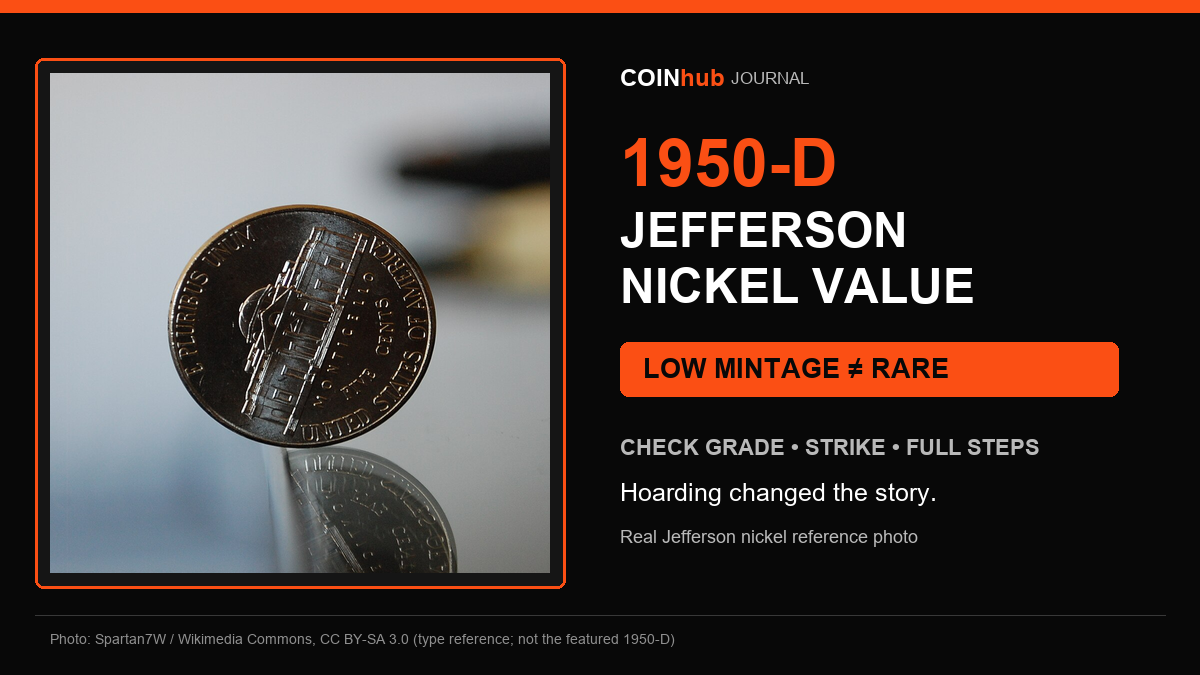
On the reverse, the steps below Monticello are a quick way to judge strike sharpness. NGC explains that its 5FS and 6FS designations are used only with qualifying Mint State Jefferson nickels. They describe five or six full, distinct steps on the certified coin—not merely a raw coin that looks sharp in one photograph.
This distinction matters for a 1950-D. NGC notes that striking quality weakened around 1950, so crisp steps can be especially interesting. Still, a raw coin deserves a closer look rather than an automatic designation. Bag marks, weak areas, lighting, and circulation can all make a quick count unreliable.
A practical five-step check before you sell or submit
- Confirm the date and reverse mint mark. Make sure it is a 1950-D, not a different Jefferson nickel with a similar amount of wear or toning.
- Separate wear from strike. A flat detail can come from circulation or from a softer original strike. CoinHub's weak-strike-versus-wear guide can help you keep those questions apart.
- Protect the surfaces. Avoid cleaning, dipping, scratching, or taping the coin. Original surfaces and an honest holder are more useful than a rushed home treatment.
- Compare completed sales, not wishful asking prices. Match the same grade, holder designation, surface quality, and date/mint. A top-grade or Full Steps sale does not set the value of an ordinary raw example.
- Choose certification deliberately. Submission, shipping, insurance, and attribution costs should make sense for the likely outcome. A dealer or experienced numismatist can help you decide whether the coin's grade and strike justify that step.
Frequently asked questions
Why is the 1950-D Jefferson nickel valuable?
Its 2,630,030 mintage makes it a recognized key date, but value is still driven by the individual coin. Grade, original surfaces, strike sharpness, a certified Full Steps designation, and current buyer demand can all change the answer.
Are all 1950-D nickels rare?
No. The date was widely hoarded after it became popular with collectors, so many saved examples survive. It remains a key date, but a low mintage does not make every raw coin rare in the marketplace.
Where is the D mint mark on a 1950-D nickel?
On the reverse, look to the right of Monticello. The date is on the obverse below Jefferson's portrait.
Can I call a raw 1950-D a Full Steps nickel?
You can identify sharp-looking step detail and decide whether it merits more study, but 5FS or 6FS is a grading-service designation on a qualifying Mint State coin. A raw photograph is not a substitute for the holder's designation.
Should I clean a dark or dull 1950-D nickel?
No. Cleaning can leave damage that reduces collector appeal. Preserve the coin, photograph it, and compare it with trusted references before making any irreversible decision.