
Start beside Monticello, not with the date alone
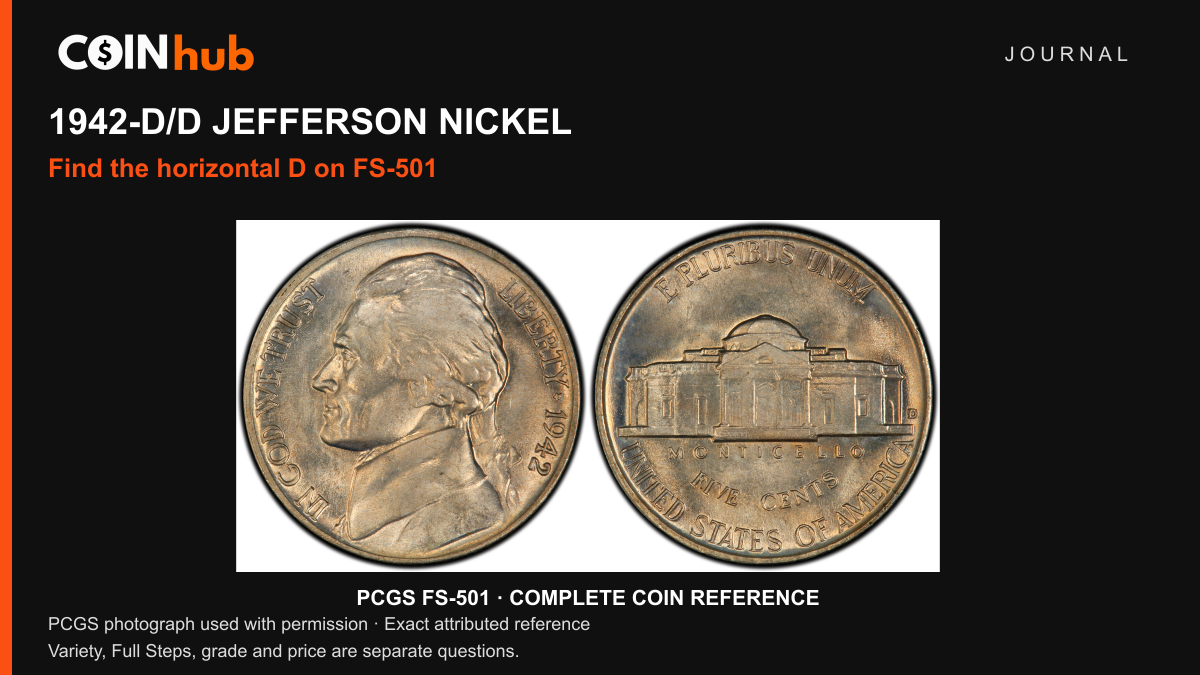
The 1942-D/D Jefferson nickel called D over Horizontal D has a repunched Denver mint mark on the back. An upright D was punched over a sideways D in the die used to strike coins. PCGS lists the specific variety as FS-501. A plain 1942 date or a thick-looking D is not enough to identify it.
Turn the coin to the Monticello building. Look to the right of the building for the small D, then compare that area with a clear attributed example. The photograph below is a crop of the same genuine PCGS FS-501 reference used in our header.
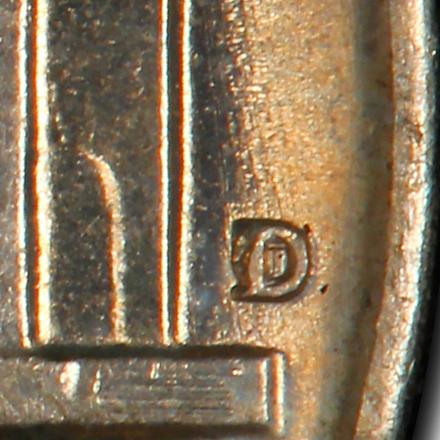
What was repunched?
A working die is the metal tool that presses a design into a coin. On this issue, the mint mark was put into that tool by hand. The mistake belonged to the die, so coins struck from it could carry the same extra mint-mark detail.
PCGS's Jaime Hernandez explains that the mark was first punched in the wrong position. Collectors call the result a repunched mint mark, often shortened to RPM. That is different from saying the finished coin was struck twice.
The D/D notation means D over D. It does not mean D over S, and it does not describe doubling across the whole design. CoinHub's 1955-D/S nickel comparison concerns a different date and a different mint-mark combination.
Compare the whole feature
| What you see | Useful next check |
|---|---|
| An extra raised shape around the D | Compare its outline, position and relationship to the upright D with the attributed reference. |
| A scratch, dent or displaced metal | Photograph it under another light angle; an odd mark alone does not establish FS-501. |
| Unclear detail on a worn coin | Keep the identification open rather than drawing a missing feature into the photo. |
| A seller's variety label | Check the actual coin and, when present, the grading service's certification record. |
Take a straight-on photograph of each face and a sharp close-up of the mint mark. Keep the images unfiltered. A close-up is useful only when the date, denomination and location can also be checked.
A 1942-D is a copper-nickel issue
PCGS lists the Denver issue at 5.00 grams and 21.20 millimeters, made from 75% copper and 25% nickel. The date 1942 also appears on the different silver wartime issues. Their large mint mark is above Monticello, rather than in this small-D position.
NGC's wartime-alloy explanation gives the silver mixture as 35% silver, 56% copper and 9% manganese. Do not assign that silver content to a normal 1942-D simply because the year falls within the wartime period.
Keep the variety, grade and price separate
FS-501 names the variety. A separate Full Steps designation concerns the detail on Monticello's steps. Neither label, on its own, gives every example the same grade or selling price. Wear, surface damage and the particular coin still matter.
Use CoinHub's Variety Attribution Assistant to organize a research checklist. It cannot assign an FS number or confirm that a coin is this variety. If a sale depends on the attribution, seek a qualified in-person review.
Primary references and photographs checked November 1, 2026. PCGS photograph used with permission; CoinHub added framing and made the labelled mint-mark crop without altering coin detail. No current price, variety mintage or survival estimate is supplied.