
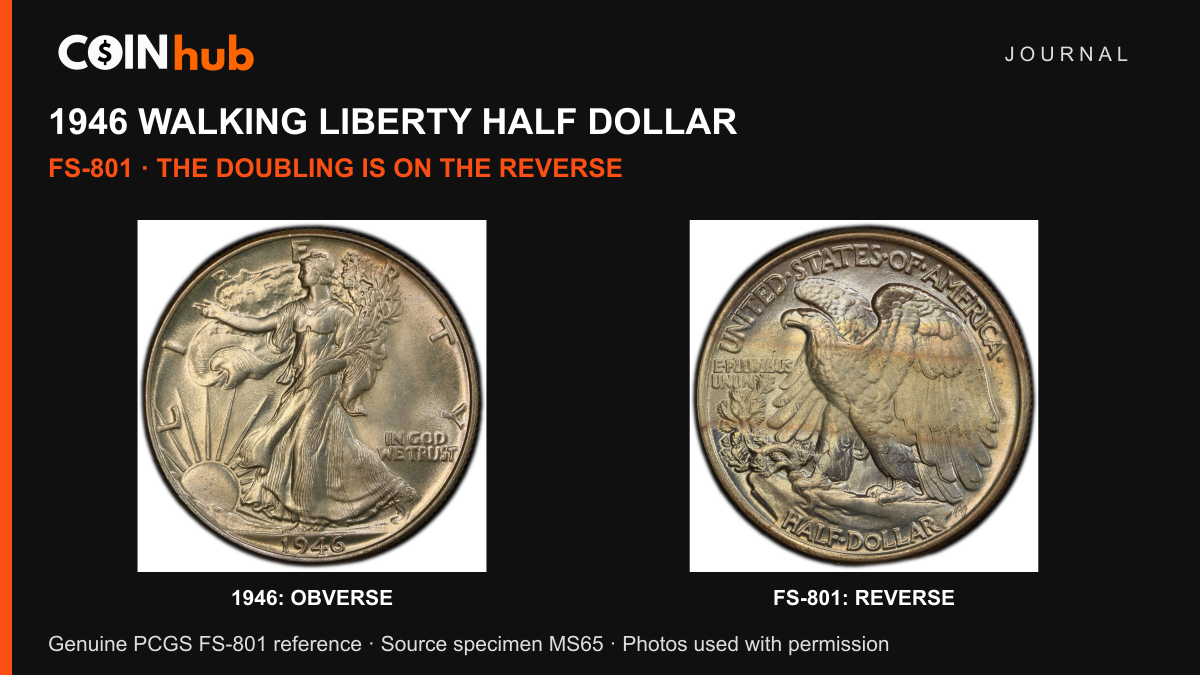
The 1946 Walking Liberty half dollar FS-801 is a doubled die reverse: the repeated detail is on the eagle side. Start with E PLURIBUS UNUM to the eagle's left, then compare the wing feathers and the branch below the motto. A thick-looking letter on its own is not enough to identify the variety.
Turn to the eagle and find the motto
The reverse is the back of the coin. Hold the eagle upright, with HALF DOLLAR along the lower rim. E PLURIBUS UNUM appears in two lines to the left of the eagle's body. Keep the full reverse in view before moving in for a closer look.
PCGS's FS-801 entry identifies this as a Philadelphia issue and assigns it coin number 145152. The genuine PCGS reference above shows both faces of one example. Its front carries the 1946 date; its back is the side to examine for this variety.
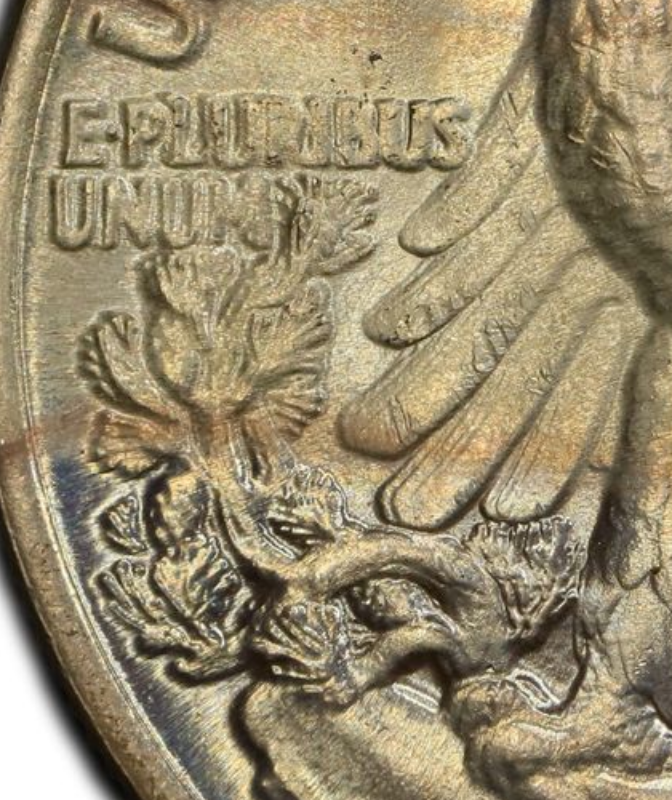
Use several areas together
GreatCollections' entry for an FS-801 coin names three areas to check: the upper edges of the motto, the wing feathers, and the branch and leaves at lower left. Compare the shape and location of the extra edges. A bright reflection on its own is not a match.
| Area | What to compare |
|---|---|
| E PLURIBUS UNUM | The shape and placement of extra edges along the letters |
| Wing feathers | Corresponding detail on the eagle side |
| Branch and leaves | The pattern below and beside the motto |
Change the direction of soft light if a reflection hides the relief. Keep an ordinary full-face photo as well as the close views. Wear, marks and glare can obscure a comparison; an unclear feature should stay uncertain.
What DDR and FS-801 mean
DDR means doubled die reverse. A die is the steel tool that stamps a coin's design. Here the duplicated detail belongs to the die's design, rather than being a second complete strike on the finished coin.
FS-801 is a catalog reference for this particular variety. The GreatCollections entry also gives its older number, FS-011. Keep the year and denomination with the number: FS-801 is used for varieties on other coins as well.
Our double strike versus doubled die comparison explains the separate causes. Machine doubling can also leave extra-looking edges. A listing that says double stamped, or a photo with one shelf-like mark, does not settle which cause is present.
Identify the coin before comparing prices
Write down the year, face value, mint mark if present, and side with the extra detail. Keep a seller's claim apart from what your own photos show. The source coin's MS65 grade describes that piece. It is not a grade for every coin of the same variety.
The Variety Attribution Assistant can help plan the next steps. It cannot prove that a coin is real or confirm an FS number. If the match is unclear, ask a specialist to examine the coin.
Before using a sale as a value reference, match the exact attribution, grade and surface condition. An asking price is not a completed sale, and a high-grade result is not a price for a worn or cleaned example. No current value range is assigned here.
For broader background, CoinHub founder Blake Alma's The CoinHub: An Ultimate Guide to Coin Errors is an optional introduction to the field. Use the specific references above for this variety's identification.
Sources and photograph credit
References checked October 24, 2026. PCGS CoinFacts 145152 supplies the genuine FS-801 photograph, used with CoinHub's saved permission. The complete faces and the separately labeled detail come from the same source image. CoinHub added framing and labels while preserving the photographed coin's details and color.