
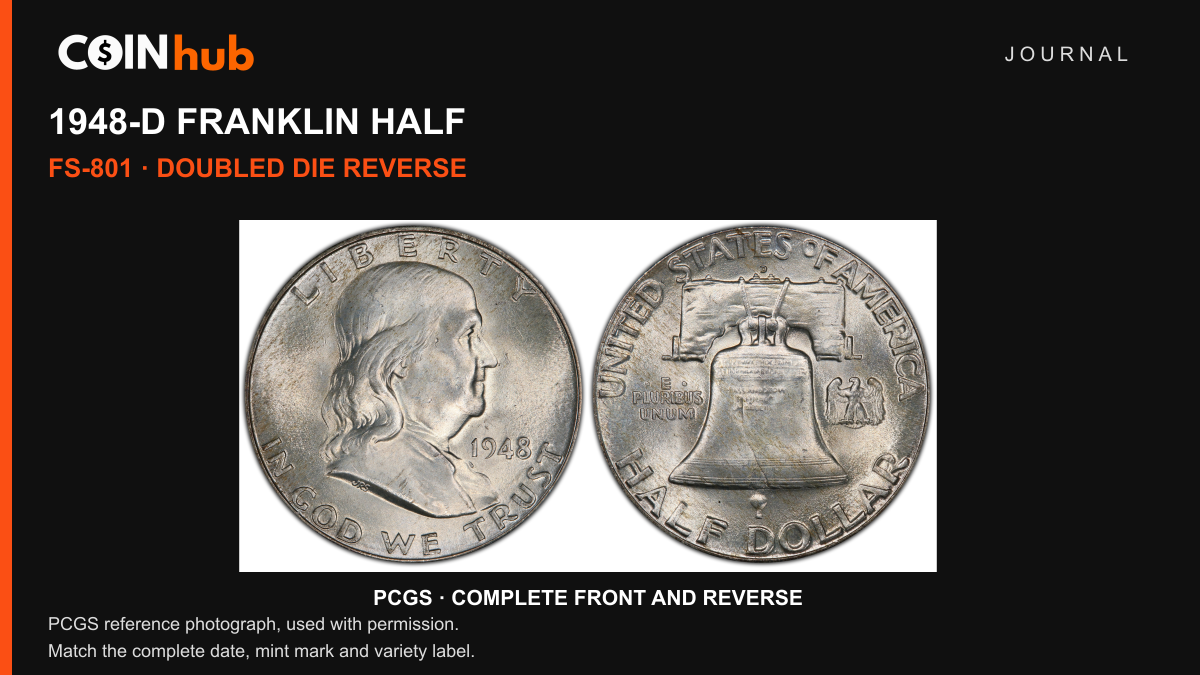
The 1948-D Franklin half dollar FS-801 has a doubled die reverse: extra raised detail in parts of the design on the back. Start with E PLURIBUS UNUM beside the Liberty Bell. Compare the full pattern with an attributed reference, rather than treating one thick letter as a match.
PCGS lists this exact Denver variety as 1948-D, DDR FS-801. DDR means doubled die reverse. The date, mint mark and denomination all belong in the label because other coins can share the same FS number.
Confirm the date and the D first
Look for 1948 beside Franklin's portrait on the front. On the back, find the small D above the bell. Keep full photographs of both sides so the letter detail remains tied to the same coin.
The D matters. PCGS also lists a 1948 Philadelphia doubled die reverse with an FS-801 number. A photograph or search result for that coin cannot, by itself, establish the Denver variety. Match the whole label before comparing the small features.
Compare more than one group of letters
The motto is a useful place to begin. The detail below comes from the same PCGS reference coin shown in the main image. It retains the actual raised edges; no extra lines, sharpening or retouching have been added.
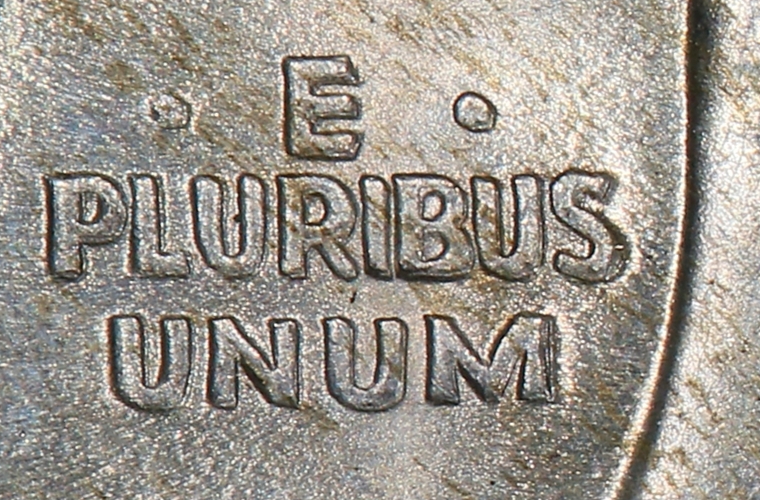
In Kevin Flynn's Franklin reference excerpt hosted by Heritage, printed page 91 shows the 1948-D DDR-001. It points to doubling at E PLURIBUS UNUM, UNITED STATES and HALF. Use the photographs together to compare a pattern across the reverse.
A die is the steel tool that puts a design on a coin. With a doubled die, the extra detail is in that tool and can repeat on coins it strikes. Wear, glare and damage can hide or imitate parts of the effect. Try another light angle and keep an unclear result qualified as a possible match.
| Check | What it helps establish |
|---|---|
| 1948 on the front and D above the bell | The correct date and mint for this reference. |
| The motto and other reverse lettering | A pattern to compare with the doubled die. |
| The bell's lower lines | A separate strike-quality question, not proof of FS-801. |
Keep the front, Full Bell Lines and Proof coins separate
Flynn's cross-reference connects the reverse entry with an obverse entry, DDO-001, on printed page 90. Obverse means front. That page illustrates the date and other front details. Read that separate evidence if checking the front; one blurred reverse letter does not confirm both sides.
Full Bell Lines, often shortened to FBL, is a separate grading designation for detail near the bottom of the bell. PCGS has listings for the Denver doubled die with and without FBL. FS-801 is the variety reference; it is not a grade or a promise of Full Bell Lines.
The 1961 Proof Franklin doubled die is a different issue. A Proof is made with a special production process. Do not transfer its photographs, value claims or finish to a 1948-D circulation-strike coin.
Make the comparison useful
Record the complete label, source link and clear views of the feature. CoinHub's Variety Attribution Assistant can help organize the next checks. It cannot assign an FS number, authenticate a coin or confirm a doubled die from a photograph.
Leave the surfaces as found. Cleaning or scraping can damage the coin and erase useful evidence. If buying, selling or paying for grading depends on the attribution, get a qualified review of the actual coin. Compare completed sales of the same variety and similar condition; an old reference-book price or an online asking price is not a current appraisal.
For broader beginner reading, CoinHub founder Blake Alma's The CoinHub: An Ultimate Guide to Coin Errors is an optional resource. The reference photographs and specific checks above remain the starting point for this variety.
Sources and photograph: PCGS's exact 1948-D FS-801 entry and its genuine reference photograph, used with permission; Flynn's The Authoritative Reference on Franklin Half Dollars, printed pages 90–91. The book's historical price table is not used as a current value guide.