
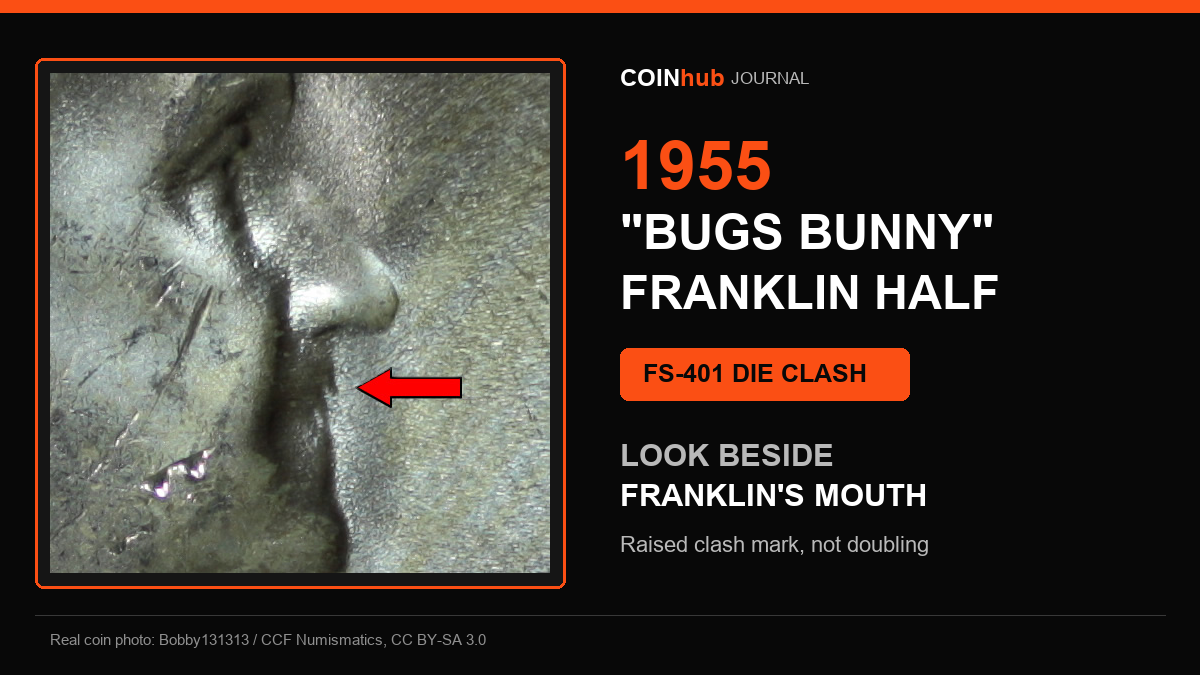
How to identify a 1955 Bugs Bunny Franklin half dollar
Start with the obverse, the side showing Benjamin Franklin. The important feature is a narrow raised projection at the mouth. Its position and shape create the cartoonish "buck tooth" appearance that gave the variety its nickname.
- Confirm the date and denomination. The coin should be a 1955 Franklin half dollar. Philadelphia made the circulation-strike halves for this date, so the absence of a mint mark is normal and does not identify the variety by itself.
- Inspect Franklin's mouth under steady light. Use a 5x to 10x loupe and move the light, not the coin, until the small raised spike is visible. Compare its location with an attributed reference photograph.
- Look for raised metal, not a cut into the surface. A genuine clash marker was part of the die when the coin was struck. A scratch or gouge usually pushes into the coin, disturbs nearby metal, or changes direction irregularly.
- Check the whole coin before making a value judgment. Wear, cleaning, contact marks, luster, eye appeal, and the reverse bell lines can matter as much as the nickname. The mouth marker alone does not establish grade or price.
What caused the "Bugs Bunny" feature?
Coin dies normally meet a blank planchet, which receives the design under pressure. In a die clash, the dies come together without a planchet properly between them. Part of one die's design can be impressed into the opposing die. Later coins struck from those dies may carry raised traces of the transferred design.
PCGS explains that on this Franklin variety, part of the small eagle's wing from the reverse die clashed into the obverse die near Franklin's mouth. Once the obverse die struck another planchet, that transferred element appeared on the coin as the familiar toothlike projection.
Collectors commonly place the issue in the coin-error conversation because the clash happened during Mint production. More precisely, FS-401 is collected and attributed as a die variety: multiple coins can be struck from the same affected die pair, rather than each coin representing an isolated one-time striking mishap.
Die clash, doubled die, or damage?
The 1955 date makes confusion especially easy because the famous 1955 Lincoln cent is a doubled die. The Franklin half dollar's Bugs Bunny marker formed by a different process.
| Feature | What you would expect to see | Why it differs from FS-401 |
|---|---|---|
| Bugs Bunny die clash | A raised, localized toothlike spike beside Franklin's mouth in the known diagnostic area. | This is the target marker caused by transferred reverse-die detail. |
| Doubled die | True design doubling on letters, numbers, or other devices, following the design's shape. | The Bugs Bunny marker is not a second image of Franklin's mouth or the date. |
| Scratch or gouge | An incuse line, displaced metal, fresh brightness, or an irregular cut across the surface. | Damage was added after striking and does not match the established raised clash location. |
| Contact mark | A random hit, nick, or abrasion from another coin or object. | Its placement and shape are accidental rather than repeated on coins from the same affected die. |
1955 Franklin half dollar facts
PCGS lists the 1955 Philadelphia circulation issue at 2,498,181 coins. The standard specifications are 12.50 grams, a 30-millimeter diameter, a reeded edge, and a composition of 90% silver and 10% copper. John R. Sinnock designed the Franklin portrait and the Liberty Bell reverse, with the small eagle based on work associated with John Frederick Lewis.
The date and specifications identify the host coin, not FS-401. A regular 1955 half dollar and a Bugs Bunny example share those basic facts. The mouth diagnostic is what separates the attributed die-clash variety.
Full Bell Lines is a different test
Full Bell Lines, commonly abbreviated FBL, describes the horizontal lines near the bottom of the Liberty Bell on the reverse of qualifying Mint State coins. It is a strike and surface designation used by grading services, not the cause of the Bugs Bunny marker.
- A 1955 Franklin half can show FS-401 without qualifying for FBL.
- A coin can qualify for FBL without being the Bugs Bunny variety.
- A certified label may identify both, one, or neither, depending on the coin and the service requested.
This distinction matters when comparing listings. An asking price for an FS-401/FBL coin should not be treated as the value of every 1955 Bugs Bunny half.
What affects a 1955 Bugs Bunny half dollar's value?
There is no single dependable value for every example. Silver value provides a floor that moves with the market, while collector value depends on the coin's grade, originality, strength of the clash marker, eye appeal, certification, and any FBL designation. A seller's asking price is not proof that a comparable coin sold for that amount.
For a realistic comparison, match all of these details:
- the same FS-401 attribution;
- the same numerical grade or a closely comparable raw condition;
- the same FBL or non-FBL status;
- similar originality, toning, luster, and clash-marker strength; and
- recent completed sales rather than unsold listings.
High-grade certified pieces can sell for far more than ordinary examples, but that does not make a worn, cleaned, or weakly attributed coin equivalent. For broader series context, see CoinHub's guides to Franklin half dollars worth money and valuable U.S. half dollars.
Should you have the coin attributed or graded?
Certification may make sense when the marker is convincing, the coin appears problem-free, and the likely market value justifies grading, attribution, shipping, and insurance fees. It may not make economic sense for a heavily worn or damaged coin with only a modest premium.
Before submitting, check the current grading service rules. Variety attribution can require a separate fee or service selection, and a holder that lists only the date and grade does not necessarily mean the service evaluated FS-401. Never crack a coin from a holder or attempt surface work merely to chase an attribution.
Frequently asked questions
Why is it called a Bugs Bunny half dollar?
The raised clash mark beside Franklin's mouth resembles a protruding tooth, which inspired the cartoon nickname. The name is informal; the attributed 1955 variety is FS-401.
Is the 1955 Bugs Bunny Franklin half a doubled die?
No. Its best-known marker came from a die clash involving the reverse eagle and the obverse die. That is different from hub doubling on a doubled die.
Does every 1955 Franklin half dollar have the marker?
No. The date alone is not enough. Inspect the mouth area for the known raised clash diagnostic and compare it with reliable attributed images.
Does FS-401 automatically mean Full Bell Lines?
No. FS-401 identifies the die-clash variety. FBL evaluates the bell lines on the reverse of qualifying Mint State coins. They are independent characteristics.
Should I clean a dark coin before checking it?
No. Cleaning can permanently change the surfaces and hurt collectibility. Use controlled lighting, magnification, and clear photographs instead.
Are Bugs Bunny clashes known on other Franklin half-dollar dates?
Yes. PCGS notes the effect on several dates in the 1948-1963 series, with 1955 and 1956 being the best-known issues and 1955 the more popular attribution.