
Look at the numerals, then the mintmark
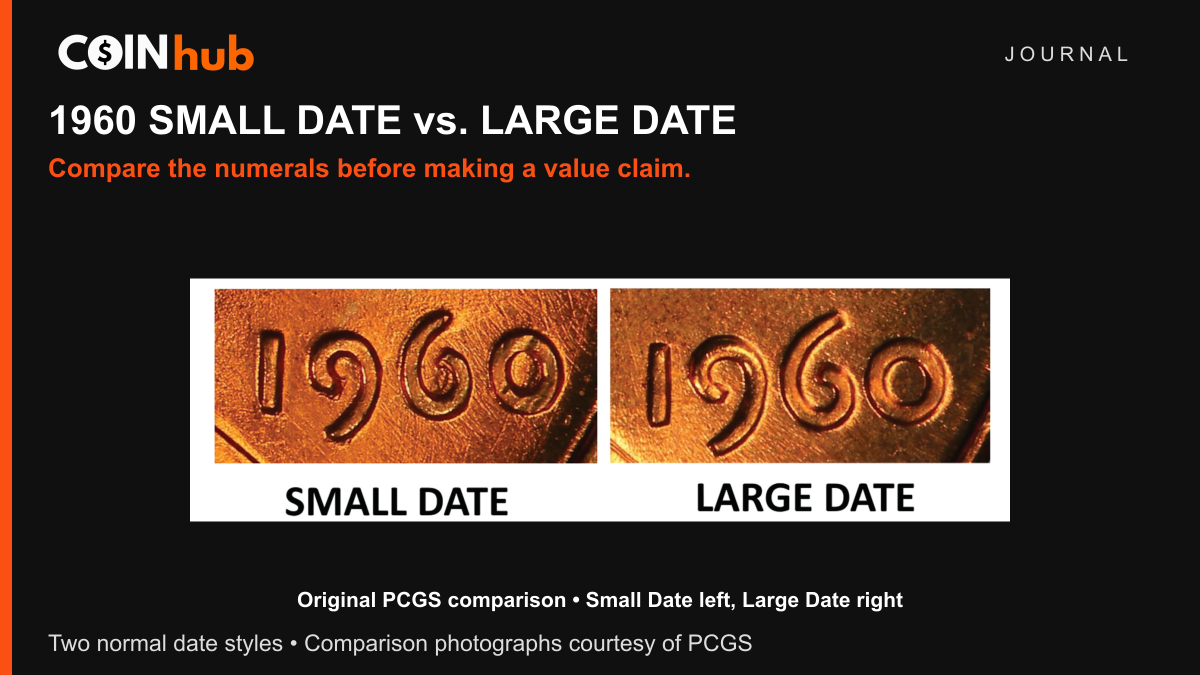
The easiest way to compare a 1960 Small Date versus Large Date penny is to study the shape and alignment of the date. On the Small Date, the tops of the 1 and 9 sit at nearly the same height, and the zero is narrower and more oval. The Large Date has a more prominent, broader zero and a different relationship between the tops of the 1 and 9.
Both date styles are normal varieties. Finding the Small Date does not, by itself, mean that a coin is a doubled die, a striking error or a valuable rarity. You still need to identify the mint, the coin's format and its condition.
Read the genuine photo comparison
The photograph above places the Small Date on the left and the Large Date on the right. These are genuine PCGS reference photographs with their original labels. Use the relationship among the digits rather than trying to estimate their size against your screen.
| Check | Small Date reference | Large Date reference |
|---|---|---|
| Tops of 1 and 9 | Nearly level with each other. | The 9 rises more clearly above the 1. |
| Zero | Narrower, with a more oval appearance. | Larger and broader in the comparison. |
| Overall confirmation | Match the complete date, not one worn corner. | Match the complete date under comparable lighting. |
Start with a straight-on view. Tilted photographs change the apparent height of the numerals, while glare can make a rounded edge look sharp. If you are comparing two images, bring them to a similar scale using the same coin feature as a reference.
A practical sequence is to compare the 1 and 9 first, check the zero second, and then look back at the entire date. If the clues disagree, improve the image before making an attribution. Wear or damage can leave too little detail for a confident answer.
A D mintmark does not settle the date variety
Philadelphia and Denver both produced 1960 cents with Small Date and Large Date styles. A D identifies Denver; the absence of a mintmark on a normal Philadelphia issue does not tell you which date style it has.
For circulation-strike sorting, that gives four basic date-and-mint combinations: Philadelphia Small Date, Philadelphia Large Date, Denver Small Date and Denver Large Date. The arrangement is useful for a collection checklist. It does not mean all four have the same availability, market demand or value.
Write the mintmark after you have looked at the date, rather than using a remembered claim such as “all Denver coins are Small Dates.” Photograph the mintmark area too, particularly when discussing a coin with another collector.
Why two date styles appeared in 1960
In his NGC article The Coins of 1960, David Lange explains that the date design changed during the year's production. The 19 portion was carried in the master hub, while the final two digits were entered into a master die. The change produced the two familiar date styles.
This is a design-variety question. It is different from a coin receiving an accidental extra strike or suffering damage after it left the Mint. The variety can be interesting and collectible without being an error.
That distinction matters when reading listings. A title that combines Small Date, rare, error and doubled die still needs evidence for each separate claim. The ordinary Small Date shape proves only the date style.
Proof coins and doubled dies require another check
Proof cents also exist with the two date styles. Keep proof comparisons separate from circulation-strike comparisons. A shiny surface alone is not enough to establish that a coin is a proof; consider its manufacture, complete appearance and reliable attribution.
NGC's history also discusses doubled-die varieties involving the two date styles in the die-making process. Those are specific attributed varieties, not a name for every 1960 Small Date or every date that looks thick.
If you suspect doubling, obtain a clear close-up and compare the exact coin with an authoritative variety reference. Our die deterioration doubling guide explains another reason numerals can look doubled. For a wider view of recognized problems and look-alikes, see the CoinHub penny error list.
Before comparing values, build a complete description
A useful description might read “1960-D, Small Date, circulated, unattributed for any doubled die.” That separates what you can actually see from what remains unproven. Add clear photographs of both sides, rather than relying only on a date crop.
Then compare the same mint, date style, format and condition category in credible sold records. Asking prices can reflect a seller's hopes or a mistaken attribution. Certified high-grade results also do not establish the value of a worn coin found in change.
Keep the coin uncleaned. Rubbing the date to make the digits easier to see can damage the surface without resolving the identification. Better lighting and a steadier photograph are the useful next steps.
Common questions
Is the 1960 Small Date a mint error?
The ordinary Small Date is a normal date variety. A separate error or doubled-die claim needs its own evidence.
Can a 1960-D be either date style?
Yes. Identify the shape of the date independently of the D mintmark.
Does no mintmark mean Small Date?
No. Philadelphia made both date styles.
What if the date is too worn to match?
Leave the attribution uncertain. A reliable identification is more useful than a confident guess based on one damaged digit.
Sources: PCGS, Looking for the 1960 Large/Small and David Lange, The Coins of 1960, NGC, consulted September 26, 2026. Original comparison photographs courtesy of PCGS; CoinHub layout.