
An extra outline needs an explanation
Quick answer: Die deterioration doubling is a doubling-like effect associated with wear of a working die. It can make design edges look swollen, blurred or repeated. It is different from a true doubled die, whose duplicated detail originates in the making of the die.
A close photograph of one digit can look convincing before the rest of the coin is considered. The important question is what produced the feature. An extra-looking edge is an observation; a doubled-die attribution is a conclusion that needs a matching reference.
Start with a documented die-erosion example
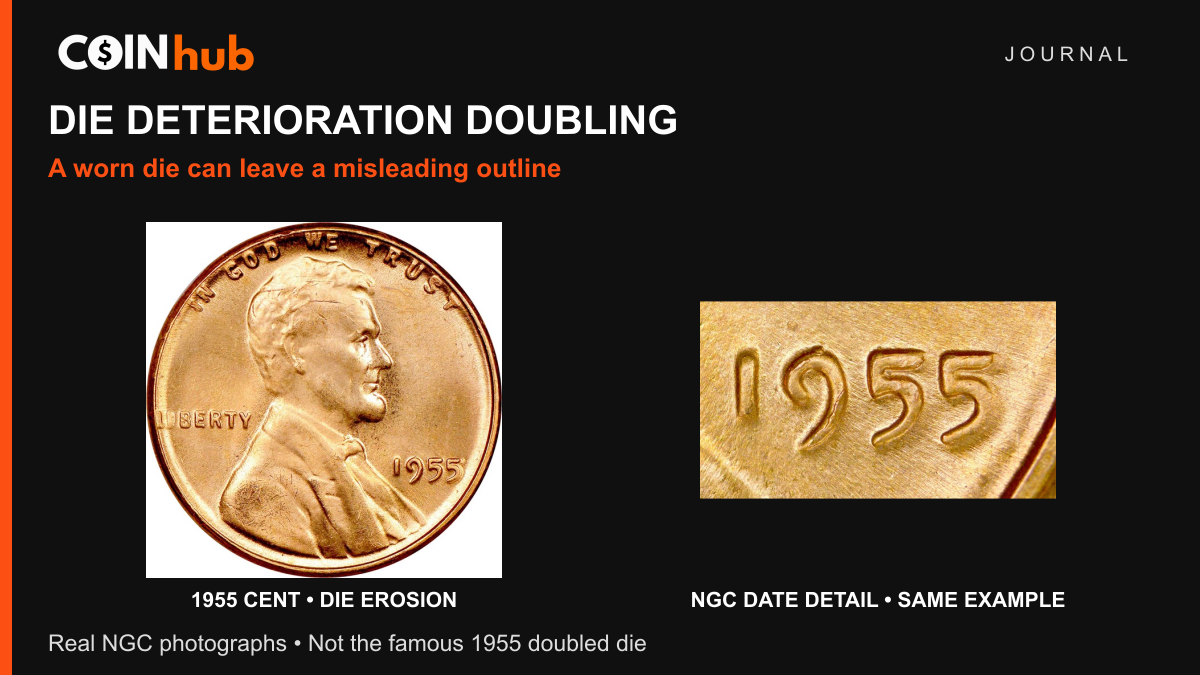
The photographs above come from NGC's discussion of misleading doubling. They show a 1955 Lincoln cent and a close view of its date. NGC identifies the effect as die erosion and discusses the familiar poor man's doubled die nickname. This is not the dramatic 1955 doubled-die variety.
Keep that distinction attached to the picture. A nickname can survive in dealer listings and collector conversations even when it does not describe the production cause accurately. Calling a coin a poor man's doubled die does not make it a lesser grade of the famous variety.
For that separate issue, use CoinHub's 1955 doubled-die guide. The article here addresses die wear and the way it can be mistaken for duplicated design.
What wears: the die, not just the coin
A working die is repeatedly used to strike planchets. Wexler's die deterioration reference explains how repeated metal flow can erode areas of the die around design details. Coins struck after that wear develops can carry the altered appearance.
This means an unusual surface can originate at the mint without being a recognized doubled-die variety. It also separates deterioration of the manufacturing tool from ordinary circulation wear on the finished coin. A coin may show evidence of both, but they happened at different stages.
| Possibility | Where the effect comes from | Useful next question |
|---|---|---|
| Die deterioration doubling | Wear of a working die | Does the feature match documented die-wear characteristics? |
| True doubled die | Duplicated detail in the die's design | Does it match a cataloged variety and its diagnostics? |
| Machine doubling | Movement associated with striking | Is the extra area displaced or shelf-like relief? |
| Double strike | An additional strike on the coin | Is there evidence of another impression? |
The table is a sorting aid, not a photo-authentication test. CoinHub's double strike versus doubled die comparison develops the distinction between an additional strike and a duplicated die design.
Why one visual rule is not enough
Error-ref's specialist entry documents variation in the appearance of die deterioration doubling. It can be raised or incuse and may occur on one side of a design element or around more of it. A rule such as “raised means doubled die” is therefore too simple.
Lighting adds another problem. A bright rim of reflection beside a digit can resemble a second edge, while shadows can conceal whether a feature is raised or recessed. Read the whole date and surrounding field, not just the brightest part of a highly magnified crop.
Look for consistency across the relevant details. If a variety reference identifies a particular pattern on several letters or numerals, one vaguely similar edge is not enough. The exact date, denomination, side and documented markers must fit the candidate attribution.
A practical inspection sequence
- Record the ordinary identification. Start with denomination, date and mintmark before assigning a special label.
- Photograph both complete faces. Add a detail image, but preserve the surrounding design and field in the record.
- Describe what you see. Note which edges look swollen, repeated, flat or recessed without deciding the cause immediately.
- Change the lighting direction. Check whether the apparent second outline remains a physical feature rather than a reflection.
- Compare the right references. Match the coin to documented examples of the proposed variety and to known look-alikes.
If your photographs cannot resolve the feature, record it as uncertain. Sharpening an image until it looks more dramatic does not improve the evidence. Nor does cleaning or scraping the coin. Preserve the original surface for someone who can examine it directly.
Does die deterioration doubling add value?
It does not establish a doubled-die premium. NGC's variety-attribution explanation excludes die deterioration doubling from the varieties it recognizes. That classification is more useful than a seller's dramatic nickname.
The underlying coin can still have value for its date, condition or other correctly identified features. A policy about variety attribution is not a valuation of every coin showing die wear. Before paying a premium, ask what specific attribution is being offered and what evidence supports it.
Specialist references and source photographs checked September 25, 2026. Images courtesy of NGC, from the linked Collectors' Edge article: one documented 1955 die-erosion example and its supplied detail. CoinHub resized the photographs and added labels. This guide does not authenticate a reader's coin or promise a grading result.