
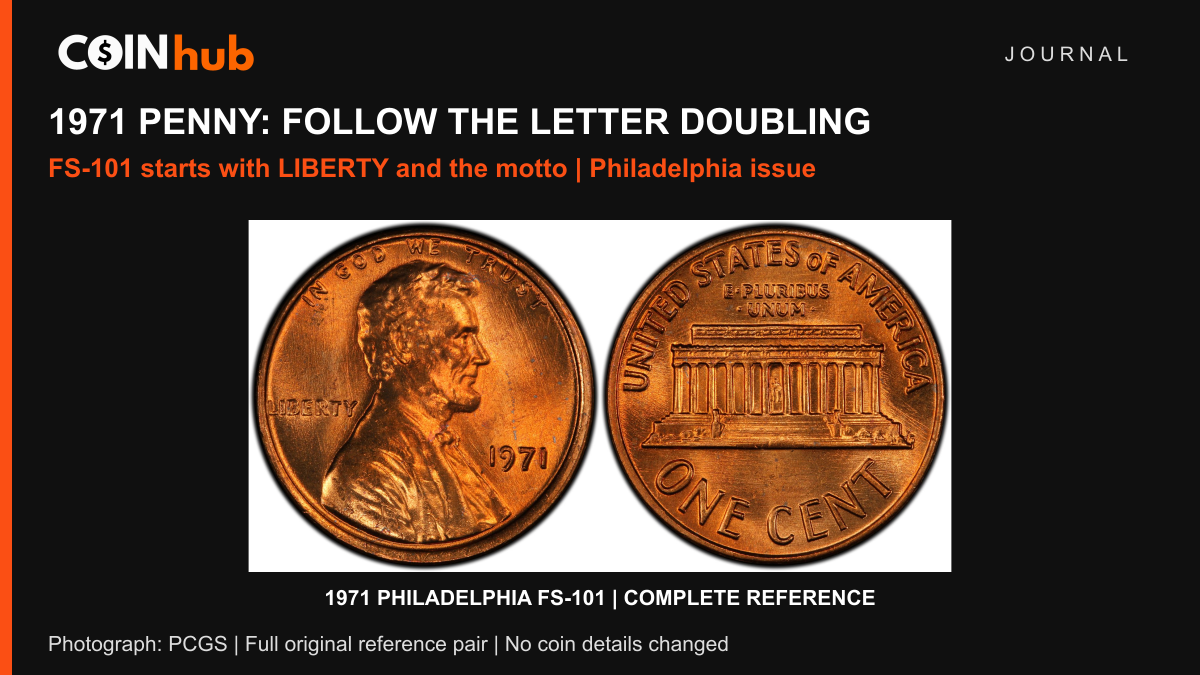
On the Philadelphia 1971 doubled die penny known as FS-101, start with LIBERTY and IN GOD WE TRUST. The doubled letters belong to the front die's design. They do not show that the coin was struck twice. This is a different issue from a 1971-S Proof doubled die.
The date is a useful starting point, but the letters deserve the closer look. A thick-looking 7 or a bright outline beside one digit is not enough to name this variety. Match all the letter detail to a known example.
Read the coin before reading the variety number
Check that the coin is a Lincoln cent dated 1971. The regular Philadelphia issue has no mint letter below the date. In the complete PCGS reference photograph above, the back shows the Lincoln Memorial. Keep that full view with your closeups.
FS-101 is a catalog number used to name a variety. The same number can appear under other dates and issues. Record the year, mint and kind of strike with it. A listing that says only “FS-101 penny” leaves out key facts.
PCGS lists the 1971 FS-101 as a regular-strike variety. It separately catalogs the 1971-S Proof doubled die. A Proof is a specially made collector coin. Do not combine the two records because their dates look similar.
Follow the lettering across the front
In its 1971 doubled-die account, PCGS names LIBERTY and IN GOD WE TRUST as the strongest areas. It also notes that you usually need a lens to see the doubling. Do not expect the wide spread of a famous 1955 cent.
Use a steady light and a clear magnified view. Examine the edges and corners of several letters in LIBERTY, then move across the motto above Lincoln. Note exactly which parts look repeated. Changing the light can help separate a physical edge from a reflection.
| Area | What to compare | What it cannot prove alone |
|---|---|---|
| LIBERTY | The shape and spread of repeated letter detail | One broad or worn letter is not an attribution |
| IN GOD WE TRUST | Whether the motto matches the reference pattern | A bright photographic outline is not a second design |
| 1971 date | Supporting detail after the lettering check | The date alone does not establish FS-101 |
A Stack's Bowers description preserved by PCGS also records doubling on the date, with less emphasis than the lettering. Its comments about that auction coin's die alignment are not a requirement that every candidate must look equally off-center.
A doubled die is different from strike doubling
A die is the steel tool that stamps a design into a coin. A doubled die already has repeated detail before it strikes the blank. Machine doubling instead comes from movement during striking. CoinHub's double strike and doubled die comparison explains the separate causes.
A flat, shelf-like edge can suggest machine doubling. Blurred or swollen detail can suggest die wear. Neither observation should be turned into a one-feature test. A coin can have several features, and a photograph may not show their relief clearly. The correct variety needs a consistent match.
Build a record that someone else can check
Save both full faces, a clear date view and separate closeups of LIBERTY and the motto. Keep the original files. An image sharpened until its edges develop halos is less useful than a clean photograph of the actual surface.
The CoinHub Variety Attribution Assistant can help you record the date, mint and unusual feature. It cannot assign an FS number or confirm this doubled die. Call it a possible match until the right details or an expert service support the name.
Do not clean or scrape the coin. If it is in a certified holder, check the service's record and compare the pictured coin; leave the holder sealed. Confirm the variety and grade before using a sale price as a comparison. This guide gives no current price and cannot prove that a reader's coin is genuine.
References: PCGS CoinFacts entries 38009, 92941 and 3548, and the November 2017 Stack's Bowers lot, checked October 16, 2026. Old counts of known coins and old auction prices are not current counts or values.
Photograph: PCGS, complete front and back of its cataloged 1971 FS-101 reference. Original photograph resized in full under CoinHub's saved permission; CoinHub labels and branding added outside the coin. No lettering or other coin detail changed.