
Look below the date before looking up a price
A listing that treats “Wide Rim” and “Near Date” as two different discoveries creates confusion before the coin is even examined. Start with the identity of the issue, then compare its design. A seller’s description, a shiny surface or an unusually high asking price cannot supply the missing evidence.
First confirm 1979 and the P mintmark
This comparison concerns Philadelphia business-strike dollars dated 1979. Read the date and mintmark on the actual coin rather than relying on a flip, album caption or listing title. If either feature is unclear, record that uncertainty before assigning a variety. A proof-dollar mintmark question calls for a different reference.
The 1979-S proof varieties commonly discussed as Type 1 and Type 2 concern the shape of the S mintmark. They are not the Wide Rim/Narrow Rim distinction shown here. NGC’s illustrated Anthony dollar reference treats the proof mintmarks and Philadelphia rim varieties separately.
Compare the gap, not the outside diameter
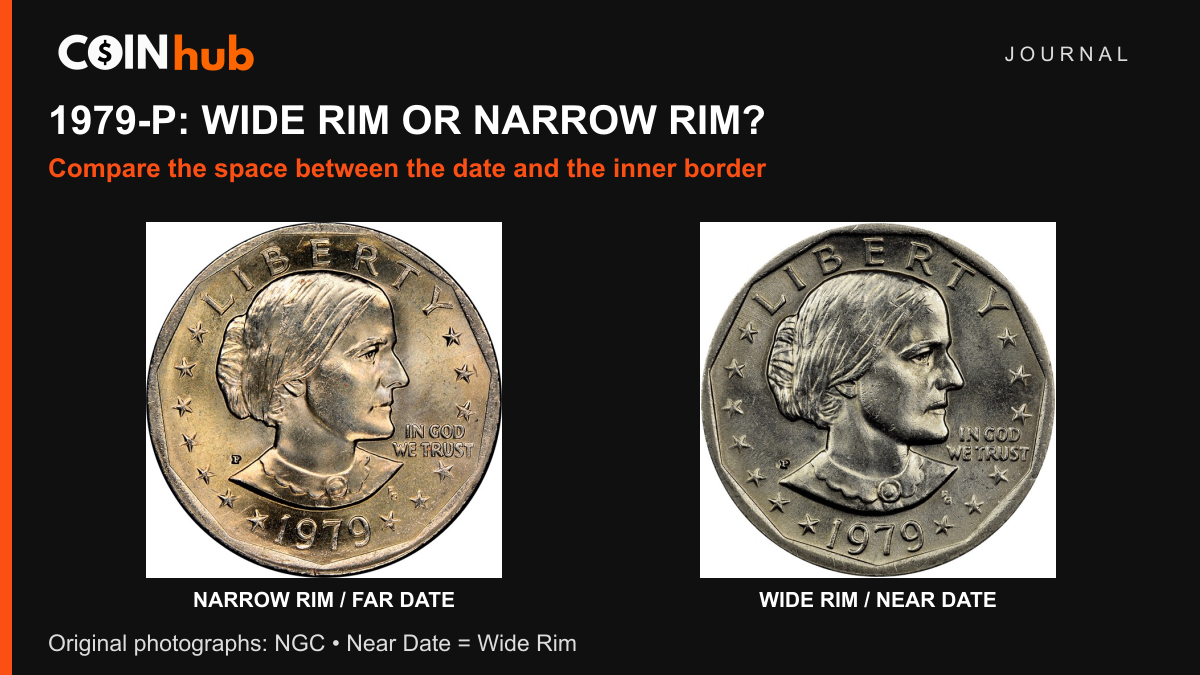
The relevant border is the raised, eleven-sided design inside the coin’s circular outline. Look directly below the four digits of 1979. The Wide Rim example has less open field between the date and that border; the Narrow Rim example has a more generous gap. These names do not describe two different face values or a coin that was cut to a larger diameter.
| Name on a reference or holder | Equivalent name | Area to compare |
|---|---|---|
| Wide Rim | Near Date | Smaller gap below the date |
| Narrow Rim | Far Date | Larger gap below the date |
The two complete obverse photographs above come from NGC’s documented examples. Compare the same area on each, especially the border directly below 1979. They are enlarged independently for viewing, so the graphic is an attribution reference rather than a ruler.
Why there are two names for one change
“Wide Rim” describes the border; “Near Date” describes its relationship to the date. PCGS’s historical account explains that the Philadelphia obverse-rim modification brought the border closer to the date. Both terms therefore describe the same design relationship from different directions.
Keep that naming issue separate from a mint error. The recognized rim variety is a repeatable design difference. An isolated dent, flattened edge or distorted patch should not be promoted into a Wide Rim attribution simply because it makes one part of the border look thicker.
Make a useful comparison photograph
Place the coin flat and hold the camera square to its face. Include the whole obverse, then make a second photograph showing the date and the border together. A close-up of the numerals with the border cut off removes the feature needed for comparison. Keep the uncropped original too.
Use soft light and try a second lighting angle if glare hides the gap. Avoid filters, sharpening that creates bright outlines, or a tilted view that compresses one side. Photograph the reverse and edge as supporting records. Our coin photography guide explains how to improve the view without cleaning the surface.
For an uncertain example, send those photographs with a short neutral note: “1979-P dollar; rim variety uncertain.” That gives a specialist more useful information than a firm claim built around a blurry crop. If the date or border has heavy wear or damage, a photograph may not settle the question.
Identify the variety before estimating value
Once the attribution is supported, compare transactions for that exact variety and comparable condition. Do not compare a worn raw coin with a top-grade certified example, or treat an unsold listing as an achieved price. The PCGS Wide Rim issue page is a starting reference for the correct issue name.
A useful collection entry keeps four things separate: the coin’s date and mintmark, the proposed variety, the evidence supporting it, and any remaining condition or authenticity questions. That record is more durable than copying an impressive price from a search result.
References and image identities checked September 21, 2026. This guide addresses attribution, not a current price estimate. Historical price figures in the linked 2020 and 2023 articles have not been reproduced as today’s values.