
A mark tied to the metal-checking role
An assayer's mark on a coin identifies its assayer. This was the mint official who checked precious-metal purity. The mark often takes the form of letters. A mintmark identifies where the coin was made; an assayer's mark points to a different part of the mint's work.
These marks are especially useful when reading older Latin American coins. NGC's guide to coin parts illustrates them on Mexican and Bolivian coins. An assay is a test of metal content or quality, as explained in the Royal Mint's glossary.
Keep the roles separate: A historical assayer mark is part of a coin's identification. Reading it is not the same as testing that coin today, and it does not by itself prove that the specimen is genuine.
Start with the whole coin
Before looking up initials, record the date, the coin's value as issued and the main design. The value as issued is its denomination. Then compare both faces with a reliable reference for that type. One letter on its own is too little to make a firm match.
This matters because the same letter can serve different roles. The Mel Fisher Spanish coin tables organize assayer marks by mint and period. They even note cases where P appears as both a Potosí mintmark and an assayer mark. A general alphabet of coin letters would miss that context.
Use such tables as a starting point for the exact series. Do not expand initials into a person's full name based only on a matching letter. Dates, paired initials and changes of officials can make the full attribution more involved than the mark first suggests.
Read the marks on this 1796 example
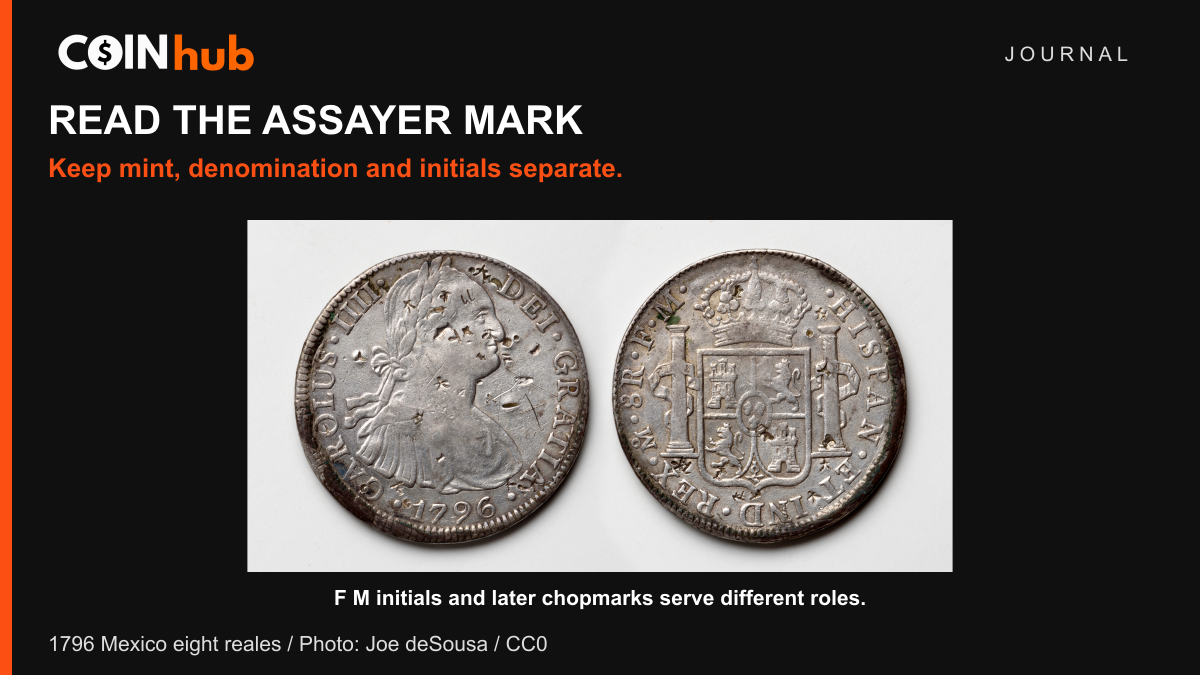
The photograph shows a 1796 Spanish colonial eight-reales coin from Mexico City. Both faces are shown: the portrait and date are at left, while the shield and pillars are at right. The photograph's source record identifies the Mexico City mintmark and the F M assayer initials.

On the right-hand face, read the group along the left side of the rim. The small o above M is the Mexico City mintmark. Next is 8R, the denomination. Farther up are F and M. Keep those groups separate in your notes instead of turning all the letters into one long mintmark.
- Date: 1796, below the portrait on the left-hand face.
- Mint: the M with a small o above it, on the right-hand face.
- Denomination: 8R, meaning eight reales.
- Assayer initials: F M, recorded as seen without guessing a full-name expansion.
That short record preserves four different clues. If a later reference disagrees with your reading, you can return to the exact photo and check one clue at a time. You have not committed to a grade, a price or a claim about an unseen coin.
The punched marks tell a different story
The same specimen has many small punched marks across its surfaces. The photo record describes these as chopmarks from Chinese coin testers and money-changers. They are separate from the original F M lettering in the coin's design.
Do not treat every mark associated with testing silver as an assayer's mint mark. A later punch and an original design element can appear on the same coin. CoinHub's guide to chopmarked Trade dollars explains the separate merchant-mark topic using U.S. Trade dollars.
Look at a clear reference before deciding which category an unfamiliar mark belongs to. A photo can show placement and shape, but an unusual punch may need specialist review. Avoid a dramatic explanation when the evidence supports only “unidentified mark.”
Use the initials as one part of the record
In your notes, give the date, mint, coin value and assayer letters their own fields. Save the reference and a full image of each face. If a letter is hard to read, say so instead of filling a blank with the most convenient match.
The mark can help you narrow an identification when it agrees with the rest of the coin. It cannot replace that wider check. Read the initials in context, preserve what you observed, and leave claims about authenticity or value for evidence that actually addresses those questions.