
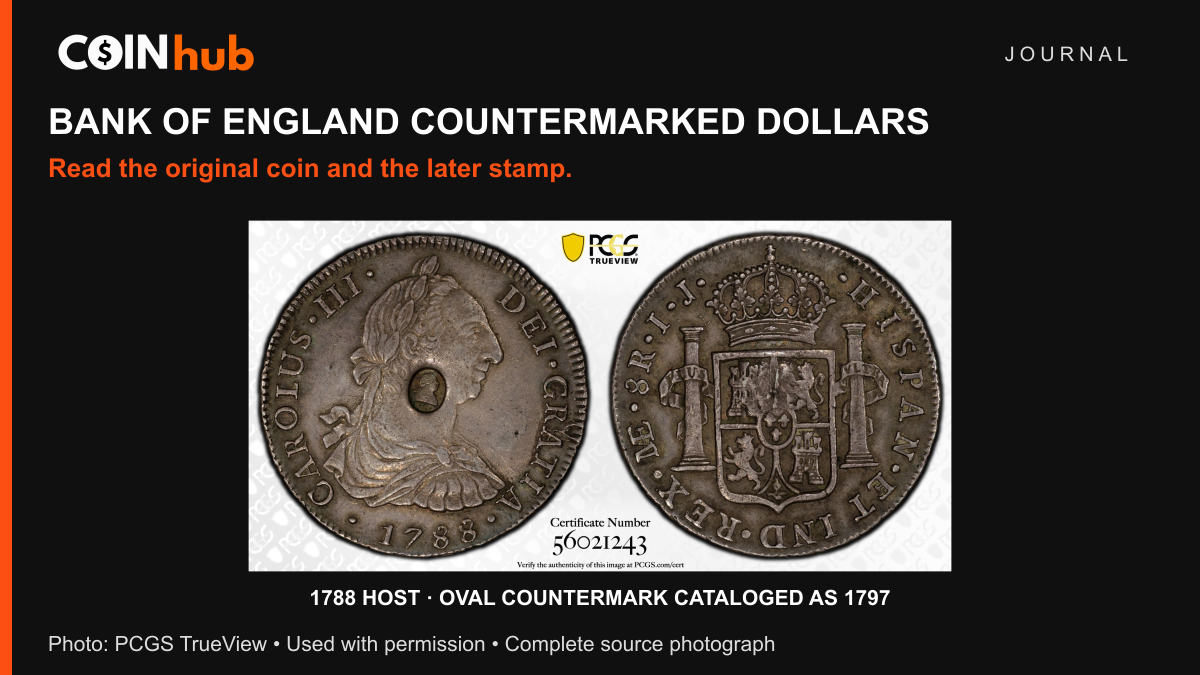
A Bank of England countermarked dollar joins a foreign silver coin to a small, later portrait stamp of George III. The oval mark belongs to the 1797 issue; the later octagonal mark belongs to 1804. Read the old coin first, then the added stamp. The large date on the coin need not be the date of the British countermark.
That distinction explains the photograph above. The host coin carries 1788 beneath its large portrait. Inside that portrait is a much smaller head in an oval. These clues show two stages in the coin's life. One date belongs to the old coin; the other belongs to its later use.
Start with the whole coin, then the small stamp
The host coin is the coin that existed before a countermark was applied. A countermark is a design struck into that coin with a small punch. The Bank of England Museum explains this reuse of existing coins, particularly Spanish eight-real pieces. Eight reales was a large silver coin often called a Spanish dollar.
In the full PCGS photograph, first find the large portrait, the surrounding letters and the date below it. Then find the small oval portrait stamped within the larger head. Turn to the reverse, or back, and record its shield, lettering and other marks. Keep photographs of both sides together.
PCGS certification 56021243 identifies this example as a 1797 countermarked dollar on a Peru eight-real coin. Its catalog references are S-3765A and KM-636. That record describes the pictured specimen; it does not authenticate another coin with a stamp that looks the same.
Use two lines in your notes: “Host coin: date, mint and denomination” and “Countermark: portrait, outline and reference.” Leave uncertain details blank. Keep the two parts clear. A short sales title may leave out facts you need.
Why Britain used foreign silver dollars
Britain was short of silver coins for daily use in 1797. The Royal Mint Museum's account of George III's coinage describes how Spanish dollars received a small oval stamp of the king's head. The punch came from the system used to mark silver plate. The stamped dollars entered circulation at four shillings and nine pence.
The point was to put existing silver to work. The Spanish design remained visible, while the added British portrait gave the coin a new role as British money. You may find the same piece listed as both a Spanish-American coin and a British issue with an added stamp.
H. E. Manville's archival study in the British Numismatic Journal documents the Treasury's March 3, 1797 warrant to countermark dollars at the Royal Mint. It also shows why this series needs more care than a simple picture match: the history includes false marks and later use of punches.
Oval, octagonal and a completely new design
The order of events helps. The first official issue used an oval portrait countermark in 1797. A later issue used an octagonal outline in 1804. “Octagonal” means eight-sided; it describes the stamp's frame, not the shape of the round host coin.
Do not confuse either small countermark with the fully overstruck Bank of England dollar. An overstrike places a new coin design over an older coin. The Royal Mint Museum explains that Matthew Boulton's Soho operation followed with a full George III and Britannia design dated 1804. Traces of the earlier coin can survive beneath that new design.
For a first sorting pass, look at how much of the coin the new design covers. Is there a small portrait stamp within a largely intact Spanish design, or a new design across the coin? That question helps you choose the right reference before comparing examples.
A genuine host does not settle the countermark
There are two parts to checking whether the piece is real. An old silver host can be genuine while its added mark is false or belongs to a different history. Manville discusses such problems, including genuine punches used beyond the official issues. The presence of a small king's head is therefore a clue to examine. It does not prove the coin was an official Bank issue.
Preserve sharp photographs of the stamp, both full faces and the edge. Avoid polishing the recessed mark to make it brighter. If the type or value matters, ask an expert who knows this exact series. Keep their written findings with the coin.
Also keep the later stamp apart from marks in the host's original design. CoinHub's guide to assayer marks explains another kind of mark found on old coins. A letter beside the shield and a portrait punched into the face need not tell the same story.
For the collection record, keep the host date, countermark type, reference number and any certificate distinct. The photographed example makes the lesson concrete: 1788 is visible on the host, while PCGS catalogs its oval countermark under 1797. Reading both layers gives the coin a clearer history without claiming that a lookalike must be real.