
Read the contrast designation separately from the grade
A mirrored proof coin can look dramatic without being labeled Cameo. The missing ingredient may be frost on the design—or enough of that frost on both sides. If you are comparing cameo vs. deep cameo vs. ultra cameo, start with the relationship between the raised design and the flat background, then read the rest of the holder label.
Cameo, Deep Cameo and Ultra Cameo at a glance
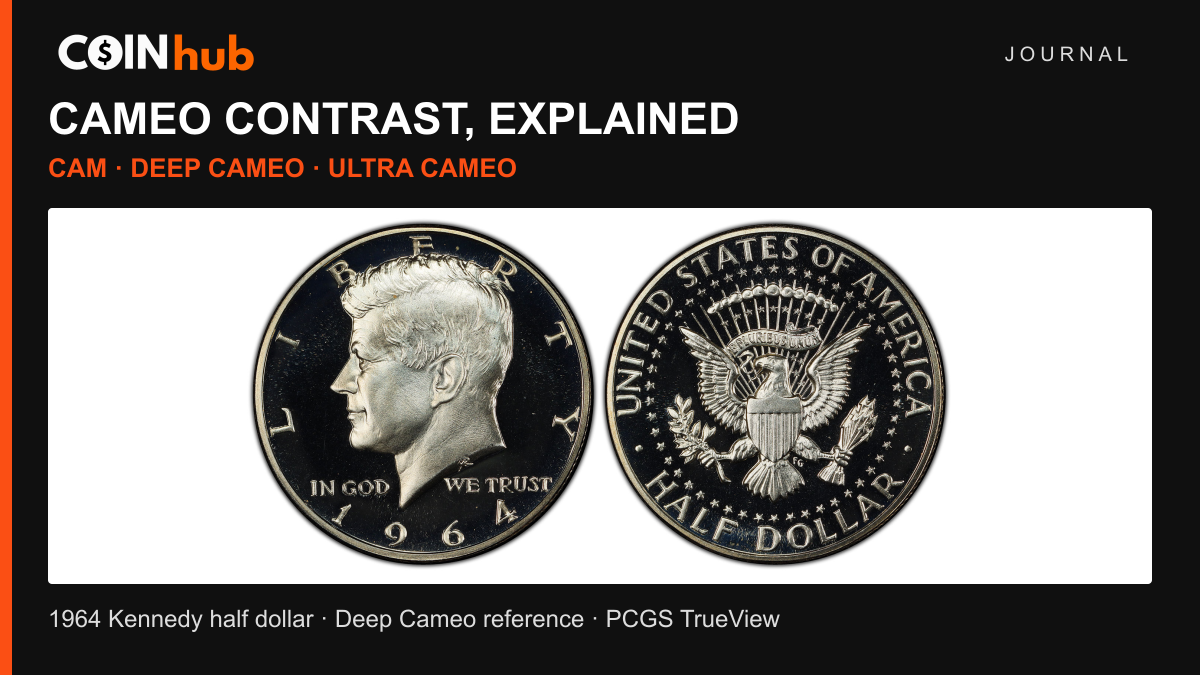
The devices are the design elements, such as a portrait or eagle. The fields are the open areas around them. On a brilliant proof with cameo contrast, the devices look frosted while the fields reflect light like a mirror.
| Term on the label | What it describes | What to check |
|---|---|---|
| Proof without a cameo designation | The coin is identified as Proof, without the additional contrast designation. | Do not treat the missing designation as proof that the coin is worn or improperly made. |
| PCGS CAM | Light to moderate frost on devices, with the required appearance on both sides. | Look beyond the most attractive portrait photograph. |
| PCGS DCAM | Deep, even device frosting on both sides. | Read the numeric grade as a separate part of the description. |
| NGC Cameo / Ultra Cameo | NGC’s contrast designations; Ultra Cameo describes the stronger effect. | Keep the grading service and full designation with any comparison. |
These distinctions follow PCGS’s designation definitions and NGC’s explanation of proof contrast. This guide focuses on U.S. brilliant proofs. Do not automatically apply its shorthand to every world issue: PCGS also recognizes cameo on specified Canadian specimen and prooflike strikes.
Why a higher number does not mean stronger cameo
Think of the label as answering different questions. The proof abbreviation identifies the strike category. The number reports the assigned grade. The cameo wording describes an additional surface characteristic. Learn the rest of the fields in our PCGS and NGC label guide.
For a hypothetical comparison, imagine two otherwise matching PCGS coins labeled PR68 CAM and PR67 DCAM. The first has the higher numeric grade; the second carries the stronger contrast designation. Neither label, by itself, tells you which coin you will prefer. Write down both pieces of information instead of mentally turning DCAM into an extra grading point.
Likewise, comparing a PCGS coin with an NGC coin requires more than translating DCAM into Ultra Cameo. Preserve the service name, exact issue and grade in your notes. Similar terminology is a useful starting point, not a promise that another service would assign the same result.
A practical routine for viewing both sides
- Read the full description first. Record the date, mintmark, denomination, strike category, grade and contrast wording. Avoid guessing a designation from an auction headline that abbreviates the label.
- Inspect the obverse and reverse under comparable light. Look at how the design separates from the surrounding field. Move the encapsulated coin gently through different viewing angles; keep the coin inside its holder.
- Look for consistency. A bright portrait in one image is only part of the evidence. Examine the reverse design too, and note areas where reflections make the appearance difficult to judge.
- Separate uncertainty from a diagnosis. A dark patch in a photograph may be a reflection. A bright patch may be glare. Ask for additional views when a purchase depends on what you cannot see clearly.
This routine helps you compare appearances; it does not replace an in-hand grading opinion. The reference photograph above is a real 1964 Kennedy half dollar that PCGS illustrates as Deep Cameo. We are not assigning a numeric grade to it or using it to certify another coin.
Three shortcuts to avoid
“Every proof must be cameo”
Proof is not another word for cameo. PCGS illustrates proof coins with and without cameo designations. A shiny field alone is insufficient. If your question is whether a reflective coin is a proof at all, start with prooflike versus proof coins.
“Reverse proof means even more cameo”
A reverse proof reverses the usual frosted-design and mirrored-field relationship. NGC does not apply its Cameo or Ultra Cameo designations to reverse proofs. Read that finish on its own terms instead of treating it as a higher step on a cameo ladder.
“Cleaning will bring out a better designation”
Do not alter a coin to chase a label. NGC explains that the underlying contrast is imparted during striking; conservation cannot manufacture a stronger effect. Surface residue may obscure contrast, but deciding whether professional conservation is appropriate is different from polishing a coin yourself.
Questions collectors ask
Is Ultra Cameo better than Deep Cameo?
Not simply because “ultra” sounds stronger. NGC describes Ultra Cameo as generally synonymous with Deep Cameo. Compare the actual coin and the complete certification details.
Does Deep Cameo guarantee a large premium?
No fixed premium follows from the word alone. If you research prices, compare the same issue, grade and designation, and distinguish completed sales from asking prices. A contrast designation is a description—not a dollar amount.
Can a photo prove a raw coin will receive CAM or DCAM?
No. Use photographs to decide what needs closer inspection, not to promise a future grading outcome. A useful description can remain modest: “strong contrast visible in these photographs; designation not independently assigned.”
Sources reviewed September 14, 2026: PCGS and NGC guidance linked above; PCGS non-cameo and cameo examples; Canadian-strike exception. Label comparison is hypothetical. No historical population figures are presented as current counts.