
Give every population number its missing context
Two listings can both advertise a low population while describing different groups of coins. One might refer to a variety; another might refer to a designation within a grade. Before comparing their claims, write down exactly which report rows and columns the sellers used.
Population, mintage and survivors answer different questions
| Number | Question it addresses | Limit |
|---|---|---|
| Original mintage | How many were produced for the issue? | Does not tell you how many survive in a particular condition. |
| Grading-service population | How many certifications does this service currently record in the selected category? | Scope and submission history matter. |
| Survival estimate | How many examples are thought to remain? | An estimate needs a method, scope and source. |
PCGS’s population-report guide distinguishes reported grading counts from the total number of coins in existence. It also shows why a coin plentiful in lower grades can become difficult in higher grades. That pattern is a starting point for research, not a reason to ignore the particular coin being offered.
A fictional example: population 12, two higher
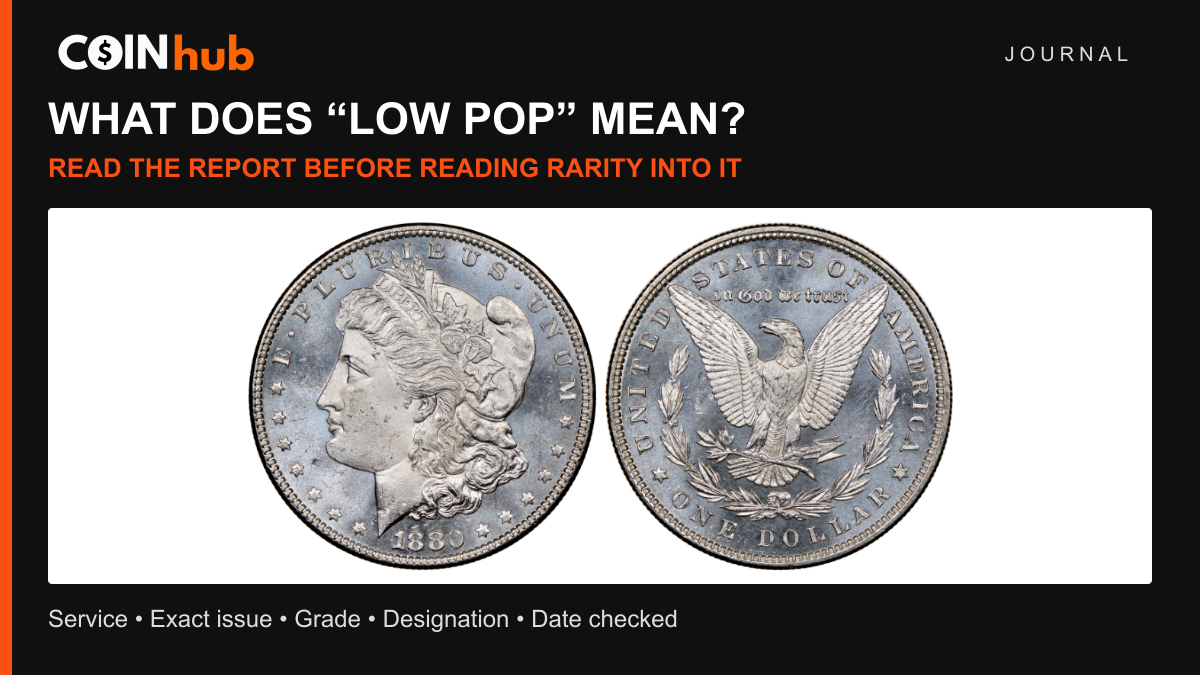
The following numbers are invented for teaching. They describe no real issue, service or coin in the hero photograph. Suppose a selected report row shows:
| Grade column | Recorded count |
|---|---|
| MS64 | 80 |
| MS65 | 12 |
| MS66 | 2 |
| MS67 and higher | 0 |
For that exact selection, there are 12 recorded at MS65 and two recorded above it. “Twelve at this grade, two higher” describes the table. “Only 14 coins survive” goes beyond it. So does “this is the thirteenth-best known,” because the report has not ranked every surviving coin.
If you change the variety or designation filter, read the headings again. Do not carry the old count into the new selection. If the report separates plus grades or other subcategories, check how those columns contribute before calculating a higher-grade total.
Why a report cannot count every surviving coin
Raw coins outside the service’s submissions are absent from its graded population. A common issue can have a small certified count when owners have little reason to submit ordinary examples. Another grading service also keeps its own records.
In his NGC discussion of population reports, Jeff Garrett explains that resubmissions and unreturned old labels can distort totals. A coin removed from a holder and graded again can leave more than one record if the old record is not removed. Corrections can also reduce a count.
For that reason, adding service totals does not establish a count of unique surviving specimens. Nor does a change between two snapshots, by itself, reveal whether a new coin was discovered, an existing coin was resubmitted or a record was corrected. Record the change; investigate its explanation separately.
How to make a comparison you can reproduce
- Start with the label. Record the service, date, mintmark, denomination, grade and every relevant designation. Our coin-label guide explains those fields.
- Open that service’s report. Use the PCGS Population Report or NGC Census, as appropriate.
- Match the precise category. Check strike type, variety and designation. A general issue row may not answer a narrow variety claim.
- Save the headings with the counts. A cropped number without a row label is weak evidence. Keep the source URL and date checked in your inventory notes.
- Compare like with like. Repeat the same selection for the second listing. If the services or categories differ, identify that difference explicitly.
NGC’s Census FAQ describes its date, mint, denomination and strike-type searches, plus variety and Details options. It states that the Census is updated on Mondays. Save your access date because a later reader may see different figures.
Use low population as a research question
A useful follow-up is: “Why is this count low?” Possibilities worth investigating include a genuinely difficult condition level, a narrowly selected category or a low submission rate. The report alone does not choose among those explanations.
NGC cautions on its Census page against assuming that the figures establish rarity or value. Inspect the coin, examine appropriate completed sales, and separate scarcity evidence from a seller’s asking price. Our auction-terms guide helps keep reported prices comparable.
Does “none higher” mean the finest coin that exists?
It describes the higher-grade records within the cited service and selection at the time checked. It does not establish that no better raw coin or differently certified example exists.
Can a certified population decrease?
Yes. Corrected records can change totals. Save both dated observations if tracking a change, and avoid assigning a cause without supporting information.
Sources checked September 14, 2026. All worked numbers are fictional. No current population, valuation, investment return or grade is asserted for the pictured Morgan dollar.