
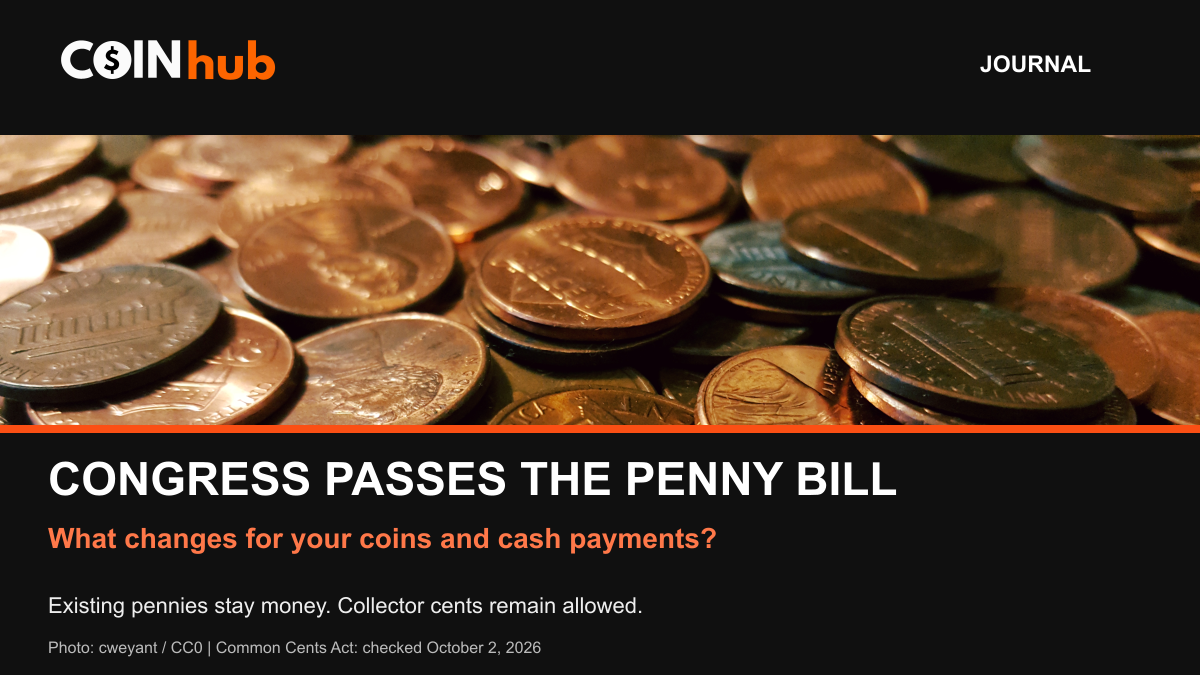
Congress has passed a bill to end penny production for everyday use. But the pennies in your pocket are not being recalled, and the bill leaves room for new cents made for collectors.
The Senate passed H.R. 10167, the Common Cents Act, without changes on September 28, 2026. The House had passed it on September 14. As of our October 2 check, Congress.gov lists the bill as Passed Senate, with no enactment recorded. Passing Congress is a major step, but it is not the same as becoming law.
For coin collectors, the biggest question is not whether every penny disappears. It is what happens to the coins we already own, the cents the Mint could still sell, and the way people pay with cash.
Why Congress is acting after the Mint stopped making pennies
If this news sounds familiar, there is a reason. The U.S. Mint held its ceremonial final strike for circulating pennies in Philadelphia on November 12, 2025.
The new bill addresses what comes after that production stop. It would write an end to general-circulation cent production into federal law. It also sets out cash-rounding rules and calls for a plan to help move existing pennies through the banking system.
Those are different jobs. Stopping the presses does not remove coins from change jars, cash drawers or bank vaults. Nor does it tell a store how to handle a cash total when it cannot provide the last few cents in change.
Your pennies would remain money
The Senate-passed bill's text protects the legal-tender status of cents issued before it becomes law. In plain English, those coins would still count as money for debts, taxes and other public charges.
The Mint's penny information page also says existing pennies remain legal tender. The bill is not a recall, and it does not set a deadline for turning in your cents.
That does not promise that every bank branch will have penny rolls ready when you ask. The bill treats distribution as a separate problem. It would require the Federal Reserve to report on penny orders, deposits and access, including the effects on people who rely on cash.
The collector exception matters
The bill draws a clear line between cents made for daily spending and cents sold to collectors. It would stop the first while allowing the Treasury secretary to continue minting and selling the second.
The term used in the bill is numismatic items. Here, that means coins made for the collecting market rather than for everyday change.
This is permission, not a new product announcement. It does not promise a specific year's proof cent, a certain mintmark, a release date or a limited mintage. A claim about a future collector penny still needs its own official Mint announcement.
That distinction is worth keeping in mind when a listing calls a coin the "last penny." Last regular circulation issue, last coin struck at a ceremony and last collector issue are not the same claim. Ask which one the seller means and what evidence supports it.
How cash rounding would work
The bill would allow rounding when exact change cannot be provided. It would not require every purchase to be rounded, and it would not tell stores to round each item on a receipt.
Instead, the rule covers the final cash amount, including tax, or the change owed. The usual pattern would round that amount to the nearest five cents:
- Down: Amounts ending in 1, 2, 6 or 7 cents. For example, $12.42 would become $12.40.
- Up: Amounts ending in 3, 4, 8 or 9 cents. For example, $12.43 would become $12.45.
- No adjustment: Amounts already ending in 0 or 5 cents. A $12.45 total would stay $12.45.
These examples describe the bill, not a new nationwide rule already in force. The text also allows further rounding in the customer's favor. A total of only one or two cents could be rounded up to five cents.
Cash wages have a separate safeguard: if an employer chooses to round a cash payment under this provision, it must round up. The bill does not excuse failures to meet minimum-wage, overtime or paid-leave requirements.
Card payments, electronic transfers, checks, gift cards and the other listed noncash methods are outside this rounding provision. A $12.43 card purchase would not become $12.45 because of this bill.
There is a nickel provision, too
H.R. 10167 also allows a possible change to the five-cent coin's metal. A nickel could have a zinc inner layer and nickel outer layer, but only after tests address cost and compatibility with machines that accept coins.
That is not an announcement that a new-composition nickel is already in your change. The tests and the decision to use a different metal remain separate steps.
CoinHub's earlier report on a possible nickel composition change covered H.R. 3074. The bill that passed the Senate on September 28 is H.R. 10167. Similar names make the bill number and text version important.
What penny collectors should take from the news
This is a significant chapter in the penny's story, but it is not a reason to treat every cent as rare. A production change does not, by itself, establish the value of a particular coin.
Start with the coin, not the headline. Check its date, mintmark and condition. If a seller asks more because it is a final-year issue, compare sales of the same issue and grade. An asking price alone does not show what buyers will pay.
For a low-cost keepsake, setting aside an example of the final circulating year can be a way to remember the change. That is a collecting choice, not a promise that the coin will rise in value.
The next key development is the bill's legal status. After that, watch for official guidance on cash payments and separate Mint notices about collector products. For now, the supported headline is straightforward: Congress has passed the penny bill. Existing cents would remain money, and collector cents would still be allowed.
Reporting checked October 2, 2026 against Congress.gov's action record and September 15 Referred in Senate text, plus U.S. Mint releases. The Senate passed that bill without amendment on September 28. This updates CoinHub's earlier coverage of the same measure.