
What is a counterbrockage coin error?
A planchet is the prepared metal disc that receives a coin's design. In this error, another piece of coin metal supplies part of that design. The result may look stretched or incomplete, even though the portrait faces the expected direction.
Start with the relief: does the unusual design rise above the surface or sink into it? Then check which way it faces. Those observations are more useful than calling every large, blurred portrait a counterbrockage. A photo alone may not settle how the coin was made.
Why a second transfer produces a raised image
A raised design pressed into soft metal leaves a recessed copy. Press that recessed copy into another blank and the next image rises again. Think of the sequence as raised, recessed, then raised. The second transfer also reverses the mirror effect of the first.
Mint Error News describes one route through a capped die. A struck coin sticks to a die, the steel tool that normally impresses the design. Another struck coin presses its raised design into that cap. The cap then carries a recessed impression that can transfer a raised image to a fresh blank.
The broader Error-Ref definition centers on a brockage-bearing coin striking a planchet. Examples can be centered or off-center, aligned or rotated. The amount of spreading depends on earlier strikes and whether the metal was held by the collar around the striking area. One dramatic shape is not a rule for every example.
Read the genuine Indian cent shown above
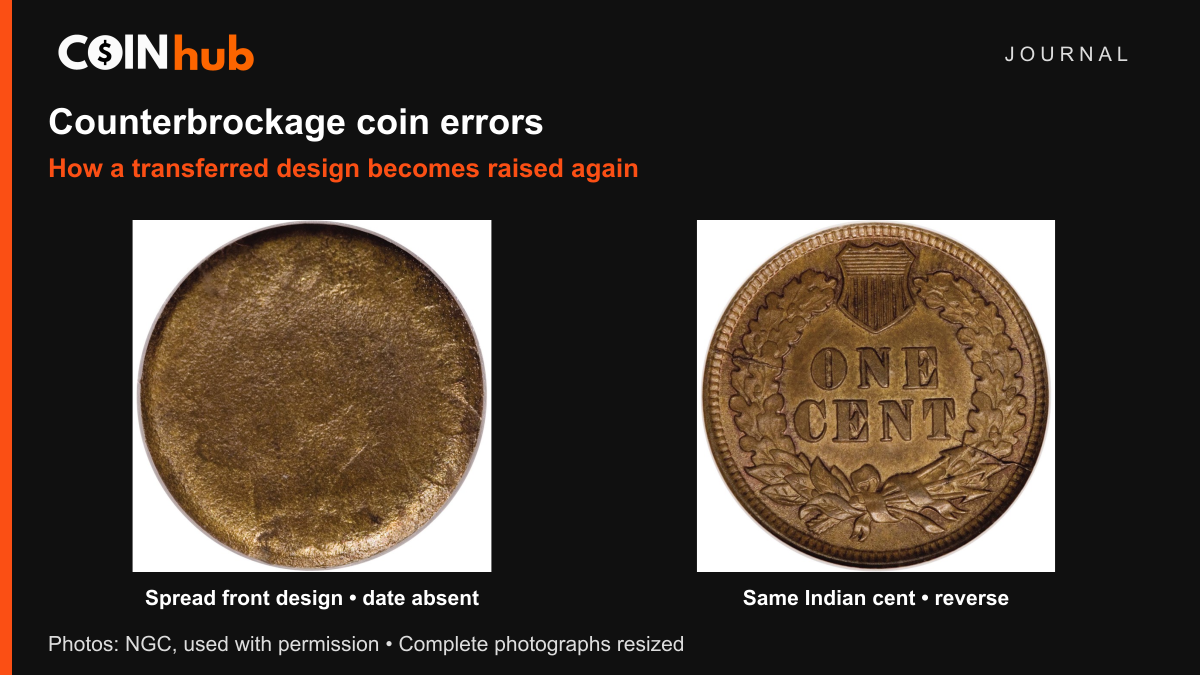
The photographs show the two faces of an undated Indian cent documented by NGC. NGC identifies an obverse counterbrockage and grades this specimen MS 65 BN. The front is the obverse; the wreath and ONE CENT side is the reverse.
The enlarged portrait occupies much of the front. NGC notes that the date and the surrounding UNITED STATES OF AMERICA lettering are missing. Its reference to 1859–1909 identifies the Indian cent series, not this coin's exact year. The missing date cannot safely be supplied from the illustration.
Compare the broad, spread portrait with the recognizable reverse design. This pairing makes the example useful: a coin's two faces can preserve very different evidence from the same striking event. The photograph is a reference specimen, not a grade or authenticity judgment for another coin.
Counterbrockage, brockage and a die cap
- Brockage: The transferred design is recessed and mirrored. See the brockage identification guide for that distinction.
- Counterbrockage: A further transfer from a brockage-bearing surface produces a raised image with normal orientation.
- Die cap: This describes the coin stuck to a die. Its form and the coins it strikes are related evidence, but they are not the same object. The capped-die guide explains the cap itself.
Make a useful observation record
Photograph the whole front and back straight on, then take a close view of the unusual design under light from the side. Keep both the full coin and the close-up. A tight crop that removes the rim can hide the very area needed to judge the spread.
- Record which details are raised, recessed or unclear.
- Note the direction of the portrait and any readable lettering.
- Describe missing details without inventing a date or mint mark.
- Keep the coin unchanged while an error specialist reviews it.
A useful note might say, “Raised portrait, normal direction, date not visible; reverse photographed.” That is stronger evidence than a confident error label with no supporting views. Do not rub or scrape the surface to make a feature easier to see.
For broader reading, my book The CoinHub: An Ultimate Guide to Coin Errors is an optional introduction to the field. I am its author, Blake Alma. A book or photograph does not replace examination of the actual coin.