
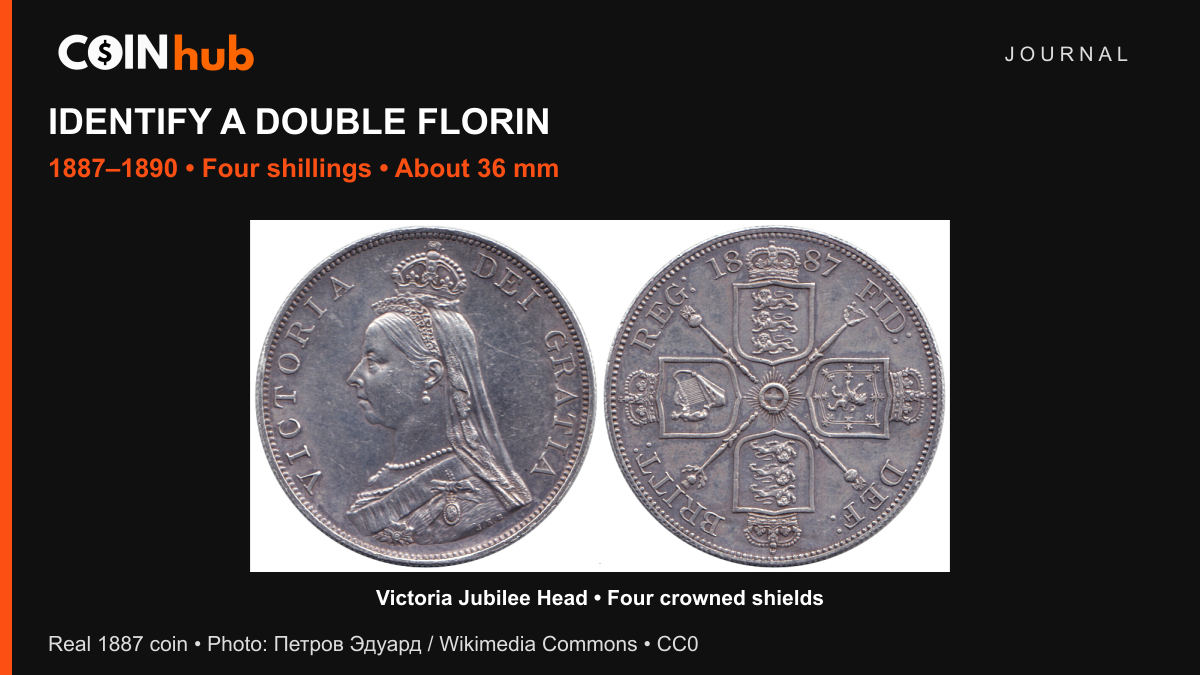
The British double florin is a four-shilling silver coin struck from 1887 to 1890. Look for Queen Victoria's Jubilee portrait on the front and four crowned shields around a central star on the back. The standard diameter is about 36 mm and the standard weight about 22.62 grams.
The name tells you its place in the old currency: a double florin was worth two florins. It was not the same denomination as a crown, even though both were large silver coins. Check the date, both designs and measurements together before labeling an unfamiliar example.
Four shillings, not four pence
A florin represented two shillings. The double florin represented four, while a crown represented five. With 12 old pence in a shilling, the double florin's face amount was 48 pence, or one-fifth of a pound.
These are old face values, not modern collector prices. The word double also does not describe an error or a doubled image. Here it is simply part of the denomination—the coin's stated monetary value.
For the smaller two-shilling coin and its nearby denomination, see our florin versus half crown guide. A half crown was two shillings and sixpence. Keeping the full names in your notes avoids confusing these amounts.
Check the date and portrait
The Royal Mint Museum identifies the double-florin issue as 1887–1890. Its collection includes a carefully made standard weight from 1887. The four-year span is a useful first check, but a date within it is not proof that a coin is a double florin.
The front, or obverse, shows Victoria facing left with a small crown and a veil. This is her Jubilee Head portrait. On the example pictured above, the surrounding words read VICTORIA DEI GRATIA.
The date appears on the reverse, the back of the coin. In the 1887 photograph, it is split above the upper shield, with 18 to the left and 87 to the right. Read both parts. A worn first digit can be easy to miss if you expect the whole date to sit together.
Look for the four-shield reverse
Four crowned shields form a cross around a central star. The shields carry English lions, the Scottish lion and the Irish harp; sceptres fill the spaces between them. The Museums Victoria record for an 1889 example describes this arrangement and identifies the denomination as four shillings.
The photograph in this guide shows a real 1887 coin. Use it to understand the overall layout, then compare your coin with a record for its exact date and variety. A variety is a recognized difference within an issue. Small lettering details need a closer reference than a general photograph.
Do not use Victoria's portrait alone to identify the coin. Other denominations from her reign can show a similar portrait. Nor should a single shield or star settle the question. You want the complete design, date and physical size to agree.
Measure without treating the result as a verdict
The Royal Mint's double-florin specification lists .925 sterling silver, 22.62 grams and a 36 mm diameter. Sterling silver contains 92.5% silver. Those figures describe the type's standard, not an exact reading guaranteed for every surviving coin.
A worn coin may weigh less. The Museums Victoria 1889 specimen, for example, is recorded at 22.361 grams and 36 mm. That individual measurement should not replace the standard, and a similar weight cannot prove that another coin is genuine.
Use a suitable scale and measure carefully over a soft surface. Record the result as measured, including the unit. Do not file an edge, scrape a surface or polish away toning to test the metal. If the design and measurements disagree, leave the identification open and ask a qualified specialist.
Why it is called the “barmaid's ruin”
The Royal Mint recounts the traditional explanation: the double florin could be mistaken for the more valuable crown, causing errors in change. It presents stories about the consequences for barmaids as an anecdote. The nickname is memorable, but it is not a test of rarity or a price guide.
For practical identification, write three separate notes: the four-shilling denomination, the date you can read, and the design features you matched. Add your measured weight and diameter, with clear photographs of both sides.
Only after that should you compare sale records for the same issue and condition. A four-year series does not make every surviving example rare or expensive. Keep asking prices, completed sales and your own coin's unresolved condition separate in the record.
Sources checked October 8, 2026: Royal Mint, Royal Mint Museum and Museums Victoria references linked above. The main image is a licensed real 1887 specimen; no grade or value is assigned from the photo. Face-value calculations are explanatory rather than appraisals.