
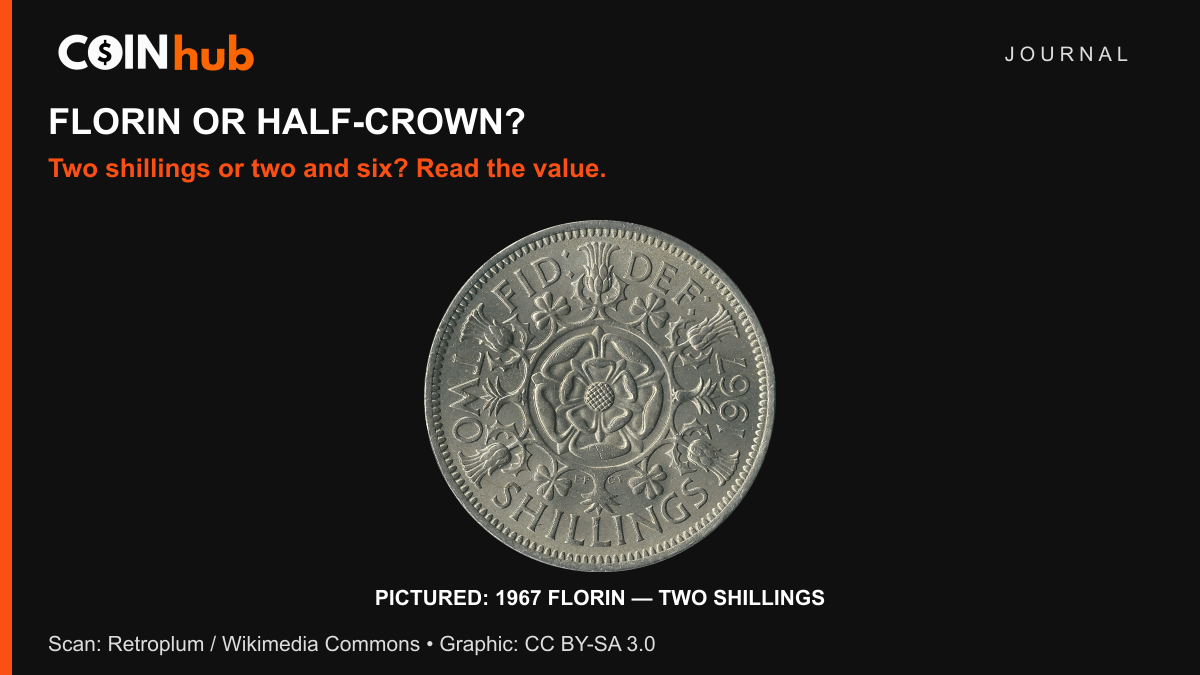
A British florin was worth two shillings, or 24 old pence. A half-crown was worth two shillings and sixpence, or 30 old pence. The half-crown had the higher face value. Neither name tells you what a collector will pay today.
To sort a loose coin or check a listing, start with its country, date and value words. Then compare its size with the right issue. A portrait of the same king can appear on both coins.
Quick check: Two florins made four shillings. Two half-crowns made five shillings. They were separate denominations, not two names for the same coin.
Read the old money first
The old British pound held 20 shillings, with 12 pence in each shilling. The letter d meant pence; s meant shillings. These are old units, not today's decimal pence.
| Coin | Old face value | Share of £1 | Coins making £1 |
|---|---|---|---|
| Florin | 2 shillings = 24d | One tenth | 10 |
| Half-crown | 2 shillings 6 pence = 30d | One eighth | 8 |
“Two and six” means two shillings and sixpence. Written as 2/6, it is not a fraction and does not mean 2.6 shillings. The six pence add half a shilling, so the total is 2½ shillings. A florin plus a sixpence therefore matched one half-crown in face value.
Use the reverse, then the date
The reverse is the side opposite the main portrait. Read all of it, including the rim. The genuine 1967 florin pictured above says TWO SHILLINGS. That is a direct value clue; a seller's title is only a claim to check.
Designs changed through time. The Royal Mint Museum explains that the florin began in 1849 as a step toward decimal money. Some later Victorian florins carry dates in Roman numerals. An unfamiliar date or design does not by itself make a coin an error.
Keep the scope British. Other countries also issued coins called florins, and similar royal portraits appear across many countries. A name match alone does not establish which catalog entry applies.
Compare measurements for one defined period
These catalog specifications apply to the 1937–1946 George VI British types. They are not a table for every florin or half-crown. In particular, the 1967 coin in the header is a later illustration, not the silver issue measured here.
| Type | Catalog reference | Standard mass | Diameter | Silver proportion |
|---|---|---|---|---|
| Florin | KM 855 | 11.3104 g | 28.3 mm | 50% |
| Half-crown | KM 856 | 14.1380 g | 32.3 mm | 50% |
NGC's World Price Guide lists these measurements using NumisMaster data. Standard mass means the catalog target, not a promise that a worn coin will weigh exactly that much. These figures also do not prove that a piece is genuine.
For a safe first check, place the coin on a suitable scale and record the reading. Measure the diameter without scratching the edge. If the date, design and measurements disagree, leave the identification open. Do not force it into the nearest row or clean it to make the details easier to see.
Separate denomination, metal and market price
A half-crown's old face value was 25% higher than a florin's. That does not mean every half-crown sells for 25% more. A fair price comparison needs the same date, type and condition, plus any important variety and evidence of past sales.
Metal is a separate check. Read our British silver coin date guide once you know the denomination. A silver-colored coin is not proof of silver, and an old face-value calculation is not an appraisal.
The florin later served as 10 decimal pence and remained in use until 1993. The half-crown was withdrawn at the end of 1969. That history explains why a late florin may sit beside decimal coins in a family collection; it does not give it current spending power.
Keep a record that another collector can check
For an unclear listing, ask for clear images of both sides, the complete date, diameter and weight. Save the exact value wording too. “British George VI, 1942, TWO SHILLINGS, about 28.3 mm” gives a reader far more to test than “old silver crown.” Keep uncertain details marked as uncertain until the evidence fits.
Sources and image credit
- Royal Mint Museum: pounds, shillings and pence.
- Royal Mint Museum: the florin and its relationship to the half-crown.
- NGC World Price Guide: florin KM 855 and half-crown KM 856, NumisMaster specifications.
Header: genuine 1967 florin reverse, scanned by Retroplum via Wikimedia Commons. Complete scan resized within a new layout; no coin details changed. Scan and adapted graphic: CC BY-SA 3.0. CoinHub trademark rights remain separate. Not actual size.
