
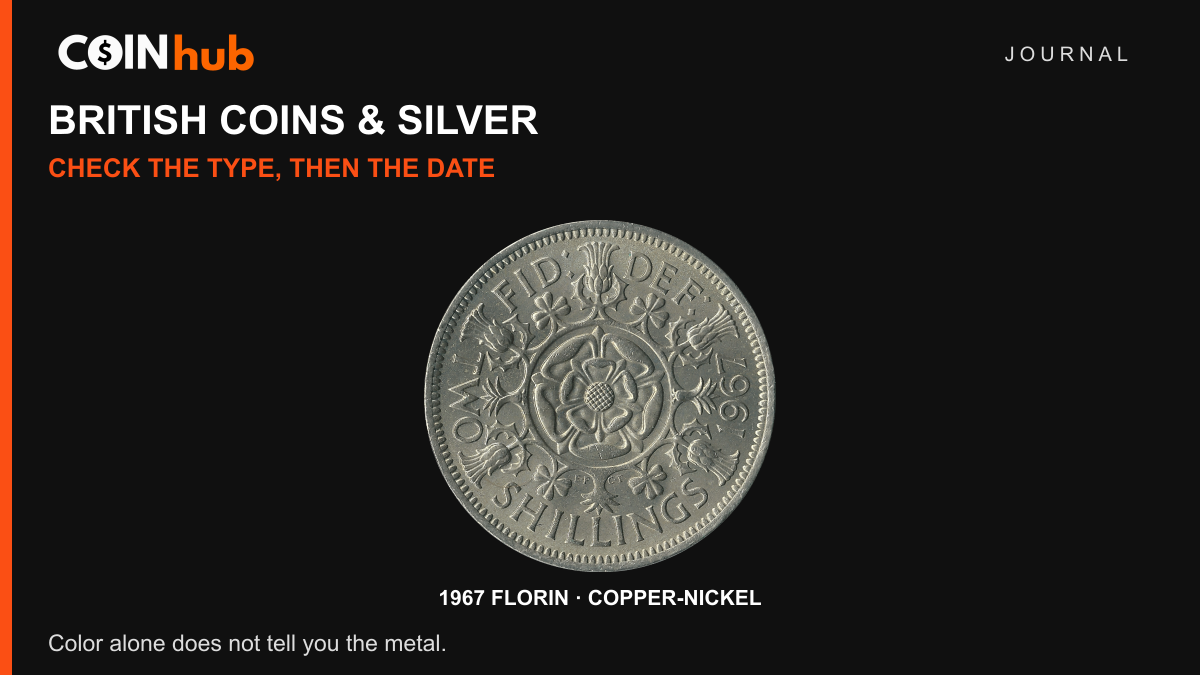
Many familiar British silver denominations dated before 1920 contain 92.5% silver. Most of their 1920–1946 issues contain 50% silver. The regular silver-colored coins changed to copper-nickel in 1947. But the coin type matters: 1920 has exceptions, the twelve-sided brass threepence is not silver, and later Maundy, bullion and collector coins can contain silver.
A date is a useful starting clue, but it cannot answer every question about a mixed jar of British coins. First read the face value, called the denomination, and match the design. A silver-colored florin, a tiny Maundy penny and a large bronze penny follow different rules.
This guide covers common British coins from the 1800s and 1900s, plus a few newer types. Older coins and coins made for other parts of the world need their own checks. A king or queen's portrait alone does not prove that a coin is a United Kingdom issue.
Start with the type, then use the date
The Royal Mint Museum dates the last issue of sterling silver circulating coins to 1920 and the last 50% silver issues to 1946. Sterling means 925 parts silver in every 1,000 parts of metal, or 92.5%. An alloy is a mixture of metals.
| Coin or group | Useful starting rule | Check before deciding |
|---|---|---|
| Common nineteenth-century silver denominations through 1919 | Generally .925 sterling silver | Match the crown, half crown, florin, shilling, sixpence or silver threepence. Do not include ordinary bronze pennies. |
| 1920 silver denominations | A transition year to .500 silver | Sixpences and threepences were struck in both .925 and .500 silver. Do not choose purity from the date alone. |
| 1921–1946 regular silver issues | .500, or 50% silver | Only the silver types belong here. Not every denomination was issued in every year. |
| Regular silver-colored issues from 1947 | Copper-nickel replaced silver | A later florin can look silver without containing precious metal. |
| Twelve-sided threepence introduced in 1937 | Nickel-brass, not silver | Distinguish it from the much smaller round silver threepence. |
| Maundy, silver bullion and special collector versions | Use the exact issue's specification | The general circulation cutoff does not identify these coins' metal. |
The transition details are set out in Chards' denomination-specific silver guide. Its 1920 exceptions are important when sorting small coins. A blanket “everything before 1947 is silver” rule would also sweep in base-metal coins that never belonged in that group.
Why 1920 needs a closer look
The Museum's history of George V's coinage explains that rising silver prices led to the lower standard. The Mint first struck the new 50% silver alloy in April 1920. It used three different 50% alloys within the first two years.
For a 1920 sixpence or threepence, write “silver; purity unknown” until you can check the alloy. Both types contain silver, but they do not hold the same amount. A worn date, surface color or a seller's loose label is not enough to settle the question.
Keep the coin intact. Do not scrape it, apply acid or drop it on a hard surface to hear its ring. If the precise metal content matters, ask a qualified coin specialist about an appropriate non-destructive check. The aim is to learn about the coin without creating new damage.
Two different threepences can share a date
The Museum's wartime coinage account describes the twelve-sided nickel-brass threepence introduced in 1937. It replaced a much smaller round silver coin. Shape and size therefore matter alongside the date.
Imagine a tray containing a round 1938 silver threepence and a chunky twelve-sided 1938 threepence. Applying the same 50% silver rule to both would be a mistake. Identify the physical type first, then use the matching catalog entry.
The same caution applies to pennies. An ordinary large bronze penny does not become silver because it predates 1920. A small ceremonial Maundy penny is a different coin. Keep those separate in your notes rather than grouping them under the word “penny.”
1947 ended silver in regular issues, not every British coin
The Museum's account of the postwar change says the new copper-nickel coins were all dated 1947. Banks began receiving them on January 2. The 1967 florin pictured above is a later copper-nickel example. Its pale color does not make it a silver coin.
Maundy money belongs in a separate category. The Museum describes a set of four small silver coins used for the ceremony. Chards records .500 Maundy issues from 1921 through 1946 and a return to sterling in 1947. Match the year and denomination instead of assuming every Maundy piece has always had the same fineness.
Modern silver bullion is another clear exception. The Royal Mint's 2013-onward one-ounce Silver Britannia specification lists .999 fine silver and one troy ounce of pure silver. This describes that bullion product, not every coin showing Britannia or carrying a £2 face value.
Special collector coins can also come in different metals. Read the original specification or certificate for the exact version. A proof finish describes how a coin was made; the word “proof” alone does not tell you its metal. Our proof versus prooflike guide explains why finish and manufacture need their own check.
Calculate silver weight only after identification
For a worked example, NGC's NumisMaster-based entry for the 1937–1946 florin lists a standard weight of 11.3104 grams and .500 fineness. That gives 5.6552 grams of silver, or about 0.1818 troy ounce. A troy ounce is about 31.1035 grams.
Silver weight = coin weight × silver fraction.
For this florin: 11.3104 g × 0.500 = 5.6552 g of silver. This uses the catalog standard, not a measurement of your individual coin.
Wear can reduce a coin's weight. A metal-content calculation also does not give its full collector value or a guaranteed dealer offer. Date, condition, authenticity and demand can matter beyond the silver. Keep an unusual or high-quality coin separate until you have assessed it.
For a mixed tray, make three groups in your records: a confirmed silver type, a confirmed base-metal type and an unresolved coin. For example, the cataloged 1946 British florin fits the first group; the illustrated 1967 florin fits the second. A 1920 small silver coin with unconfirmed purity stays unresolved for the calculation.
Take a photo of each side, save the source you used and note what you still need to check. Our coin collection records checklist helps keep those details together. You can then return to those coins without mixing a guess into the silver total.
Sources checked September 30, 2026: Royal Mint Museum and Royal Mint references, Chards' historical fineness notes, and NGC's NumisMaster-based florin specifications linked above. The tray examples are illustrative, not reports of coins examined by CoinHub. Real 1967 florin scan: Retroplum / Wikimedia Commons, CC BY-SA 3.0. CoinHub resized the complete scan and added the labeled Journal layout; the adapted graphic is shared under the same license. No photographer or royal endorsement is implied.
