
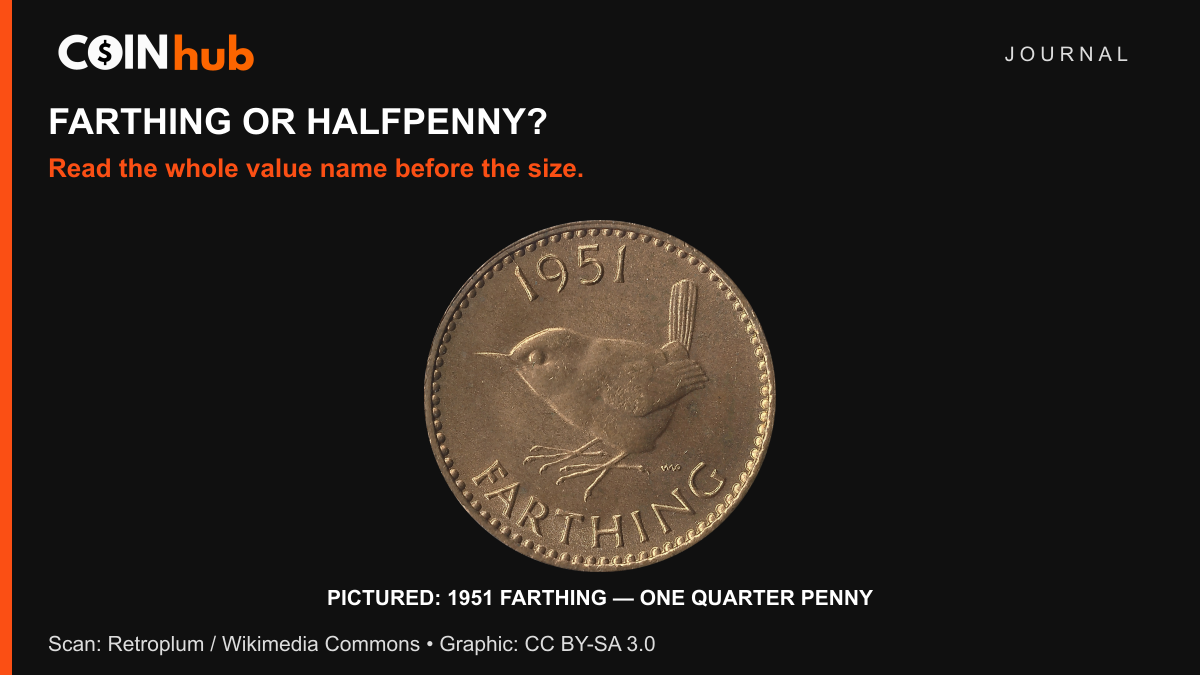
A British farthing was one quarter of an old penny. An old halfpenny was one half of a penny, so two farthings made one halfpenny. That is a value ratio, not a rule that one coin must be half the width of the other.
Start with the date and full value name. “Halfpenny,” “half-farthing” and the later decimal halfpenny mean different things. A small brown coin and a royal portrait are not enough to choose between them.
Keep the units: ¼d means a quarter of an old penny. ½d means half an old penny. A later coin marked ½p belongs to the decimal system.
Two farthings made a halfpenny
The old British system had 12 pence in a shilling and 20 shillings in a pound. Use those units when reading an old coin label or price list.
| Coin | Share of one old penny | Number in a penny | Number in a shilling |
|---|---|---|---|
| Farthing | ¼d | 4 | 48 |
| Old halfpenny | ½d | 2 | 24 |
For example, three farthings plus one halfpenny total five farthings, or 1¼ old pence. This is just face-value arithmetic. It says nothing about the worth of those four coins as collectibles.
A wren is a useful clue for later farthings
The genuine 1951 farthing shown above has a wren, its date and the word FARTHING on the reverse. Read the word as well as the picture. The header shows one coin, enlarged, and is not a size comparison.
In 1937, the wren took the place of Britannia on British farthings. The halfpenny received a sailing ship. Earlier copper and bronze pieces can both show Britannia, so “has Britannia” does not settle the denomination. Check the whole design and the date against a reference for that issue.
The Royal Mint Museum traces both denominations back to medieval silver coins. Later copper halfpennies and farthings began in 1672. A brown color rule therefore cannot identify every coin across their long history.
Half a farthing is not half a penny
Read the last word in the name. A half-farthing is half of a farthing, so it is one eighth of an old penny. Four half-farthings equal one old halfpenny. Missing that word changes the value by a factor of four.
The Royal Mint Museum records that half-farthings were first made for use in Ceylon, now Sri Lanka. They later gained legal-tender status in the United Kingdom. Third-farthings for Malta and quarter-farthings for Ceylon did not become UK legal tender. A British royal portrait alone does not tell you where a coin was meant to circulate.
When a seller lists a “small halfpenny,” ask for the full inscription. Do not replace a clear HALF FARTHING label with a more familiar coin name. Keep the country or territory and catalog type with the record.
The decimal halfpenny uses a different penny
The decimal system divides £1 into 100 pence; the older system used 240. Half of a new penny is therefore not the same fraction of a pound as half of an old penny.
In decimal terms, ½p is one two-hundredth of a pound. The old ½d was one four-hundred-and-eightieth. The shared name does not make the two coins interchangeable. The Royal Mint Museum's decimal coin material shows the later halfpenny and the original NEW PENCE wording.
Do not sort by the monarch alone. Elizabeth II appeared on both old and decimal coinage. Record the date and value words before using a reference. A listing that only says “Queen Elizabeth halfpenny” still needs more detail.
Use size as a check, not a shortcut
Two separate photos may have been cropped to the same width. They cannot show the real size difference without a reliable scale. Ask for the diameter in millimeters and a weight in grams, then compare them with the exact date and type you have identified.
Record both sides under even light. Do not scrape dirt from the lettering or polish the surface. If wear hides a letter, write down what is visible and leave a gap for what is not. A cautious record is more useful than a confident wrong name.
Keep old spending value apart from collector value
British farthings were last struck in 1956 and ceased to be legal tender at the end of 1960. The old halfpenny ceased to be legal tender in 1969. Neither is a current shop payment, and the old two-to-one ratio does not set a modern selling price.
After identification, compare coins of the same date, variety and condition. Look at completed sales, including fees and any damage, rather than one ambitious asking price. For other large old copper coins, our 1797 cartwheel penny and twopence guide explains a separate comparison where measurements matter.
Sources and image credit
- Royal Mint Museum: halfpenny and farthing history.
- Royal Mint Museum: fractional farthings.
- Royal Mint Museum: old money units and decimal coins.
Header: genuine 1951 farthing reverse, scanned by Retroplum via Wikimedia Commons. Complete scan resized within a new layout; no coin details changed. Scan and adapted graphic: CC BY-SA 3.0. CoinHub trademark rights remain separate. Not actual size.
