
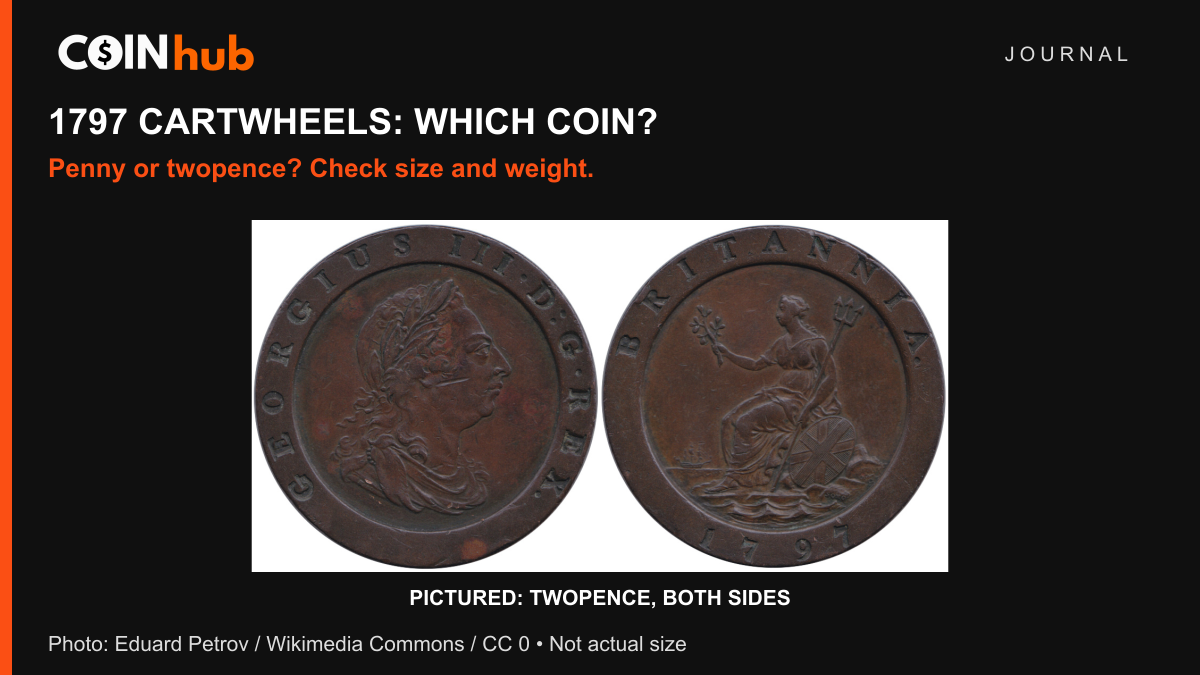
A 1797 cartwheel penny and a 1797 cartwheel twopence can look almost alike in a listing. Start with size and weight: the penny is about 36 mm across and 28.35 g; the twopence is about 41 mm and 56.7 g. Those are useful identification guides, not proof that a coin is genuine.
Both coins are copper. Both show George III on one side and seated Britannia with the date 1797 on the other. A close-up of the portrait, with no scale or measurements, leaves the main question unanswered.
The penny and twopence at a glance
| Check | Cartwheel penny | Cartwheel twopence |
|---|---|---|
| Original weight standard | One ounce, about 28.35 g | Two ounces, about 56.7 g |
| Approximate diameter | 36 mm | 41 mm |
| Date on the coin | 1797 | 1797 |
| Main designs | George III / Britannia | George III / Britannia |
The Royal Mint Museum gives the diameters as 1.4 and 1.6 inches and the original weights as one and two ounces. The rounded metric figures above help you separate the two types. They are not a grading service's acceptance limits for a worn coin.
The photo shows a twopence, on both sides. It is one coin shown twice, not a penny beside a twopence. The image has been resized for the page and is not actual size.
Why the designs are so easy to confuse
The broad rims and sunken lettering give both pieces their distinctive look. Matthew Boulton's private Soho Mint in Birmingham made them. Look below Britannia's shield for the small SOHO name. The large copper content was intended to bring the cost of the metal and manufacture close to the coin's face value.
That shared design makes an enlarged image a poor size test. Two sellers can crop their photos so that a penny and a twopence fill the same space on your screen. Even a clear date does not settle which denomination you are seeing.
A useful check for a loose coin
Write down the weight in grams and the diameter in millimeters. Keep the units with the numbers. Measure the coin itself, not its holder, and do not remove a coin from a sealed grading holder. Our coin-weighing guide explains how to make the measurement useful.
For example, a listing called “1797 penny” might give a diameter near 41 mm and a weight near 57 g. Those figures point toward the twopence. Ask the seller to confirm the measurements and show both sides before relying on the title.
If the measurements conflict, keep the identification open. A wrong unit, holder weight, damaged coin or inaccurate listing can all make a comparison misleading. Do not file an edge, polish a surface or perform a destructive test to make the result fit a table.
Identify the coin before comparing prices
Save the two-sided photos, measurements and exact denomination together. Then compare examples of the same coin in similar condition. A large asking price for another “cartwheel” is not evidence that your piece has the same value.
The word also has a different use in collecting: cartwheel luster describes a moving light effect. That term does not identify either of these 1797 denominations.