
A thin flange at the boundary of the face
A finned rim is a thin, raised flange formed when metal is forced into the narrow space between the striking die and the collar. It stands at the outer boundary of a coin’s face, where the rim meets the edge. Collectors also encounter the description wire rim. The important starting point is the shape and location of the metal, not the excitement of the label.
A rim that merely looks tall in a photograph is not enough to establish finning. Lighting, viewing angle, ordinary design features and damage can all complicate what you think you see. Before calling a coin an error, make a description that another person can check.
How finning forms during a strike
Error-Ref’s explanation of finning connects the flange with excess striking pressure or pressure concentrated in one area, including pressure associated with a slightly tilted die. Metal enters the clearance between the die’s neck and the collar, producing a narrow projection rather than simply a broad, flat raised border.
The feature can extend around a face or appear along only part of it. It may occur on one face or both. That means a partial lip is not automatically disqualified, and a full circle is not required. It also means the entire perimeter needs inspection before you describe its extent.
Rim, edge and border detail are different areas
PCGS distinguishes the rim from the edge: the rim borders a coin’s face, while the edge is its narrow third side. Reeding belongs on that edge. Small toothlike design elements inside a face’s border are denticles, not a fin merely because they stand above the surrounding surface.
| What you observe | What to record | What it does not establish by itself |
|---|---|---|
| A broad raised boundary | Its width and shape compared with the same coin type | A thin fin or a striking error |
| A narrow lip at the outer boundary | Its height, extent and appearance from several angles | Its cause, authenticity or market premium |
| A bent or irregular projection | Nearby impacts, displaced metal and surface disturbance | Whether the projection began at the Mint |
| An apparently doubled bright line | Whether it remains visible when the light moves | That a physical second ridge is present |
Why a wire rim is not always a rare-error claim
In NGC’s discussion of collars and coin rims, David W. Lange explains that the clearance involved in striking can produce a fine wire rim. Proof coins, which may receive multiple strikes, can display this feature. A fine lip therefore needs to be considered in the context of how that particular issue was made.
Do not use a wire rim by itself to identify a Proof, authenticate a coin or assign an error premium. Likewise, a familiar catalog term on a historic coin does not mean every modern coin with a similar-looking perimeter belongs in the same collecting category.
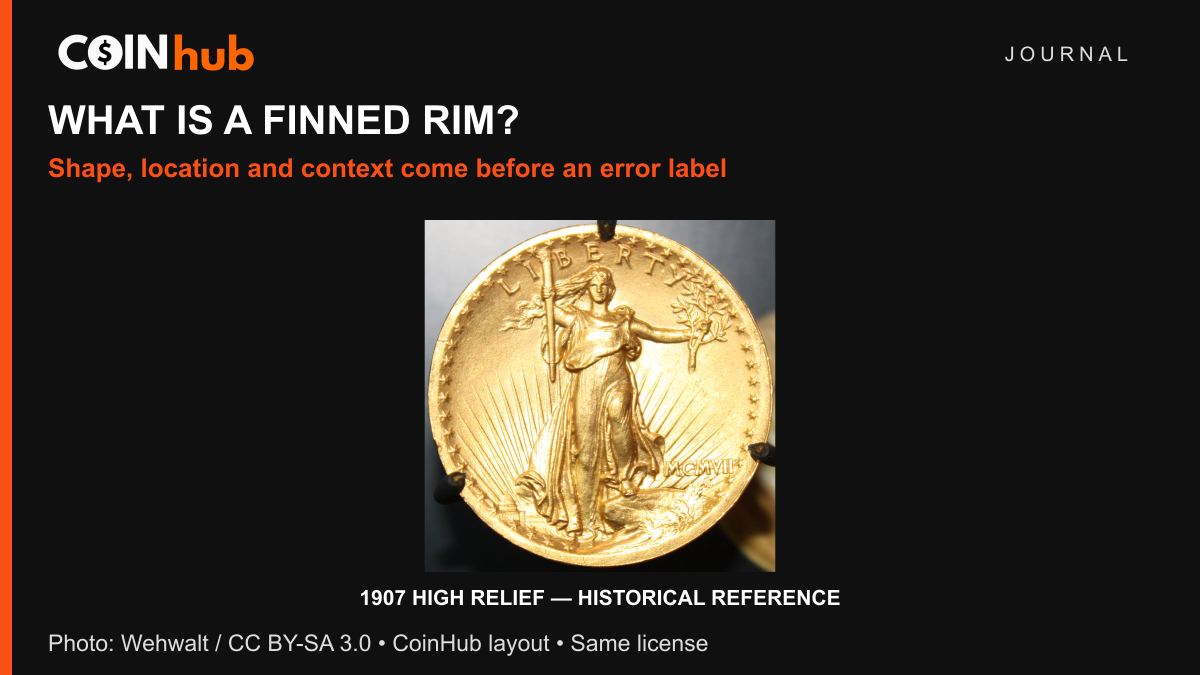
The 1907 High Relief double eagle pictured here is a historical reference. Its face-on photograph is not a sufficient view for attributing the specimen’s rim. For the history and distinctions of that issue, see our 1907 High Relief double-eagle guide.
Inspect without changing the evidence
Begin with both faces and the complete edge, using soft light and more than one angle. A shallow side view can reveal whether an apparent line actually rises above the face. Keep the date, mintmark and denomination in your records so that any comparison uses the correct issue.
Then look for signs that the metal has been pushed, flattened or bent. A damaged rim and a striking feature can coexist, so visible damage does not automatically explain every part of the coin. Equally, a sharp-looking projection does not eliminate damage as a possibility. If your photographs cannot resolve the shape, leave the cause undecided.
Do not press the lip with a tool, straighten it or clean the area to “see it better.” Those actions change the very evidence you are trying to understand. Photograph it as found, including a wider view that places the unusual area on the coin.
When a specialist opinion is useful
Seek an experienced error specialist or grading service when the attribution would affect a purchase, sale or submission decision. Supply clear views rather than only a dramatic close-up. A useful question is, “What evidence distinguishes this projection from damage or the normal rim for this issue?”
There is no defensible universal price for “a finned rim coin.” The underlying coin, the feature’s identification and visibility, condition and buyer demand all matter. A high marketplace asking price is not evidence that a comparable piece sold for that amount. Establish the attribution first; consider genuinely comparable sales afterward.
Sources and photograph: Error-Ref, NGC and PCGS references linked above, checked September 28, 2026. Historical photograph by Wehwalt, Truman Collection, Federal Reserve Bank of Kansas City, licensed CC BY-SA 3.0. CoinHub resized the complete photograph and added layout/text; the resulting graphic uses the same license. No specimen rim attribution or endorsement is implied.
