
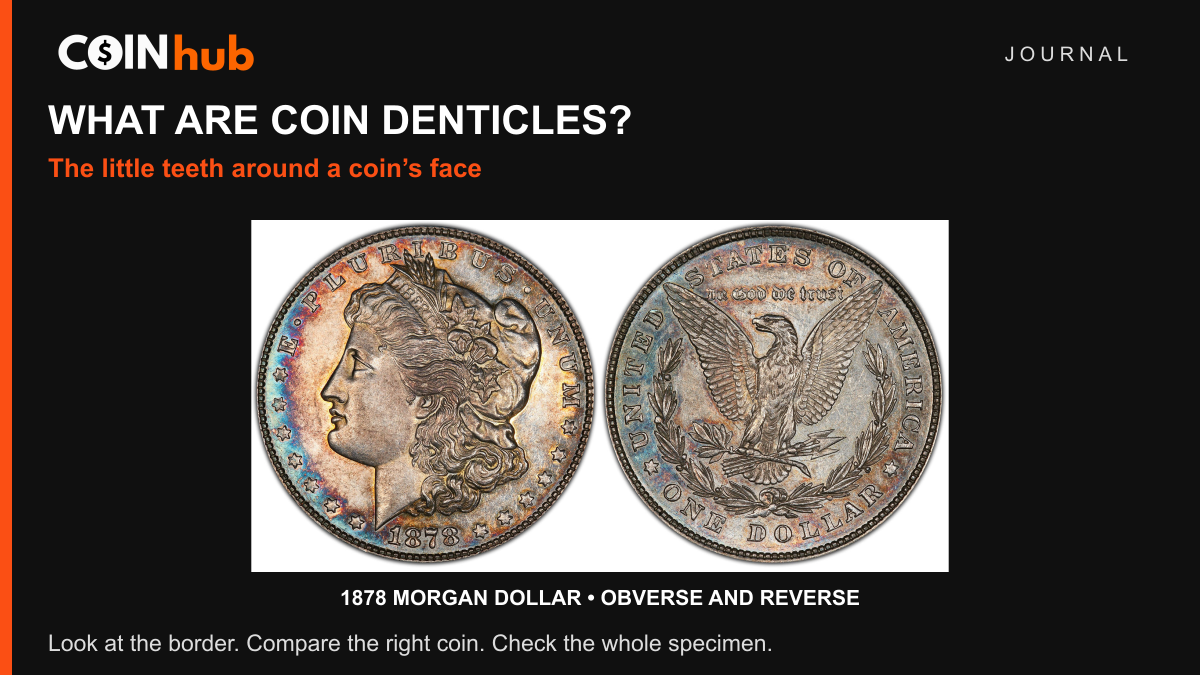
A small border detail worth learning to read
Denticles are the small, toothlike elements arranged around the outer border of a coin’s face. You may also see the word dentils. On many older U.S. coins, they form a repeated fringe just inside the rim. They are easy to overlook until a catalog description or collector points them out.
Knowing the name helps you describe what you see. It does not give you a one-detail authenticity test. A soft border, an unusually sharp tooth or a gap needs context: the coin’s design, strike, condition and the rest of its surfaces all matter.
Denticles, rim and reeding: three different things
| Feature | Where to look | What you are describing |
|---|---|---|
| Denticles | Around the face, near its perimeter | The repeated toothlike border elements |
| Rim | Raised outer boundary of the face | The surrounding raised margin, not each individual tooth |
| Reeding | The narrow side of the coin | A series of grooves on the edge |
The Morgan dollar pictured above makes the distinction approachable: follow the little projections around each face. The photograph shows the faces, so it is not evidence of that specimen’s edge condition. Our guide to why coins have ridges explains the separate subject of reeding.
Why put teeth around a coin?
PCGS describes denticles as both a design feature and a potentially useful part of a coin’s border. A regular perimeter can help frame the artwork; disruption to it can also prompt closer examination for alteration. That makes the border worth studying, but it does not mean every coin uses the same tooth shape or arrangement.
For a collector, the practical benefit is a more precise observation. “The border is indistinct above the date” tells another person more than “the coin looks strange.” Record the location and appearance before deciding what caused them.
Two counterfeit cases show why sharpness is not the answer
In a 2010 NGC examination of a counterfeit 1878 Proof Shield nickel, part of the reverse border looked shallow and beadlike, with denticles separated from the rim. The date and fields also raised concerns. The finding depended on a combination of details, not merely weak teeth.
A different problem appeared in NGC’s 2019 examination of a counterfeit 1877 Liberty Seated quarter. Its denticles were excessively prominent compared with the expected border. Porous surfaces and composition and weight evidence supported the diagnosis.
One counterfeit had an unconvincingly weak section; another had exaggerated teeth. Together, these examples defeat a tempting shortcut: neither “sharper is genuine” nor “fainter is fake” works as a general rule. They also concern different coin types. Do not transfer one specimen’s diagnostic detail to an unrelated series.
A useful way to examine your coin
- Identify it first. Read the date, denomination and mintmark, and establish the correct design type. A comparison with a different issue can create a false problem.
- Inspect the full circumference. Note whether the unusual area is local or widespread. Take clear photographs of both faces and the edge without cleaning the coin.
- Compare like with like. Use clearly attributed images of genuine examples of the relevant issue. Similar lighting and comparable wear make the comparison more useful than a tiny sales thumbnail.
- Test the explanation against other evidence. Examine lettering, devices and surfaces. If measurements are appropriate, follow a careful coin-weighing procedure; weight alone also has limits.
- Leave uncertain conclusions open. For a potentially valuable or suspicious coin, seek a qualified numismatist or authentication service before buying, selling or labeling it as an error.
Common questions about coin denticles
Does every coin have denticles?
No. Denticles are a design feature, not a requirement for a genuine coin. Compare the coin with the border appropriate to its actual type.
Are missing denticles automatically a mint error?
No. A photograph of a weak or incomplete border establishes an appearance, not its cause. The rest of the coin must support a specific explanation before an error attribution is justified.
Should I count the teeth?
Only when a reliable reference for the particular issue makes that count useful. There is no single denticle count that authenticates all coins. Start with correct identification and a clear comparison.
Sources and photograph: PCGS terminology and denticle discussion; the two linked NGC counterfeit examinations. The genuine 1878 Morgan dollar photographs are courtesy of PCGS and used with permission. CoinHub added the surrounding layout; the coin photographs are unretouched and do not depict the counterfeit examples discussed.